
VAPE FAQs
How Long Does Vape Stay In Your Lungs?
May
How long does vapor remain in the lungs after a draw? The question surfaces in online forums, in conversation among friends, and in the quiet moments when a user exhales and still senses something lingering. It is a reasonable question—one that speaks to a desire to understand what is happening inside the body. Yet the answers circulating are often too simple. They rarely account for the one variable that matters most: the device itself.
Aerosol retention is not a fixed value determined by a category label. It is a function of engineering. The physical form of the aerosol, the consistency of its production, and the manner in which it is introduced to the respiratory tract all shape how long particles stay suspended and where they eventually land. A user who misunderstands these relationships will, sooner or later, misattribute their experience to the wrong cause—blaming a brand, a formula, or their own biology when the explanation is sitting right in their hand.
At OZVAPE Shop, we routinely encounter questions like this from adults who want to move beyond guesswork. We believe that transparent, technically grounded information is the foundation of a trustworthy retail relationship. What follows is not a medical analysis—that is not our role—but a structured, industry-informed look at the physics of aerosol inhalation, presented so that any user can evaluate their own equipment and habits with fresh clarity.
The Physics of Aerosol Retention: What Actually Matters
When people ask how long vapor “stays” in the lungs, they are asking two questions simultaneously. One is about the immediate sensation—how long the feeling of the inhale persists. The other is about clearance—how long the body takes to process and remove the aerosol particles that did not get exhaled. Both are influenced by a small set of physical factors that are, in many cases, directly engineered into the device.
Particle Size Distribution and Device Architecture
The vast majority of what a user perceives is not a gas but a suspension of fine liquid droplets. Their size matters enormously. Particles larger than about 5 micrometres tend to deposit in the mouth, throat, and upper airways, from which mucociliary clearance moves them relatively quickly—often within minutes to an hour. Particles below 2 micrometres, however, can travel deep into the bronchioles and alveoli, where they may remain for hours or, in some cases, longer while absorption and macrophage clearance occur.
What determines particle size? Primarily, the temperature at the heating element and the rate of e-liquid feed. A coil that runs inconsistently, spiking in temperature during one draw and sagging during the next, will produce a polydisperse aerosol with unpredictable deposition. A well-regulated system, by contrast, generates a tighter particle size band, leading to more repeatable inhalation dynamics. This is not a matter of “better” or “worse” in a health sense, but of predictability. Users frustrated by an experience that varies dramatically from session to session are often reacting to a device whose thermal management is rudimentary.
Inhalation Technique and the User’s Role
No device exists in isolation. The same hardware will produce wildly different retention patterns depending on how a user inhales. A slow, extended mouth-to-lung draw allows larger droplets to coalesce in the oral cavity and upper throat. A sharp, direct-lung inhalation propels finer particles deeper. Breath-hold duration further modifies deposition: holding vapor in for several seconds after the inhale can increase the fraction that settles in the lower respiratory tract, while immediate exhalation reduces it.
This is where much of the confusion originates. Two people using identical devices may report completely different sensations of lung residence, simply because their inhalation patterns differ. A user who feels like the vapor “sits” in their chest all afternoon may be combining a high-output device with a deep-lung technique—a perfectly valid combination, but one they should understand rather than attribute to mysterious product qualities.
Output Consistency and Its Practical Importance
If a device’s power delivery degrades as the battery drains, the aerosol changes. An unregulated model may start with a warm, dense cloud and end with a thin, cooler vapor. The particle size distribution shifts, and with it the likely deposition zone. A user who takes ten puffs over an hour might experience a completely different lung interaction with the tenth puff than with the first.
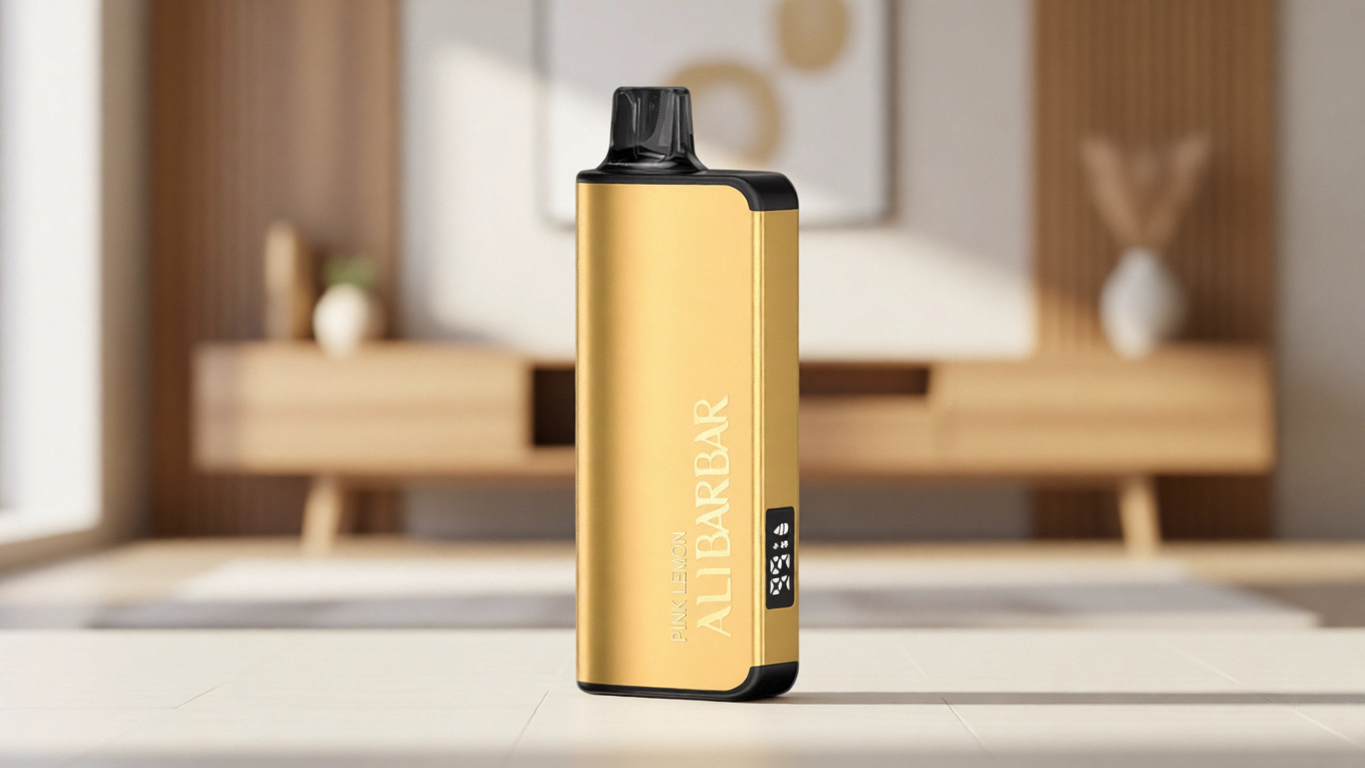
This hidden variability explains why many experienced users gravitate toward devices with fixed-output power curves or stable voltage regulation. It is not about maximizing cloud density; it is about knowing what to expect. Some manufacturers, including ALIBARBAR, have made this consistency a central design objective. Their INGOT series, for example, employs a calibrated mesh coil and a power-management chip that maintains output within a narrow band throughout the device’s rated life. The aerosol characteristics at the end of the session remain close to those at the beginning—an engineering decision that directly addresses the frustration of an unpredictable lung experience.
Airflow Design and Its Effect on Deposition
The physical path the aerosol travels from coil to mouth is not an empty tube; it influences droplet behavior. A restrictive, cigarette-like draw creates turbulence that promotes droplet collision and coalescence, producing larger particles that deposit higher in the respiratory tree. An open, high-airflow design preserves the original particle size distribution and, when combined with low-resistance coils, tends to deliver more fine particles to the lung periphery.
Many mid-range and premium devices now offer adjustable airflow, giving the user agency over this parameter. The ALIBARBAR Ice Adjust 12000, for instance, includes a slider that lets the user select a tighter or looser draw. Such a feature is often marketed in terms of “throat hit” or “cloud production,” but its practical consequence is a tangible effect on where the aerosol ends up and, by extension, how long it lingers.
How Real Devices Illustrate These Principles
Engineering abstractions become useful only when they map onto the products people actually hold. By examining a few representative device families, we can see how the factors above play out in practice.
Consider the simplest disposable pens that dominate convenience-store shelves. These typically use a silica wick wrapped with a round wire coil. The heating is uneven; hot spots develop, and the wick’s saturation level fluctuates. The aerosol produced is inconsistent in particle size, and the experience can vary noticeably with each puff. For a user who values predictability, such a device introduces more uncertainty about lung retention than many realize.
At the other end of the spectrum are high-end mod systems with temperature control. These use sophisticated chip-sets to monitor coil resistance in real time, preventing temperature overshoot and maintaining a stable aerosol. The user can dial in a specific temperature and reasonably expect that each puff will deliver similar droplet characteristics. This is the most direct route to controlling deposition—but it comes with complexity and cost that not everyone wants.
Between these extremes sit devices like the ALIBARBAR INGOT 9000 and INGOT 15000. They do not require user adjustment; instead, they rely on a pre-tuned, sealed architecture. The mesh coil is designed for a specific power band, and the battery management system keeps voltage stable over the device’s operational window. The result is a narrow-particle-size aerosol that behaves similarly from the first puff to the last. The trade-off is a lack of user customization—you cannot alter wattage or temperature. For those who prioritize a consistent, low-maintenance experience over granular control, that compromise makes sense.
The ALIBARBAR Ice Adjust 12000 addresses a different need. By allowing airflow adjustment, it gives the user control over the draw resistance and, consequently, the inhalation dynamics. Some will prefer a tight draw that mimics a traditional mouth-to-lung pattern, leading to upper-airway deposition; others will open it wide for a direct-lung inhale that sends particles deeper. Neither choice is inherently preferable, but having the option means the user is not locked into an inhalation pattern dictated solely by the hardware.
It is worth noting that a central reason OZVAPE Shop maintains detailed, standardized product pages is precisely to make these architectural differences visible. A quick comparison of coil type, power regulation, and airflow adjustability can prevent a mismatch between a user’s inhalation habits and a device’s inherent design.
A Practical Framework for Evaluating Aerosol Retention
For the user who wants to move beyond guesswork, a simple evaluation protocol can clarify how a given device—or a whole category—is likely to behave in terms of lung residence.
Identify the coil configuration. Mesh coils generally produce a more uniform particle size than round wire. If the manufacturer specifies coil material and structure, note it. If not, be prepared for variation.
Check for output regulation. Look for terms like “constant voltage,” “regulated output,” or “smart power management.” A device that lacks these will change its aerosol profile as the battery discharges.
Assess airflow control. Is the draw resistance fixed, or can you adjust it? If fixed, try to determine whether it is designed for mouth-to-lung or direct-lung use. This single variable dramatically shifts deposition.
Consider the e-liquid formulation. While outside the scope of device engineering, the ratio of propylene glycol to vegetable glycerin affects viscosity and, in turn, droplet size formation. Higher PG blends tend to produce slightly finer particles, though the coil temperature remains the dominant factor.
Reflect on your own inhalation habits. Do you naturally hold vapor in? Do you take deep lung hits or shallow mouth puffs? Be honest—the same device will behave differently in different hands.
This framework does not yield a number of minutes. It yields something more valuable: an understanding of which direction your experience will shift. If a device provides no status feedback, the user is operating blind and will naturally compensate by carrying a backup. If it provides consistent output, the user can form an accurate mental model of what to expect.
Common Misconceptions About Vapor and Lung Residence
Industry patterns reveal several widely held but misleading beliefs that undermine user satisfaction.
Assuming all devices produce the same kind of aerosol. The visual similarity between two cylindrical devices says nothing about internal engineering. A cheap disposable with a silica wick and a precision-regulated mesh system produce entirely different particle populations. Treating them as interchangeable ignores the single greatest determinant of lung retention.
Believing that holding vapor in longer maximizes the intended effect. While breath-hold does increase deposition fraction, the majority of nicotine absorption occurs rapidly in the upper airways. Prolonged holding mainly increases condensation in the lungs, contributing to a sensation of residue without proportional benefit. This is poorly understood in casual discussion.
Equating visible exhaled cloud with what remains inside. Much of the white plume dissipates within seconds and consists of water vapor and large droplets that never reached the deep lung. Fine particles may still be present and clearing, but the visible cloud is not a reliable indicator.
Confusing category terminology with technical specifications. A term like “premium” or “sub-ohm” tells a user nothing about particle size distribution or output consistency. These are marketing signals, not engineering descriptors. Users who overlook this distinction will repeatedly find themselves surprised by a device’s actual behavior.
From a supply-chain perspective, manufacturers often differentiate their products through coil technology and power management precisely because these influence user-perceived consistency. It is a quiet arms race among factories—one that knowledgeable buyers at OZVAPE Shop monitor to ensure that the devices they stock represent genuine engineering decisions, not cosmetic variations.
Frequently Asked Questions
Q: How long does vape aerosol actually stay in the lungs?
A: The majority of inhaled particles are cleared within minutes to a few hours via mucociliary transport and absorption. Complete elimination of all residue can take longer, but the bulk of the deposited material is processed relatively promptly by the body’s natural mechanisms.
Q: Does the type of device affect how long vapor stays?
A: Yes. Devices that produce a consistent, fine-particle aerosol (often via regulated mesh coils) can lead to deeper deposition and potentially longer residence time compared to devices with larger, less uniform droplet production.
Q: Can I do anything to clear vapor from my lungs faster?
A: Normal breathing, hydration, and avoiding deep breath-hold during use can reduce deposition. The lungs’ self-cleaning pathways operate on their own timescale; there is no evidence that forced exhalation significantly accelerates the process.
Q: Is it normal to still feel the vapor hours later?
A: Some sensation may come from residue in the throat or upper airways, which can linger and cause a tickling or coating effect. This sensation does not always indicate that particles remain deep in the lungs.
Q: How do ALIBARBAR devices compare in terms of aerosol consistency?
A: ALIBARBAR designs emphasize fixed output power and calibrated mesh coils, which yield a repeatable aerosol particle size across the device’s operational life. This engineering focus supports a more predictable user experience, though no two individuals will have identical lung clearance patterns.
Q: Does a tighter draw mean vapor stays in my lungs longer?
A: Not necessarily. A tighter draw tends to produce larger, higher-depositing particles in the upper airways, which may be cleared more quickly than fine particles that reach the deep lung from an open, direct-lung draw.
Q: Why do some devices produce a stronger “lung hit” than others?
A: The sensation results from a combination of particle size, throat deposition, and the user’s inhalation technique. Devices generating more fine particles and those allowing direct-lung airflow often produce a more pronounced chest sensation.
Q: Are there tests to measure how long vapor stays?
A: Specialized laboratory techniques, such as gamma scintigraphy or particle size analyzers, can measure deposition and clearance. These are research tools; no simple consumer test exists, which is why understanding device engineering becomes a practical substitute.
Q: Does nicotine strength affect lung retention time?
A: Nicotine concentration does not directly alter particle clearance, though it can influence inhalation depth and breath-hold behavior, which in turn affect deposition.
Q: What should I look for in a device if I want a predictable lung experience?
A: Prioritize regulated output, a known coil type (preferably mesh), and, if possible, adjustable airflow. These features provide the greatest insight into the aerosol you will be inhaling.
Conclusion
The question “How long does vape stay in your lungs?” has no single answer. It resolves into a set of interactions between device engineering, inhalation technique, and human biology. What a user can control—or at least understand—is the engineering. A device that communicates its output clearly, maintains thermal stability, and matches its airflow profile to the user’s natural draw will produce a far more predictable lung experience than one that obscures these details behind generic branding.
Informed adults make better decisions. They choose a device not because of a trending name or a flashy exterior but because its architecture aligns with how they actually use it. When sourcing from a retailer that standardizes specifications and stands behind authenticity—a role OZVAPE Shop has built its operations around—the remaining uncertainty shrinks to individual physiology, which no product can control. The right choice, ultimately, is the one that fits your daily routine, not the one that generates the loudest claims.