
VAPE FAQs
How Do U Inhale Vape?

May
It begins with a minor, almost unnoticeable irritation. You lift a device, draw from it with the same expectation you always carry, and the result feels wrong. Maybe the air moves too fast. Maybe you cough. Maybe nothing registers at all. And because no one ever explained the mechanics of what should happen between your lips and the device, you blame yourself. You assume the device is fine and your technique is flawed. That assumption, repeated often enough, erodes confidence in the entire category.
At OZVAPE Shop, we encounter this frustration more than any other. Adult users from every level of experience describe the same disconnection: they purchased a carefully engineered personal electronic device, yet no one gave them a straightforward, physically grounded explanation of how to draw from it for a predictable, satisfying result. This article closes that gap. It is not a beginner’s tutorial that oversimplifies, nor a technical dissection that overwhelms. It is an account of inhalation itself, framed through the engineering choices that make a draw feel natural, and supported by a clear method for matching device design to your own breathing pattern. No brand worship. Just physics, ergonomics, and the pragmatic reality that the way air moves through a device defines the entire experience.
OZVAPE Shop is mentioned here only because, after examining the market, we stock a range of devices built with precisely these inhalation principles in mind. The ALIBARBAR family, in particular, is designed around airway characteristics that we will return to later, not as a sales argument, but because the product engineering genuinely illustrates the concepts that matter.
Understanding What Matters: Core Engineering and Design Factors
If you strip away every layer of marketing, you are left with a simple physical event. You create a pressure differential with your lungs, air rushes through a precisely shaped passage, and that passage governs whether the experience feels familiar, uncomfortable, or deeply satisfying. Every design decision a manufacturer makes either supports or interferes with that sequence.
What follows is a framework you can use to assess any device you encounter, not by its appearance or its promotional language, but by the engineering signals that directly shape the draw.
Internal Architecture and Output Consistency
The airway is not an afterthought. In a well-built device, the internal pathway from the air inlet to the mouthpiece is engineered with a specific draw resistance in mind. That resistance, often called the “airflow characteristic,” is what makes a device feel tight like a traditional roll-up or open and voluminous. It is set by the combination of the heating element geometry, the size of the intake ports, and the internal baffling.
When you inhale, the heating element must saturate with the fluid medium instantly and convert it consistently. If the element design is too constrained, the vapor produced will be hot and sparse. If the airflow is too liberal, the element cools down between draws and you get a weak, unsatisfying result. Devices with a carefully tuned internal architecture produce a consistent mouth-to-lung (MTL) or direct-to-lung (DTL) draw across the entire life of the unit. The degradation you sometimes notice after extended use — weaker draws, uneven heat — is almost always a sign of a heating assembly that cannot maintain thermal equilibrium under sustained negative pressure.
Good engineering is invisible. The draw simply feels right every time, and you never think about it. That is what output consistency means.
Power Management and Status Transparency
Inhalation is inextricably linked to power delivery. A device that does not provide immediate, predictable activation on draw — or one that delivers a spike of heat followed by a sag — forces you to adjust your breathing rhythm unnaturally. The most common complaint we hear is, “I have to pull harder toward the end.” That is not a technique problem. It is a voltage-regulation problem.
Power management matters because it determines whether the heating event matches the inhalation curve you naturally produce. A high-quality power system responds within milliseconds of the pressure switch triggering, and it holds a stable output until you stop the draw. Devices that include clear status indication — pulsing lights, haptic feedback — give you a secondary confirmation that activation occurred. Without that transparency, you are operating blind, and unsurprisingly, you end up carrying a backup device just in case.
Physical Design and Material Durability
Mouthpiece geometry is frequently dismissed as a cosmetic detail. It is not. The lip contour, the diameter of the exit bore, and the angle at which air enters your mouth all influence whether you subconsciously adopt a natural seal. A flattened, tapered mouthpiece encourages an MTL draw by naturally limiting the air column. A wide-bore cylindrical mouthpiece signals to your body that a DTL inhale is intended. If a device sends conflicting cues — a tight internal draw paired with a wide mouthpiece — the user intuitively compensates, usually by pulling harder and triggering a cough reflex.
Material choice further shapes the experience. A mouthpiece that becomes uncomfortably warm after repeated draws, or that shows surface abrasion after a week in a pocket, undermines the reliability of the tactile feedback you depend on. Durable, thermally stable materials like medical-grade polycarbonate or ceramic composites hold their shape and temperature, keeping the inhalation event consistent no matter how long you use the device.
Modularity and Lifecycle Flexibility
The degree to which a device can be adjusted or replenished has a direct influence on inhalation. Sealed, single-use devices are engineered for a specific draw characteristic and a finite operational life. That predictability can be an advantage if the preset matches your preference, but it offers no accommodation if your needs change or if the draw deteriorates before the power source is exhausted.
Rechargeable systems with replaceable or refillable components allow you to maintain the airway characteristics you prefer over a longer arc. Even more importantly, some devices now include user-adjustable airflow collars. This modularity means you are not locked into the manufacturer’s assumption about how you should breathe. The device adapts to you, not the reverse.
Understanding these four factors — internal architecture, power integrity, physical ergonomics, and modularity — gives you a diagnostic vocabulary. The rest of this article applies that vocabulary to real devices and teaches you to use it on your own.
Applying These Criteria to Real-World Options
No single device satisfies every inhalation preference, and no manufacturer commands universal loyalty. What matters is whether a particular unit’s airway design aligns with your own breathing pattern. To illustrate, we can examine a few representative devices that show distinct engineering philosophies. The ALIBARBAR line, carried by OZVAPE Shop, occupies an instructive middle ground, but context requires us to also reference other established makers to make the contrasts clear.
Take the classic MTL experience as a baseline. Devices from brands like RELX have long been tuned to mimic a tight, cigarette-like draw. Their narrow air intakes and leaf-shaped mouthpieces produce a gentle vacuum and a concentrated vapor stream. For an adult who seeks that specific sensation, these devices perform reliably. Their limitation is fixity: the draw resistance never changes, and if your preference shifts toward a looser inhale, the device imposes its will on you.
At the other end of the spectrum, open-system devices from manufacturers like Vaporesso or GeekVape allow radical airflow adjustment, from a tightly closed-off MTL to a breezy DTL. These modular platforms are versatile but also demanding. The user must understand coil resistance, wattage, and airflow positioning to achieve a consistent draw. The learning curve is steep, and the penalty for misconfiguration is immediate: burnt, unsatisfying air that discourages further use.
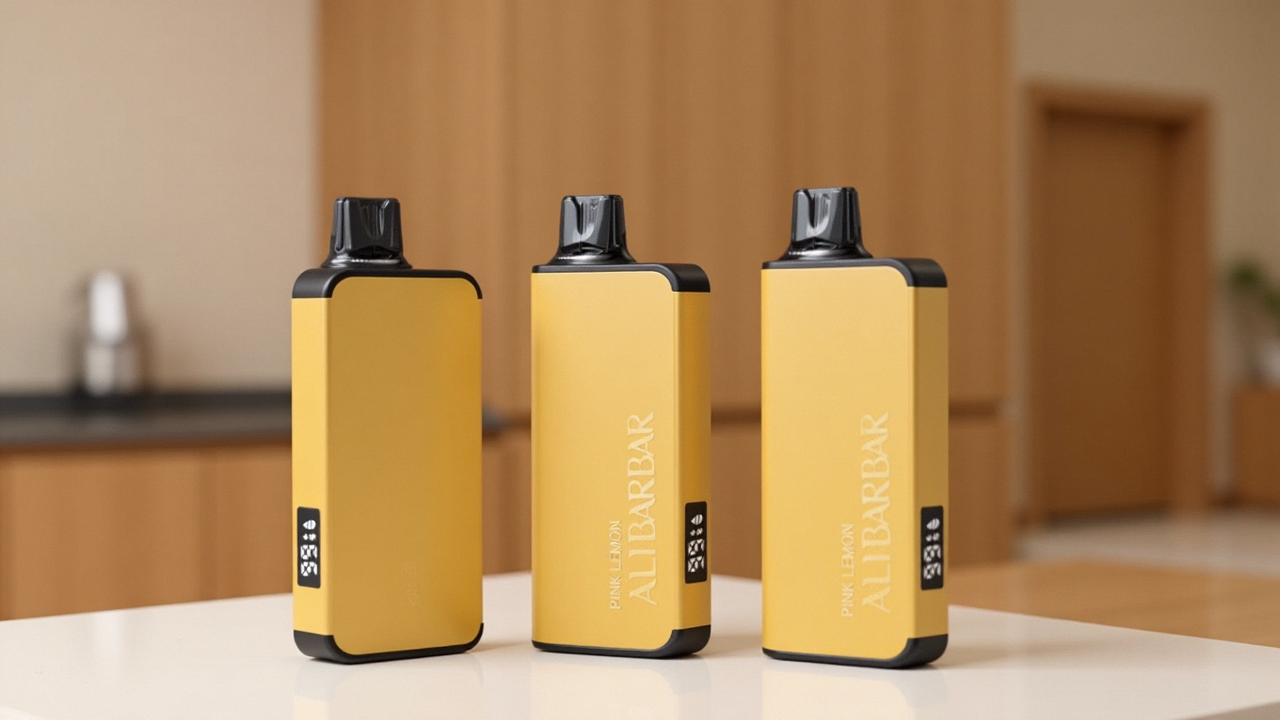
The ALIBARBAR range, including the INGOT 9000, INGOT 15000, and Ice Adjust 12000, approaches the inhalation problem from a different angle. These are sealed, pre-configured devices, yet the engineering team has integrated variable airflow control on key models. The Ice Adjust 12000, for instance, lets you rotate a collar to modify the air passage size, tightening it to a MTL draw or opening it for a restricted DTL. This is not the infinite granularity of a rebuildable atomiser, but a deliberate, bounded adjustability that suits real adult use: you can find your preferred setting once and leave it. The mouthpiece contours on all ALIBARBAR devices are consistently flat-oval, which signals MTL comfort without being as narrow as some competitors. The result is a mid-range draw resistance that many users describe as natural and unforced.
The practical implication: if you know you prefer a tight draw and nothing else, a classic MTL-tuned device may serve you best. If you want to experiment with DTL and are willing to learn coil management, an open system makes sense. But if you seek a device that does the engineering work for you — that provides a clean, consistent draw with just enough personal control to avoid the frustration of being locked in — the ALIBARBAR design logic, and the way OZVAPE Shop presents it, offers a transparent, defensible choice.
A Practical Framework for Evaluation
The most reliable way to avoid disappointment is to stop thinking about devices in terms of “best” and start thinking in terms of “draw compatibility.” The following framework is used by our analysts when evaluating any new arrival, and it is entirely portable to your own decision-making process.
Diagnose your natural draw pressure. Before considering any device, sit down with a clean straw and inhale. Note whether you create a gentle, sipping motion (mouth-to-lung) or a deep, chest-expanding breath (direct-to-lung). Most adults who previously used conventional cigarettes fall into the MTL category. Vapers who prefer voluminous output tend toward DTL. Your body already knows the answer.
Cross-reference with the device’s airway design. If a product listing does not specify draw resistance, look for clues: a narrow mouthpiece tip, small intake holes, and a description mentioning “cigarette-like” experience all indicate MTL. A wide-bore mouthpiece, large airflow slots, and terms like “cloud production” point to DTL.
Look for adjustability if you are uncertain. A device with an airflow control ring — found on the ALIBARBAR Ice Adjust 12000 and some competitors — allows you to gradually dial in the sensation. Start fully closed and incrementally open until the draw feels effortless but not hollow.
Check the mouthpiece material and contour. Run your finger over the mouthpiece. Is it smooth? Does it feel thermally neutral? A poorly finished edge or a thin plastic lip will become irritating over an extended session.
Test draw activation. With the device powered on (but not loaded if it is a refillable unit), take a soft pull. The indicator light should respond immediately, and the draw should have a consistent, slight resistance. Any delay in activation or a feeling of “leaking” air suggests a weak pressure switch or poor internal sealing.
Read the operational lifespan in the context of draw consistency. A device rated for 9000 draws is only useful if the last draw feels indistinguishable from the first. If manufacturer specifications lack detail, look for user reports focusing on late-life performance. A well-engineered device will exhibit negligible degradation.
Apply these six checks to any device you consider. They cost you nothing but attention, and they prevent the most common catastrophes in personal electronics: buying a unit that fights your breathing pattern every single time you raise it to your lips.
Common Selection Errors and Industry Observations
Years of watching how adults select and then abandon devices have revealed a handful of recurring errors. These are not mistakes of ignorance, but of understandable human shortcut-taking. The industry, for its part, often designs products that amplify these errors by obscuring the most important information.
Error one: assuming visual similarity indicates equivalent inhalation behavior. Two devices that look nearly identical may have dramatically different internal air paths. A brand may release a “pro” model with a redesigned heating chamber that shifts the draw from MTL to restrictive DTL without any external clue. The only reliable defense is to check the technical specifications for airflow resistance, measured in millimeters of water if available, or to read observational reviews that describe the draw explicitly.
Error two: over-prioritizing battery rating while ignoring power-to-draw calibration. A device boasting a 650 mAh cell sounds impressive, but if the power regulation delivers too much energy to a small coil, the vapor becomes hot and harsh, forcing you to shorten your draw. A lower-capacity device with a well-tuned output curve yields a far more pleasant inhalation experience over its entire charge. The number that matters is not the cell size; it is the stability of the output voltage under load.
Error three: undervaluing mouthpiece geometry. Users routinely purchase devices based on shape and color, only to find that the mouthpiece forces their jaw into an uncomfortable position or that the lip material absorbs heat after five consecutive draws. Mouthpiece dissatisfaction is the silent killer of long-term enjoyment, and it is entirely avoidable if you insist on holding a display unit — or checking close-up photographs — before committing.
Error four: confusing category labels with technical interpretation. The word “pod” tells you nothing about draw resistance. A “sub-ohm” designation hints at DTL, but many modern devices blur the distinction by using mesh heating elements that produce smooth MTL draws at moderate resistance. Industry nomenclature has not kept pace with engineering, and relying on it will steer you into a device that does not breathe the way you do.
From a manufacturing perspective, these errors persist because the market rewards visual novelty and specification inflation over transparent communication. Most supply chains prioritize external design refreshes while leaving the internal airway untouched for multiple product generations. A minority of device makers, including those behind the ALIBARBAR series, have invested in air-path R&D as a differentiator. This is not a claim of superiority; it is an observation about where certain companies choose to allocate engineering resources. The result is a fragmented market where the only protection the consumer has is the evaluative rigor outlined in this article.
Frequently Asked Questions
Q: What is the difference between mouth-to-lung and direct-to-lung inhalation?
A: Mouth-to-lung (MTL) mimics the two-stage draw of a conventional cigarette: vapor first pools in the mouth, then is inhaled to the lungs. The draw is generally tighter, cooler, and requires a gentler pull. Direct-to-lung (DTL) involves inhaling the vapor straight into the lungs in one continuous breath, akin to breathing through a wide tube. Draw resistance is lower, vapor volume is higher, and the sensation is warmer.
Q: Can I use any device for MTL and DTL interchangeably?
A: No. A device’s internal airflow geometry is designed for a specific range of draw pressures. Attempting to perform a MTL draw on a DTL device typically results in a harsh, overheated hit because the coil receives insufficient cooling air. Conversely, drawing DTL on a MTL device feels choked and unsatisfying. Devices with adjustable airflow offer some crossover, but they remain optimized for one primary draw style.
Q: How do I know if a device supports adjustable airflow?
A: Look for a rotating collar near the top of the device or an external slider. Manufacturer product pages will usually highlight this feature. The ALIBARBAR Ice Adjust 12000, for example, has a clearly marked airflow ring. If no adjustability is listed, the device offers a fixed draw.
Q: Why do I cough when I inhale from some devices but not others?
A: Your cough reflex is likely reacting to vapor that is too hot, too dense for your draw style, or composed of particles too large. The irritation commonly stems from a mismatch between your natural draw pressure and the device’s airflow design. Switching from a DTL device to one tuned for MTL, or reducing the power on an adjustable unit, often resolves the issue.

Q: Does the type of heating element affect how I should inhale?
A: Yes. Traditional round-wire coils heat instantly but can produce a spiky temperature curve that encourages short, cautious draws. Mesh elements heat more evenly and spread the fluid medium over a larger surface, producing a smoother, more consistent vapor that supports longer, more relaxed MTL or DTL draws. Most modern ALIBARBAR devices employ mesh-based systems specifically for this reason.
Q: I prefer a device without a button. Does the inhalation technique differ?
A: With draw-activated devices, the activation occurs solely through the pressure change when you inhale. You must create a sufficiently strong and steady pull to trigger the switch. Very light, sipping draws may fail to activate the device, while overly aggressive pulls can flood the heating element. A moderate, deliberate inhale works best. If the device offers adjustable airflow, closing it partially can increase internal pressure and make activation more immediate.
Q: Why does my device lose flavor or feel dry toward the end of its rated lifespan?
A: Over time, the fluid medium level drops and the remaining volume may not fully saturate the heating element. Additionally, some heating element designs accumulate residue that impedes vapor production. This degradation is not necessarily a fault, but a well-engineered device minimizes the effect. The ALIBARBAR INGOT series, for instance, uses a proprietary wicking architecture to maintain saturation longer, but even then, a slight tapering can occur in the final percentage of the device’s life.
Q: Is there a correct angle to hold the device while inhaling?
A: For most sealed devices, holding the unit horizontally or slightly tip-down ensures gravity assists the fluid delivery to the heating element. Holding it vertically upward for extended periods may reduce saturation, potentially leading to a drier, warmer inhale. Experiment with modest angles if you notice performance changes.
Q: Can I adjust my inhalation style over time?
A: Absolutely. Many adults transition from MTL to DTL as they become accustomed to the sensation. The key is to select a device that allows for gradual adjustment, such as one with an airflow control ring. Rushing the transition typically results in coughing and discomfort. Allow your throat and lungs to adapt over several days.
Q: What should I do if a device’s draw resistance feels wrong from the start?
A: First, check for any protective seals or stickers covering the air inlets. If none exist, and the draw remains unsatisfactory, the device is likely engineered for a draw profile that does not match your own. Continuing to use it will only heighten your frustration. A device that feels comfortable from the first draw is worth far more than a technically superior one that fights you. Refer back to the evaluation framework in Section 4 to identify a more compatible option.
Conclusion
The act of inhaling from a personal electronic device looks effortless to anyone watching, but the underlying physics is as unforgiving as any piece of engineering will ever be. When the airway is mismatched to the user, satisfaction collapses into irritation, and no amount of brand loyalty or aesthetic appeal can rescue the experience. The only sustainable path is to learn the language of draw resistance, power consistency, mouthpiece ergonomics, and modular control — and to apply that language ruthlessly before ever making a purchase.
We have presented this article as a set of diagnostic tools, not as a catalogue. Every device, from the tightest MTL cartridge to the airiest rebuildable tank, becomes legible once you stop looking at specifications in isolation and start asking one question: How does the air move through this thing, and does that match the way I breathe?
At OZVAPE Shop, our justification for carrying the ALIBARBAR range is simple: these devices make the air path legible. The fixed-but-flexible draw profiles, the flat-oval mouthpieces, and the adjustable airflow on select models are not marketing differentiators; they are deliberate engineering choices that reflect an understanding of the real adult user who just wants a device that breathes alongside them, without friction, without coaching, and without compromise. We offer them because they align with the evaluation standards we have outlined, not because they dominate headlines.
In the end, the right inhalation technique is the one you execute without thinking about it, on a device that was built to support that exact pattern. Trust your own breath. Let it guide the device you choose.