
VAPE FAQs
Does Vape Have Smell?

May
Everyone who has ever considered using a portable vapor device in a shared space, a quiet office, or a rental property has asked some version of the same question: Will someone notice? The curiosity is rarely about the visible cloud — thin mist dissipates quickly — but about what lingers in the air afterwards. The answer is not a simple yes or no, and the marketing language that often surrounds these devices rarely addresses the question with the clarity adults need to make informed decisions. This article examines the real factors that dictate whether a vapor device leaves a scent, why some designs are far more discreet than others, and what you can reasonably expect from any device you might consider.
At OZVAPE Shop, we have repeatedly observed that users who understand the mechanics behind vapor production and scent transmission are consistently more satisfied with their choices. So, rather than making vague claims, we are going to walk through the engineering, chemistry, and usage patterns that separate devices that genuinely minimize odor from those that simply promise it.
Understanding What Matters: The Science of Vapor and Scent Perception
Scent is not an on/off switch. It is a byproduct of chemical composition, heat, and the way aerosolized particles interact with air and surfaces. To gauge whether a particular device will be noticeable, you must first strip away the marketing language and look at the physical process.
Vapor vs. Smoke: Composition and Residual Behaviour
The most critical distinction — and one that is often misunderstood — is that a vapor device does not produce smoke. Smoke is the result of combustion; it contains solid particulates, tar, and hundreds of compounds that cling to fabric, wallboard, and hair for hours or even days. Vapor, in contrast, is an aerosol of fine liquid droplets carried in a stream of air. When you exhale from a vapor device, you are releasing a cloud primarily made of propylene glycol (PG), vegetable glycerin (VG), and a small fraction of flavor compounds.
These droplets are hygroscopic, meaning they attract and bind to moisture in the surrounding air. In a moderately ventilated room, the visible part of the cloud will disperse completely within 30 to 60 seconds. The scent, however, depends on what the liquid contained and how the device delivered it. PG carries flavor more aggressively and produces a sharper, shorter-lived scent; VG produces denser clouds that can carry aroma molecules farther before they fall out of suspension. This is why high‐VG devices often leave a faintly sweet trace that outlasts the visible cloud, while high‐PG formulations almost disappear without a trace.
The Role of Ingredients in Lingering Scent
Not all e‑liquid ingredients behave identically in open air. Certain esters — common in fruit and dessert flavors — have a high odor threshold and dissipate rapidly. Others, particularly those used in creamy or buttery profiles, contain heavier molecules like vanillin or diacetyl substitutes that can settle on surfaces. If you have ever entered a room an hour after someone used a caramel‑flavored device and caught a faint, almost candy‑like note, that is heavy ester deposition at work.
Menthol and mint derivatives, interestingly, bind less to fabrics and more to moisture in the air, giving them a shorter sensory half‑life. This is why many users report that a menthol‑dominant vapor leaves no detectable trace after five minutes, while a custard or biscuit profile can hold on for twenty.
Device Design and Vapor Containment
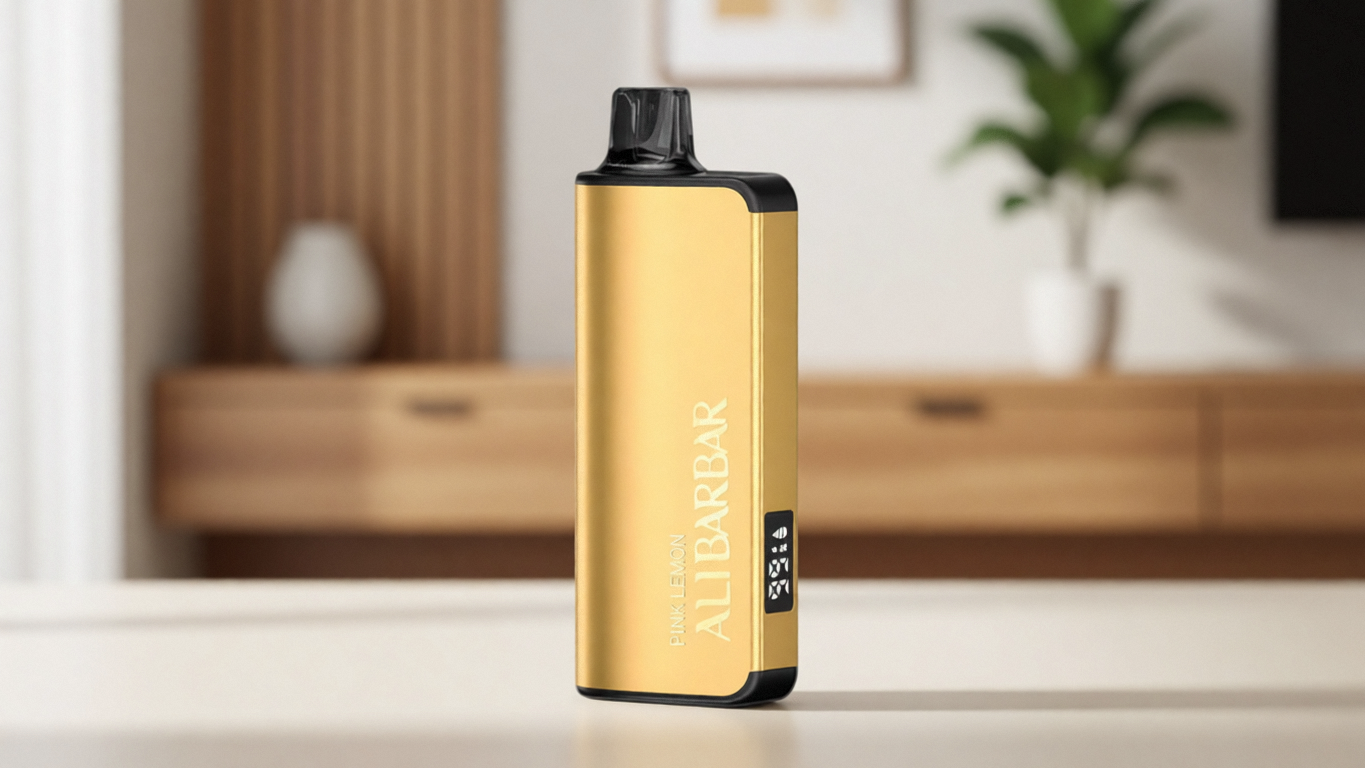
A great deal of scent transmission is governed not by what is in the liquid, but by how the device manages residual vapor. Many sealed, pre‑filled designs — such as the ALIBARBAR INGOT series — enclose the heating element and liquid reservoir within a rigid housing that is factory‑sealed. The only vapor that escapes is what the user actively draws and exhales. There is no weeping of liquid from seams, no seepage from an over‑saturated wick pooling in the battery compartment, and therefore no ambient odor when the device is simply sitting in a pocket or on a desk.
By contrast, refillable pod systems and open‑tank mods nearly always have a slight fugitive scent. A tiny amount of liquid resides on the fill port gasket, the coil base, or the drip tip interior, and over the course of a day that minuscule residue evaporates. One person may never notice it; another will pick up a faintly sweet note each time they lean toward the device. The difference is in the seal integrity. Factory‑sealed units such as the Ice Adjust 12000 have nothing to leak and nothing to off‑gas, so the device itself remains odor‑neutral.
Environmental Variables You Control
No device operates in a vacuum, and the surrounding environment often determines whether a scent is noticed.

Ventilation: A room with active air exchange (an open window, HVAC return) will clear vapor scent quickly. Still air allows droplets to settle on horizontal surfaces.
Temperature and humidity: High humidity accelerates the agglomeration of vapor droplets, causing them to fall out of suspension faster and deposit scent on furniture. Dry, cool air keeps droplets aloft longer, but also promotes rapid evaporation.
Absorbent surfaces: Upholstery, carpet, and curtains trap aroma molecules far more than hard flooring or leather. A vapor used in a carpeted bedroom will leave a far more persistent scent than the same device used in a tiled kitchen.
Applying These Insights to Real‑World Device Choices
No single device can be declared “scent‑free” because human olfaction is too variable and too subjective. However, the engineering principles outlined above make it possible to categorize devices along a continuum of discretion, and a few design families stand out.
Take the ALIBARBAR INGOT 15000. It uses a high‑density mesh heating element that fully aerosolizes the liquid at a controlled temperature, minimizing the production of partially vaporized droplets — the kind that often carry the heaviest scent. Combined with a draw‑activated firing mechanism that stops the instant the user pauses, there is no post‑draw sizzle that would create stray vapor. In practical terms, that means almost all of the produced aerosol enters the user and is exhaled under their control, rather than leaking from the mouthpiece between puffs.
By comparison, a large sub‑ohm tank with a high‑mass coil retains heat and will continue to cook residual liquid for a moment after the button is released, releasing a thin stream of scent directly into the room. This does not make one device better or worse in an absolute sense, but it does change the scent footprint — and for a user who prioritizes discretion, that difference is substantial.
A Practical Framework for Evaluating a Device’s Scent Profile
If you are trying to compare options with scent in mind, ignore the adjectives on the product page. Instead, apply this checklist:
Seal integrity: Is the device factory‑sealed, or does it have user‑accessible refill ports and replaceable coils? Every opening is a potential scent leak.
Heating element design: Lower mass, faster ramp‑up, and consistent temperature control mean less residual aerosol.
Liquid formulation visibility: If the manufacturer does not disclose the PG/VG ratio, you cannot predict the vapor density. Denser vapor carries scent farther.
Airflow adjustment: A tighter draw produces a smaller cloud and less scent dispersion.
Status indicators: This may seem unrelated, but a device that gives you a clear battery and liquid level signal prevents the surprise of a suddenly diminished output that could alter the aroma profile (a near‑empty wick can produce a noticeably different, sometimes more pungent scent).
If a device fails more than two of these checkpoints, it is reasonable to assume it will have a moderate to noticeable scent footprint.
Common Misconceptions and Overlooked Factors
After years of watching how users choose and use these devices, several patterns emerge that need to be named directly.
Misconception 1: “No visible cloud means no smell.”
Odor molecules are invisible. A device can produce a thin, barely visible vapor yet still carry potent esters that linger. The reverse is also true: large, wispy clouds from a pure menthol blend may be visually obvious but effectively scent‑free.
Misconception 2: “All sealed devices are equally discreet.”
The materials inside the device matter as much as the seal. A sealed device with a poorly optimized wicking material may singe slightly near the end of its life, producing a acrid note that cuts through any flavor profile. ALIBARBAR devices, for example, use vertical mesh configurations that maintain consistent saturation right up to the last few draws, reducing the likelihood of that telltale dry‑hit odor.
Misconception 3: “You can eliminate all scent if you hold your breath longer.”
The technique has a ceiling. Holding vapor in the lungs for longer allows a larger fraction of droplets to deposit onto the moist respiratory lining rather than being expelled into the air, but it does not eliminate the exhaled fraction entirely. Gains beyond about three seconds are marginal.
Supply‑chain reality: Not all devices on the market contain what their label says. A counterfeit unit may use lower‑grade flavorings that include compounds with markedly lower odor thresholds. When you source through an authorized channel like OZVAPE Shop, the specification sheet matches the contents. That predictability extends directly to scent behavior.
Frequently Asked Questions
Q: Does vapor smell stay on clothes?
A: Unlike cigarette smoke, vapor droplets do not bond as aggressively to fabric fibers. In most cases, any scent transferred from exhaled vapor will dissipate within 15–30 minutes in a ventilated area. Heavier, cream‑based flavors may leave a faint trace that clings to wool or fleece slightly longer, but even that washes out with normal laundering.
Q: Can someone smell vape in the next room?
A: Entirely depends on the device and the room layout. A high‑VG device used in a closed room might allow a faint sweet note to travel through an open door, but it will not carry the strong, lingering signature of tobacco smoke. With doors closed and minimal ventilation, a scent‑sensitive person might detect it; under normal conditions, it is unlikely.
Q: Do fruit flavors smell less than tobacco flavors?
A: Generally, yes. Fruit esters are lighter and evaporate more quickly. Tobacco‑flavored liquids often include complex blends of heavier molecules that can linger on soft surfaces.
Q: Is there a device that produces zero smell?
A: No. Any device that heats a liquid to produce an aerosol will release some volatile compounds. The goal is to minimize and manage that release, not eliminate it entirely.
Q: Does the battery level affect smell?
A: Indirectly. As a battery depletes on a power‑regulated device, output can drop, leading to incomplete aerosolization and a heavier, sometimes burnt‑tasting residue that also carries a more pungent scent. A device with stable output regulation, like the INGOT series, avoids this.
Q: How long does the smell from a vape typically last in a room?
A: The visible cloud dissipates in under a minute. Any residual scent from a light, fruit‑based liquid will typically be undetectable within 10 minutes. Heavier dessert profiles in a still, carpeted room can last up to 30 minutes.
Q: Are there any design features specifically aimed at reducing odor?
A: Yes. Snap‑on mouthpiece covers, magnetic caps, and silicone internal seals all trap residual vapor. Some devices, like the ALIBARBAR Ice Adjust 12000, incorporate a mouthpiece design that minimizes stray aerosol leakage between draws.
Q: Does temperature affect vape smell?
A: Warmer air holds more moisture, which can cause vapor droplets to evaporate faster and reduce scent longevity. However, high heat can also make certain plastic components in poorly built devices release an odor of their own, which is why material quality matters.
Q: Can my neighbors smell my vape through walls?
A: Almost certainly not. Vapor lacks the penetrating oil‑based particles that cigarette smoke carries. Unless you are blowing vapor directly into a shared ventilation duct, the molecular weight of the aroma compounds is insufficient to pass through drywall and paint layers in any detectable concentration.
Q: What should I do if my device has an unusually strong chemical smell?
A: A strong, acrid smell usually indicates a depleted wick, a scorched coil, or a contaminated liquid. Stop using the device. If it is a sealed unit, it may be a rare manufacturing defect. When you purchase through a retailer with a clear accountability policy, like OZVAPE Shop, you can raise the issue and expect a factual response rather than a scripted deflection.
Conclusion
The question “Does vape have smell?” resolves not to a binary answer but to a spectrum governed by chemistry, device design, and your own environment. Adults who need to be discreet will find far more control than they expected when they choose a factory‑sealed, well‑engineered device with a transparent ingredient profile, and then use it in a space with reasonable airflow. The scent will be fleeting and unremarkable — noticeable to someone standing directly next to you at the moment of exhalation, perhaps, but unlikely to announce itself minutes later or rooms away.
At OZVAPE Shop, we catalog specifications and real‑world performance data precisely because the difference between a device that fits seamlessly into your daily routine and one that creates constant low‑grade anxiety often comes down to these unglamorous details. The right choice is the one that aligns with how you actually live, not the one with the most assertive marketing copy. Trust your own diagnostic framework, verify the spec sheet, and let the device earn its place in your pocket by delivering what the engineering promises.