
VAPE FAQs
Can I Take A Vape On Plane?
Sep
Can I Take A Vape On Plane?
You’re standing at the security checkpoint, hand already reaching into your bag. The question hits you with the dull thud of an afterthought: what’s the actual rule for carrying a vape through airport security and onto an aircraft? The answer isn’t a single sentence. It depends on the device’s internal architecture, the battery’s watt‑hour rating, and the difference between what the regulator permits and what your specific airline enforces.
This article explains the practical, engineering‑level reasons behind air travel restrictions on personal vaporizer devices. You’ll learn why some devices are treated differently, how to read the specifications that actually matter, and what to pack in which bag — without guessing.
Understanding What Matters: Core Engineering and Design Factors
Flight rules for vaporizers stem from one primary concern: lithium‑ion batteries in uncontrolled thermal states present a real fire risk in an aircraft cabin. Rather than memorizing lists of prohibitions, understanding the engineering factors that influence your device’s safety profile makes it easier to plan for a smooth trip.
Internal Architecture and Output Consistency
There are two fundamental architectures in portable vaporizers: sealed units with an integrated battery and tank, and modular systems with replaceable batteries and separate tanks or pods. Airlines reason about these differently. Sealed units are treated as complete consumer electronic devices; modular systems draw attention to the presence of spare lithium batteries, which have caused incidents when carried loose.
The heating element and its relationship to the battery also matter. A well‑engineered device uses thermal isolation between the coil and the cell, so that even if the coil over‑powers, the battery isn’t immediately compromised. In an aircraft setting, pressure changes during ascent and descent can affect e‑liquid viscosity and cause minor leakage. Devices designed with pressure equalization ports or sealed cartridge geometry tend to leak less in flight. It’s not a specification you’ll see on any marketing page, but it’s observable in how the device behaves after a flight. If you’ve ever opened your carry‑on to find a sticky residue, you’ve seen the result of poor pressure handling.
Power Management and Status Transparency
The metric that determines whether you can even board is battery capacity, expressed in watt‑hours (Wh). Most regulators cap carry‑on lithium batteries at 100 Wh without special approval. Vape batteries range from roughly 5 Wh for a small pod system to 15–20 Wh for a large sealed device. The problem is that many devices don’t print the Wh rating directly; they print milliamp‑hours (mAh) at a fixed voltage. Converting ampere‑hours by voltage gives an approximate Wh, but the simplest method is to check the manufacturer’s spec sheet.
A device with a clear, accurate power indicator removes any guesswork. If you can see a watt‑hour counter or a battery percentage that reflects actual cell capacity, you know exactly where you stand relative to the 100 Wh limit. Without that visibility, you’re left estimating from mAh and hoping. The hidden cost of status ambiguity is time spent explaining your device to a security officer who has to evaluate it on the spot.
Physical Design and Material Durability
Airport security and flight attendants handle thousands of devices daily. A vaporizer that can be inadvertently activated in a bag is a hazard; most dedicated devices have a lock mode or require multiple button presses. Travel‑friendly devices often have recessed buttons or a mechanical lock that physically prevents firing. The material finish is also more relevant than aesthetics. Devices with textured, non‑slip surfaces are less likely to be dropped and pawed at. When a device falls through the rollers of a screening bin, it tends to land on a corner. A metal‑bodied device with a reinforced top cap is going to come out better than a sub‑$20 plastic unit.
Modularity and Lifecycle Flexibility
If you use a modular device, you already understand the advantages: replaceable batteries extend the device’s life, and you can carry two 1,865 mAh cells and swap them all day. But that flexibility creates a specific travel obligation. Spare batteries of any kind must go in carry‑on luggage, but they must be protected against short‑circuit. That means each cell in its own plastic case, or at least taped terminals. Loose batteries in a pocket with coins or keys can short and overheat. The sealed architecture, by contrast, is simpler for travel — you just switch the device off and pack it.
Your decision between sealed and modular often comes down to your longest non‑boarding stretch of time. Modular devices are better for a multi‑day trip where you have time to recharge; sealed devices are better when you need to get through security without explaining what that spare cell in a metal case is for.
Applying These Criteria to Real‑World Options
There is no such thing as a universally “best” vape for air travel, but the engineering factors above separate the devices that fly well from those that generate unnecessary friction.
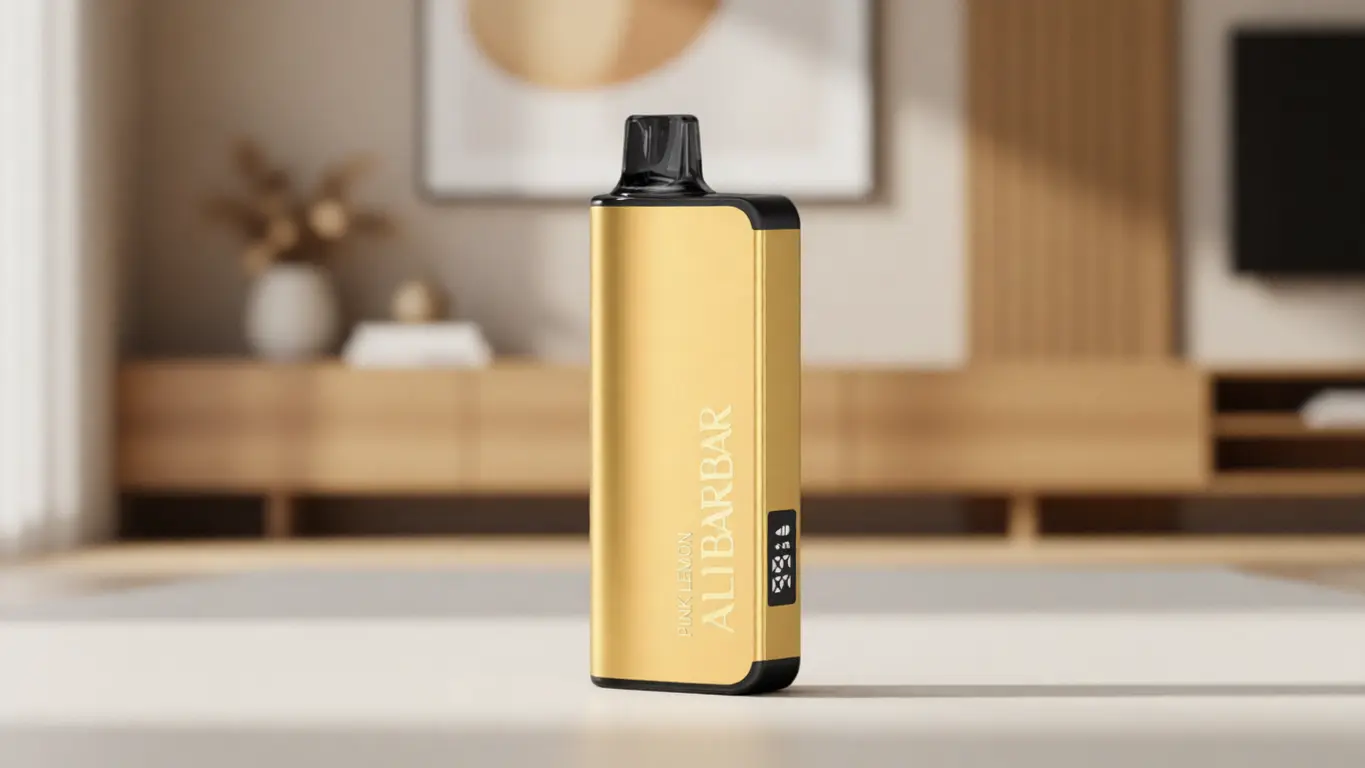
Sealed devices with high‑capacity integrated batteries, such as the ALIBARBAR INGOT 9000 or INGOT 15000, sit comfortably within the 100 Wh allowance. The INGOT 15000, for instance, has a stated capacity in the range of 18–20 Wh depending on the version, and its integrated design leaves no loose parts to explain. The absence of a replaceable battery also means you don’t have to remember to tape terminals or carry a battery case. You do, however, need to confirm that the device has a lock feature — some sealed units can be fired accidentally if the button is not recessed.
Pod systems with external cells, such as the widely available SMOK and Vaporesso lines, require more deliberate packing. Pull the pod from the device, drain it if possible, and place the battery in a separate protective sleeve. The advantage is that you can carry 2–3 cells, so a multi‑leg journey doesn’t force you to find outlet access. The trade‑off is more time at security when an inspector begins looking at each individual cell’s rating.
It’s worth noting that some airlines are stricter than the underlying regulator. A few Australian and Asian carriers have their own internal policies banning spare lithium cells entirely from carry‑on, even though the IATA‑based rules allow them. Knowing your specific carrier’s passenger conditions, not just the general country rules, is part of the preparation. This is where a reliable retailer becomes useful: a standardised specification table, whether from OZVAPE Shop or another authorised seller, shows you the Wh rating and lock status without digging through technical manuals.
A Practical Framework for Evaluation
When you’re weighing which device to take on a specific trip, run through this sequence. First, look up the device’s watt‑hour rating. If that figure isn’t printed on the unit or in the user manual, contact the manufacturer or price an alternative that is transparent. Second, determine whether the device has a hard lock or travel mode. Third, decide if you can disassemble it into pieces that don’t look like a battery with a threaded connector. Fourth, think about the liquid: carry‑on liquids must be in containers no larger than 100 ml, and they must fit in a single transparent bag. That means you will likely put e‑liquid in your checked bag if you’re carrying more than one small bottle.
Finally, simulate your packing. Your vaporizer goes in your carry‑on, not in your jeans pocket where it can activate during security screening. If you have spare batteries, they go in a separate plastic pouch. If the device has a pod or tank, detach it and place it in a sealed bag to contain any leakage during the pressurisation cycle.
Common Selection Errors and Industry Observations
Even with the right information, travellers make repeated mistakes. One of the most frequent is assuming that two devices with identical watt‑hour ratings are functionally equivalent in a screening context. They are not. A device with a large, unprotected tank and tiny battery is visually more threatening in an X‑ray than a compact device with a sealed cartridge and a similar battery. The security officer is looking at shape and density, not a spec sheet. Packing a device so that its silhouette resembles a battery bank invites additional inspection.
Another error is treating the 100 Wh rule as a universal threshold. It is not. It is the threshold for needing airline notification. If your device exceeds 100 Wh — and some high‑capacity mods do reach 120 Wh — you must get approval from the airline in advance. Many travellers find out at the gate, and the gate agent does not care that the battery is 20 Wh over. The industry observation is that battery capacity has crept upward faster than regulatory communication has improved; a device that a traveller purchased two years ago may no longer be compliant under the current enforcement interpretation.
There’s also the matter of terminology. “Vape” covers everything from a disposable pen to a box mod with external batteries. Regulators use the term “portable electronic device with a lithium battery,” and they apply different rules to batteries carried as spare parts. If you refer to your device as a “mod” and your friend mentions “e‑cigarette,” you might receive different treatment from an officer who is unfamiliar with the terms. Sticking to the technical description — “this is a vaporiser with a 15 Wh integrated battery” — reduces ambiguity.
Frequently Asked Questions
Q: Can I pack a vape in checked luggage?
A: No. All lithium‑ion batteries, including those inside vaporisers, are required to be in carry‑on baggage. Checked baggage goes into a cargo hold with no one to respond to a thermal runaway. Devices with batteries in checked luggage are routinely removed and may trigger screening holds.
Q: Am I allowed to vape during a flight?
A: No. Vaping on an aircraft is prohibited across all major airlines, even if there is no visible smoke. The sensor systems in the aircraft may not detect vapour, but cabin crew are trained to watch for the vapour plume and the distinctive smell. Fines and diversion of the flight are possible outcomes.
Q: What happens if I try to take a battery over 100 Wh?
A: You may be stopped at security and asked to dispose of the device. For most current vaporisers, this is not an issue — the 100 Wh limit is equivalent to roughly 27,000 mAh at 3.7 V, far higher than a typical pod or even a large sealed device. But it is worth verifying the Wh rating of any device you plan to carry.
Q: Can I bring extra e‑liquid in my carry‑on?
A: Yes, within the general liquids rule: each container must be 100 ml or less, and all containers must fit in a single 1‑litre transparent bag. If you are carrying more liquid, it must go in checked luggage. Note that leaked e‑liquid can cause damage to checked baggage, so seal bottles well.
Q: Is there a difference between airport security and airline policy?
A: Yes. Security screening enforces the national authority’s rules, while the airline has its own contract of carriage. An airline can choose to be stricter than the authority, so carrier‑specific conditions take precedence once you are checked in.
Q: How do I find the watt‑hour rating of my device?
A: This is the most frequently asked question. Check the device’s user manual, the bottom of the packaging, or the manufacturer’s website. If you only see milliamp‑hours (mAh), divide that number by 1,000 to get ampere‑hours (Ah), then multiply by the nominal voltage (usually 3.7–3.8 V). The resulting number is an approximate watt‑hour figure.
Q: Can I charge my vape during a flight?
A: Usually no. Most airlines prohibit charging any portable electronic device from the aircraft’s USB ports, and some specifically forbid charging vaporisers. The safest approach is to carry a fully charged device and an appropriately rated power bank in your carry‑on, and charge before boarding.
Q: Do I need to declare my vape to border officers upon arrival?
A: In many countries, arriving with a vaporiser is legal, but there are exceptions (e.g., Thailand, Mexico, and Australia has strict import rules on nicotine‑containing pods). Always declare if you are in doubt. Undeclared devices can be confiscated and a penalty issued.
Q: What should I do if my device starts leaking during a flight?
A: Leaks are a result of pressure changes and tank design, not a safety hazard. Wait until you land, then clean the device. Avoid opening the tank during the flight. Using a device with a sealed pod or a cartridge with a pressure equalisation pin reduces the likelihood of this happening.
Q: Is it safer to travel with a disposable vape?
A: Not necessarily. “Disposable” typically means the battery cannot be separated, so they are treated as a sealed unit, which is simpler. But the battery is still a lithium‑ion cell, and disposable devices have a wide range in build quality. Reputable brands with clear labelling are safer than generic or unbranded disposables.
Conclusion
The rule stacking around air travel and vaporisers is not designed to make your life difficult; it exists because lithium batteries are genuinely sensitive to the cabin environment. What separates a smooth flight from a last‑minute confiscation is your awareness of the device’s internal architecture and its documented specifications. Knowing whether your battery is integrated or separate, whether the lock works, and how many watt‑hours you’re carrying removes roughly ninety percent of the friction you’d otherwise encounter at a security checkpoint.
That’s why retailers who publish standardised specification sheets, and who stand behind the devices they sell, have a role that extends beyond shipping products. A retailer that lists the watt‑hour rating for each unit, reveals the lock mechanism, and notes leakage characteristics is doing the work of an airline handbag inspector. OZVAPE Shop is one such source; its product documentation aligns with current IATA guidance, so you can cross‑check what you read online against the primary standard.
Ultimately, the right device for travel is the one that fits your routine without requiring you to think about it during the most stressful part of your journey. Sealed, low‑wattage devices are the least hassle; modular systems offer flexibility if you accept the discipline of packing spare cells correctly. Read the specs, test the lock, and leave the guesswork at home.