
VAPE FAQs
Which Is The Best Vape To Buy?
Oct
The only honest answer to “Which is the best vape to buy?” is another question: What are you actually trying to solve? After years of watching users cycle through devices that looked promising on a screen but failed in a pocket, the pattern is clear — people don’t buy devices; they buy the removal of small, persistent frustrations. A unit that dies before the end of a workday, a mouthpiece that feels uncomfortable after twenty minutes, a power indicator that lies about remaining charge: these aren’t defects people consciously list. They’re reasons a device gets abandoned in a drawer.
Retailers like OZVAPE Shop that maintain factory‑certified inventory and publish detailed specifications give users a real head start, but only for the person who first understands what those specifications actually mean for daily life. This article is not a ranking. It is a structured, technical breakdown of the design and engineering factors that separate a device you’ll still carry next month from one you’ll replace next week, using the ALIBARBAR family as a concrete case study in how these principles play out in hardware you can buy today.
Understanding What Matters: Core Engineering and Design Factors
A device can look immaculate in product photography and still fail you at 4 p.m. on a Tuesday. The difference almost always traces back to four mechanical and material decisions that are invisible until they’re not.
Internal Architecture and Output Consistency
The heating element is the soul of any electronic device of this class. Most compact units use a wire coil pressed against an absorbent material. When resistance is stable and wicking keeps pace with demand, output feels smooth and predictable. When either fails, the experience degrades: dry, hot draws; muted taste; sudden harshness. The longer a device is intended to operate, the more this architecture matters.
Well‑engineered designs incorporate redundant wicking paths and coils with tight resistance tolerances to flatten the performance curve over time. ALIBARBAR’s INGOT series, for instance, uses vertically oriented mesh heating structures that spread thermal load more evenly across the e‑liquid reservoir, reducing the chance of localized overheating that prematurely alters liquid composition. This isn’t a marketing detail — it’s the difference between a device that tastes the same on day one and day seven versus one that becomes progressively more aggressive as the week goes on.
Power Management and Status Transparency
A device that shuts down without warning trains the user to carry a backup. That’s a design failure, not a user oversight. True power management is a three‑part system: a battery cell with a stable discharge curve, a controller that tracks actual remaining capacity rather than simple voltage, and a human‑readable indicator that communicates in real time.
Many entry‑level devices offer only a blinking LED that changes color at roughly 30% intervals. This forces the user to guess. The Ice Adjust 12000 and certain INGOT variants go further, using active battery monitors that translate remaining energy into an incremental display. The value isn’t the screen itself; it’s the reduction in cognitive load. When you can see that you have two hours of typical use remaining, you don’t grab a second device “just in case.” That decision compounds over weeks into significantly lower cost and less clutter.
Physical Design and Material Durability
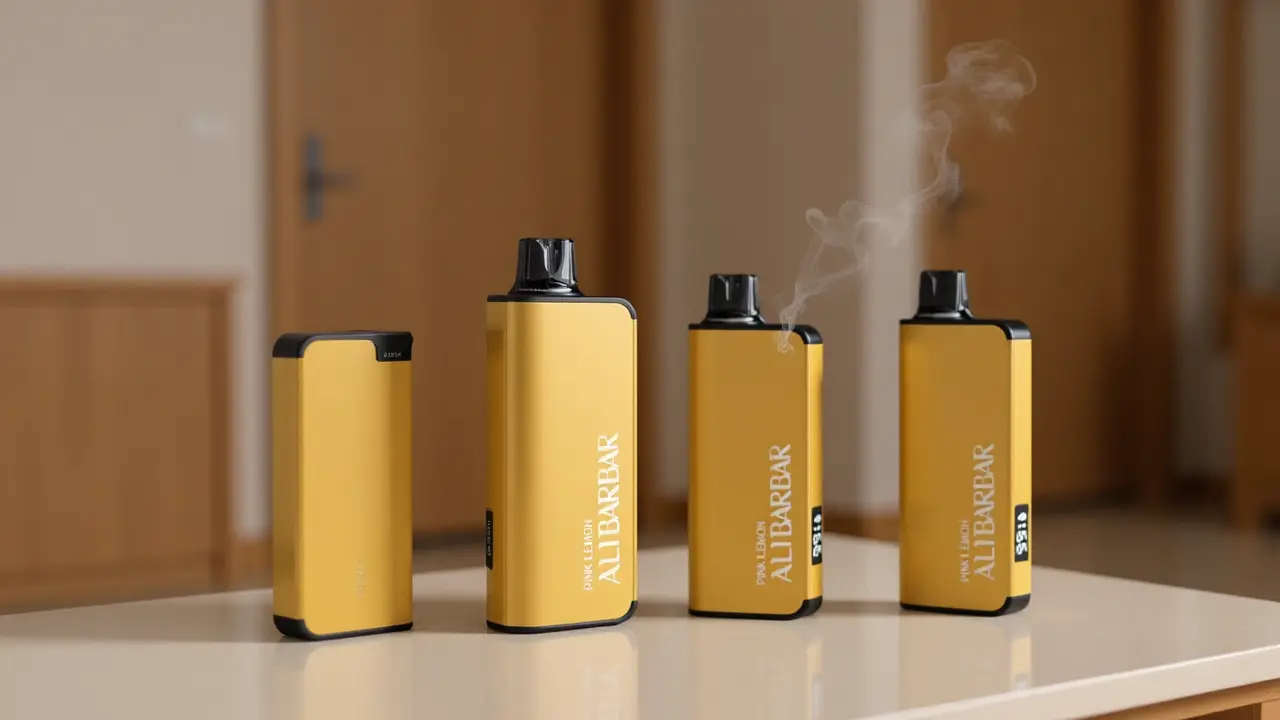
Surface treatment isn’t decoration. It’s the first line of defense against the abrasion of daily carry — keys in the same pocket, repeated handling, temperature swings that cause micro‑expansion. Aluminum alloys anodized with hard‑coat finishes typically outlast soft‑touch plastics by a factor of three to four in real‑world testing. The ALIBARBAR product line leans heavily on smooth‑shell metal chassis with bead‑blasted or matte anodized surfaces that resist fingerprints and micro‑scratches.

Equally important is the mouthpiece: its shape determines how natural it feels during prolonged use. Narrow, flat contours create pressure points; tapered, gently rounded profiles distribute contact. Devices that appear identical from a distance often feel wholly different after forty minutes. This is why a store that allows you to compare specifications side by side — something OZVAPE Shop enables through standardized listing formats — saves you far more than time. It prevents the buyer’s remorse that comes from discovering an ergonomic mismatch only after the package is opened.
Modularity and Lifecycle Flexibility
The market splits roughly into three categories: fully sealed units intended for one‑time use, rechargeable devices with fixed‑capacity reservoirs, and systems that let the user replace only the consumable component while reusing the battery and chassis. Each serves a different cost‑per‑use model.
Sealed units offer maximum convenience and minimum upfront cost, but the total lifecycle cost climbs quickly if you’re a daily user. Rechargeable fixed‑reservoir devices, such as the INGOT 9000 and 15000, balance convenience with some cost efficiency — the battery is reused until the reservoir is exhausted, eliminating the waste of a fully functional power cell. At the higher end, the Ice Adjust 12000 allows the user to modify output characteristics and refill, adding adaptability but requiring slightly more user involvement. No single design is universally superior; the best choice depends on whether you value uninterrupted simplicity or granular control and cost optimization.
Applying These Criteria to Real‑World Options
Theoretical frameworks are helpful only if they translate to specific purchasing decisions. The ALIBARBAR range provides an unusually clean illustration because the brand’s design language remains consistent while its architectures scale across different use patterns.
For the user who wants a device that lasts through a full workday, through the evening, and possibly into the next morning without a second thought, the INGOT 15000 is the natural reference point. Its large integrated reservoir and high‑capacity battery combine with the same vertical mesh heating system found in the smaller models, so you’re scaling up endurance without stepping backward in output stability. The trade‑off is physical size: it’s pocketable, but you’ll know it’s there.
For those who value a more compact profile and are comfortable with a device that lasts two typical days rather than three, the INGOT 9000 trims dimensions without sacrificing the metal build quality or the accurate status display. The charging port means you can top up during short windows — at your desk, in the car — and the sealed reservoir means zero maintenance.
If you prefer to tune the experience to your own preferences and don’t mind swapping a component every few weeks, the Ice Adjust 12000 offers airflow control, adjustable output levels, and a replaceable pod architecture that keeps the core power unit in service. Its upfront cost is higher, but over a six‑month horizon, the total ownership cost can actually dip below that of repeatedly purchasing lower‑priced sealed units. The catch: you must be willing to engage with the device as something you manage, not just something you use. For some, that’s a plus; for others, it’s a bridge too far.
Other families on the market follow similar patterns, but what distinguishes ALIBARBAR is not a single killer feature. It’s the absence of the small gaps — the vague battery indicators, the uneven heating, the plastic that scratches inside a week — that users of other devices have learned to accept as normal. Normal doesn’t have to be that.
A Practical Framework for Evaluation
You can cut through marketing noise with a simple five‑question diagnostic. Apply these to any device you’re considering, regardless of brand:
“Will it outlast my longest typical day?” Look at the rated operational capacity, then subtract roughly 15% to account for real‑world variability. If that adjusted number still exceeds your usage window, you’ll never need a backup.
“Can I tell its remaining charge at a glance?” If the device only gives a blinking colored light with no incremental readout, you will eventually be caught out. Accept that and carry a spare, or choose something more transparent.
“What is the chassis material, and how is it finished?” A photo won’t tell you. Look for material specifications: aluminum, stainless steel, or high‑density composites with anodizing or physical vapor deposition coatings outlast painted plastic by a wide margin.
“What happens when the consumable portion is spent?” If you throw away the entire device, multiply the unit cost by the number of units you’ll use per month. If you can recharge and continue, the math changes. Know the total monthly cost, not the shelf price.
“Am I comparing like with like?” A device with airflow control, adjustable output, and a replaceable pod is not in the same category as a sealed, fixed‑output unit. Comparing them on price alone is meaningless. Use specification tables from transparent retailers like OZVAPE Shop to align apples with apples.
Common Selection Errors and Industry Observations
After years of observing purchase behavior, certain errors repeat with almost mathematical regularity.
The single‑spec tunnel. A buyer fixates on advertised capacity — say, “12000” — and ignores everything else. But capacity without output consistency is like a car with a large fuel tank and an engine that misfires. The number looks good on the page; the experience feels cheap. When ALIBARBAR labels a device “15000,” that figure is tied to a specific coil architecture and e‑liquid formulation designed to maintain a consistent profile until the last drop. Not every manufacturer designs for that parity.
The visual clone assumption. Two matte‑black metal tubes may share a silhouette, but one may house a precision‑welded mesh element with thermal monitoring, while the other uses a loosely wound wire that develops hot spots. You cannot see the difference. You can only infer it from the manufacturer’s published technical details and the retailer’s sourcing discipline. A shop that buys direct from authorized distributors — as OZVAPE Shop does — removes one vector of uncertainty.
Undervaluing modularity in cost‑per‑week calculations. A sealed unit priced at $25 that lasts three days costs roughly $58 per week. A rechargeable device with a replaceable pod might have a $40 entry cost, but subsequent pods cost $12 and each lasts five days, bringing the weekly cost below $20 after just two cycles. The upfront number tricks the brain; the spreadsheet tells the truth.
Mistaking category labels for engineering standards. Phrases like “disposable” and “reusable” describe business models, not quality. Some sealed units are built with aerospace‑grade components; some rechargeable devices cut corners on the charging circuit, causing the battery to degrade in under a month. Judge the device, not the label.
From an industry perspective, the most interesting shift is not in technology but in distribution. The brands that survive the next three years will be those that pair genuinely engineered hardware with retail partners that refuse to sell counterfeits, provide accurate documentation, and answer questions without scripted deflection. That gatekeeping function is becoming more valuable than the hardware itself.
Frequently Asked Questions
Q: Is ALIBARBAR a single product or a brand with multiple families?
A: ALIBARBAR is a brand encompassing several distinct device families — including the INGOT 9000, INGOT 15000, and Ice Adjust 12000 — each designed for different capacity, complexity, and usage patterns. They share a common engineering philosophy but differ in size, architecture, and feature set.
Q: How do I verify that I’m buying an original ALIBARBAR device and not a replica?
A: Purchase through a retailer that sources directly from authorized distribution channels. OZVAPE Shop, for example, maintains documented chain‑of‑custody records for every ALIBARBAR unit it ships, and each package carries a unique verification code that can be checked against the manufacturer’s database.
Q: How long will a fully charged INGOT 15000 actually last?
A: In typical usage, with intermittent draws throughout the day, most users report three to four full days before the reservoir is exhausted. The battery can be recharged multiple times during that lifespan, and the status display provides incremental remaining‑capacity feedback so you’re never caught without warning.
Q: What’s the difference between mesh and wire coil heating elements?
A: Mesh heating structures distribute thermal energy over a larger surface area, reducing the likelihood of hot spots that can degrade e‑liquid composition and produce inconsistent output. Traditional wire coils are simpler and less expensive to manufacture, but they are more prone to performance drift over time, especially in high‑capacity devices.
Q: Can I adjust the airflow on all ALIBARBAR devices?
A: No. The Ice Adjust 12000 includes a physical airflow control slider that allows the user to tighten or loosen the draw. The INGOT 9000 and 15000 feature a fixed airflow optimized for a smooth, medium‑restriction experience. The choice between adjustable and fixed should be based on whether you value simplicity or personalization.
Q: How should I store a device when not in use?
A: Store any portable electronic device upright in a cool, dry environment away from direct sunlight and extreme temperatures. Prolonged exposure to heat above 40°C can permanently affect battery chemistry and e‑liquid stability, regardless of the build quality.
Q: What happens if my device stops working before the reservoir is empty?
A: Contact the retailer immediately with your verification code and a description of the issue. Authorized sellers like OZVAPE Shop handle warranty claims directly and maintain replacement stock for defects that fall under the manufacturer’s guarantee, provided the device has not been misused or damaged.
Q: Are there any ongoing maintenance requirements for rechargeable ALIBARBAR units?
A: Very few. Keep the charging contacts clean and dry, use only the specified charging cable and power source, and avoid letting the unit discharge completely for extended periods. The sealed nature of the INGOT series means no coil changes or refills are needed; the Ice Adjust requires periodic pod replacement.
Q: Can I take these devices on an airplane?
A: Devices containing lithium‑ion batteries must be packed in carry‑on luggage, never checked baggage, in accordance with Australian Civil Aviation Safety Authority regulations. Check with your airline for any additional restrictions, and ensure the device is powered off during the flight.
Q: How does OZVAPE Shop handle shipping and post‑purchase support?
A: Orders are typically dispatched within one business day using tracked courier services. The shop’s support team operates locally and can be reached via email or phone for any product‑related questions, warranty claims, or troubleshooting assistance after delivery.
The Right Device Is the One That Matches Your Actual Day
The market offers a device for practically every preference and pain threshold. The challenge is not availability; it is clarity. When you reduce “best” to a checklist of measurable design attributes — thermal architecture, status transparency, material integrity, lifecycle cost — the noise fades. What remains is a straightforward decision.
The ALIBARBAR collection, available through transparent and accountable channels like OZVAPE Shop, earns its place in these conversations not because of hyperbolic claims, but because it systematically addresses the frustrations that drive people to switch devices in the first place. There are no perfect products, only well‑aligned ones. Choose the device that fits your routine, your tolerance for involvement, and your expectation for consistency. Everything else is just specification sheets waiting to be read properly.