
VAPE FAQs
What Does A Vape Taste Like?
Jun
A persistent, low-grade dissatisfaction runs through a great deal of casual conversation about handheld electronic devices: someone tries a unit that a friend recommended, or one that looked impressive in a display case, and the sensory outcome feels thin, unexpectedly harsh, or just… absent. The question “What does a vape taste like?” seems simple, yet it masks an entire chain of interdependent variables that most users never have the opportunity to examine systematically. The result is a market where people blame the category for experiences that are, in fact, the predictable output of specific engineering and material choices.
At OZVAPE Shop, we have compiled user feedback over successive product cycles, and one pattern stands out: adult users who take the time to understand the few core mechanisms that govern taste rarely find themselves repeatedly disappointed. This article unpacks those mechanisms — not as a beginner’s guide, but as an analytical reference that treats the sensory outcome as a measurable function of device architecture, power delivery, and consumable design.
Understanding What Matters: The Engineering Behind Taste Perception
Taste, in the context of portable electronic inhalation devices, is not a single sensation. It is the composite result of thermal stability, aerosol density, airflow turbulence, and the chemical stability of the consumable medium. When a user reports that a device “has no taste,” or conversely that it delivers a sharp, acrid note, the explanation almost always rests in one of these four domains.
Thermal Management and Coil Architecture
The heating element — whether a round-wire coil, a mesh sheet, or a ceramic substrate — determines the speed and uniformity with which the consumable is brought to operating temperature. Wire coils that develop micro-scale corrosion before their rated lifespan, or that suffer from uneven resistance across the heating surface, produce flavour notes that experienced users describe as “tinny” or “stale.” Mesh architectures, by contrast, spread heat across a larger area with fewer hot spots, which tends to preserve the more delicate aromatic compounds in a formulation.
Why this matters: Many users report that a device tastes excellent for the first few days and then degrades abruptly. That timeline often correlates not with the exhaustion of the consumable, but with the point at which residue accumulation or minor resistance drift pushes the heating element outside its optimal temperature window. A well-engineered device will show measurable consistency across at least 85% of its rated operational volume before degradation becomes perceptible. Observing how a manufacturer describes its coil material — and whether it discloses heat-up time specifications — offers a preliminary filter.
Airflow Design and Aerosol Composition
Taste is partly olfactory, and the turbulence of an airstream alters how aromatic molecules reach the palate. Devices with narrow, aggressively constricted airways tend to produce a concentrated, sometimes overly hot aerosol that obscures subtle notes. Conversely, designs that allow for smooth, temperature-controlled mixing of ambient air with the generated aerosol can present a wider flavour spectrum — provided the airflow pathway itself does not introduce contamination from poorly finished internal surfaces or adhesives.
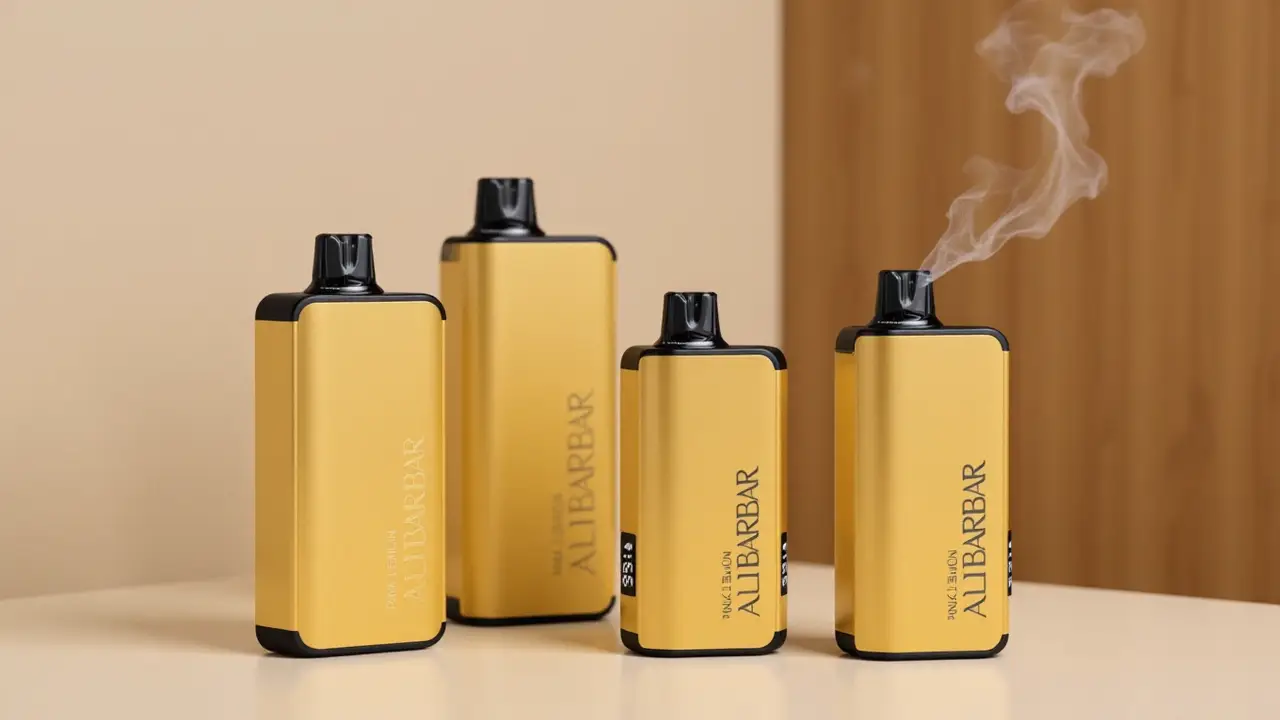
From a user’s perspective, the practical question is: does the device give you the ability to adjust airflow, even indirectly? Fixed-airflow systems simplify operation but leave the user with no recourse if the default setting does not match their sensory expectation. Some device families — including the ALIBARBAR Ice Adjust series — incorporate stepped airflow rings that allow the user to explore the relationship between draw resistance and flavour saturation without any technical knowledge. That is not a luxury feature; it is a recognition that taste is partly a mechanical problem.
Power Delivery and Consistency
A heating element that receives fluctuating voltage across the span of a single activation cycle will produce an aerosol whose density and temperature oscillate. The palate registers this as uneven flavour delivery, often described as a “thin” hit followed by a sudden spike of intensity. The effect becomes more pronounced as the battery cell approaches its discharge limit, unless the device’s power management circuitry actively compensates for voltage sag.
Users who have come to rely on a device for long days away from a charging source care deeply about this. A unit that delivers the same sensory profile at 30% charge as it does at 80% charge removes the need to constantly top up. In the ALIBARBAR INGOT 9000 and 15000 series, the discharge curve is managed so that output voltage remains within a narrow band for the majority of the rated charge cycle. This does not guarantee a specific flavour — that remains a function of the consumable — but it does ensure that the taste you experience at hour six is recognizably the same taste you enjoyed at hour one.
Consumable Integrity and Wick Saturation
The consumable medium — a liquid formulation — is itself a perishable product. Exposure to heat, UV light, or oxygen gradually alters its composition, and even a perfectly engineered device cannot compensate for a consumable that has been improperly stored or formulated with low-purity components. However, device design does influence how the consumable is presented to the heating element. If the wicking material cannot maintain saturation under rapid-fire use, the resulting partial dry-burn introduces carbonized off-notes that many users misinterpret as “the flavour running out” rather than what it actually is: a wicking failure.
This is where the distinction between a sealed, factory-filled system and an open, user-refilled system becomes relevant, not as a matter of moral superiority, but as a question of quality control. Sealed systems remove the variables of filling technique and cross-contamination. The ALIBARBAR INGOT series, for instance, uses a factory-sealed tank whose wicking material and saturation level are set under controlled conditions, which at least eliminates one entire category of user-induced flavour inconsistency.
Applying These Criteria to Real-World Options
When a user walks into any retail environment or browses an online catalogue, the surface-level product descriptions give them almost nothing that speaks to taste. Battery capacity in milliamp-hours, e-liquid volume in millilitres, and a puff count estimate do not tell you whether a device will preserve the bright, layered notes of a complex formulation or reduce it to a monochromatic sweetness. The user who applies the engineering factors above can, however, read between the lines.
Take a sealed, pre-configured device with a mesh-based heating element and a regulated power output. If it also includes adjustable airflow, the user can, with some trial and error, find the draw style that best presents the flavour profile built into the consumable. That is a fundamentally different value proposition from a simple, fixed-output unit that dumps a fixed wattage into a wire coil and leaves everything else to chance.
The ALIBARBAR Ice Adjust 12000 series is one instructive example of how a manufacturer might package several flavour-relevant features into a single, accessible form factor: mesh architecture for thermal uniformity, a battery management system with active compensation, and a tactile airflow selector. It does not promise a better taste in absolute terms — taste remains subjective — but it does promise a more controllable taste experience. In independent, side-by-side comparisons, that controllability often translates into higher user satisfaction because it reduces the likelihood of a fundamental mismatch between the device’s default behaviour and the user’s sensory preferences.
Other device families, including those with replaceable pod systems, offer a different trade-off: they allow the user to change consumable flavours without replacing the entire unit, at the cost of introducing more maintenance variables. The right choice is entirely a function of individual routine. A user who values variety above every other priority will accept the responsibility of changing pods and monitoring coil condition. A user who values predictability above all else may gravitate toward a sealed, pre-filled unit with a proven, stable flavour profile across the device’s entire operational life.
A Practical Framework for Evaluating Taste Potential
No specification sheet will tell you outright whether a device will please your palate. What it can do, however, is help you eliminate designs that are structurally unsuited to consistent flavour delivery. Use the following sequence as a diagnostic checklist when comparing options:
Heating element material: Is it a recognised mesh (stainless steel, kanthal, or nichrome) with an advertised surface area? Avoid generic “coil” descriptions that tell you nothing about uniformity.
Power management disclosure: Does the manufacturer state anything about output regulation? Terms like “constant-voltage output” or “battery sag compensation” are relevant here. Absence of information is not proof of poor design, but it does leave you unable to assess the device before purchase.
Airflow adjustability: Is there any user-facing mechanism to alter draw resistance? Even a two-position slider is valuable; fixed systems carry higher risk of mismatch.
Consumable source: Is the liquid formulation made by the same manufacturer as the device, and are its ingredients listed with reasonable specificity? If not, you are coupling two black boxes together and hoping they get along.
Indicators of authenticity: Verify that the retailer provides batch-level traceability and sources through authorised channels. A counterfeit device may look identical externally while containing a heating element of wholly different composition, which will directly and negatively affect taste.
A practical exercise: before buying any device, ask the retailer one specific question — “What material is the heating element made of, and how does the device manage power delivery across the battery discharge curve?” A knowledgeable response, even if brief, tells you that the retailer views these factors as relevant to customer satisfaction. A generic or evasive answer is itself diagnostic.
Common Selection Errors and Industry Observations
1. Confusing sweetness with quality
Many commercial consumable formulations are sweetened heavily, and sweetness acts as a sensory mask — it covers a multitude of sins, from low-quality base ingredients to inconsistent heating. Users often rate a device as “tasting amazing” when what they are actually experiencing is a concentrated hit of sucralose that binds to all available receptor sites. A more nuanced evaluation asks: are there discernible top notes, a middle body, and a clean finish, or is every hit a uniform candy-like wash? The latter can satisfy, but it doesn’t speak to device capability; it speaks to recipe engineering.
2. Assuming visual similarity indicates equivalent performance
Two devices with the same shape, the same mouthpiece contour, and even the same colour can house radically different internal electronics. This has become especially common as certain form factors gain market traction and smaller manufacturers rush to produce lookalikes. The consequences for taste are direct: a clone may use a heating element with a different resistance curve, a cheaper wicking material that burns at a lower temperature, or a power cell that cannot sustain rated voltage. These are not cosmetic differences; they are differences that register on the palate.
3. Undervaluing the impact of storage and transport
Consumables left in a hot car or exposed to direct sunlight for even a few hours can undergo irreversible chemical changes. The resulting off-flavours — often described as “stale” or “peppery” — are then attributed to the device. Manufacturers with traceable supply chains typically build in protective measures, but the end-user’s storage habits remain a major, and frequently overlooked, variable.
4. Treating “puff count” as a surrogate for taste longevity
A device rated for 9,000 activations may in fact produce aerosol for that many cycles, but the taste may become hollow or muddled after 6,000 due to gradual consumable oxidation or coil fouling. Users who plan based solely on the headline number often spend the final third of a device’s life dissatisfied without understanding why. The more useful metric is the number of consistent-taste activations, which responsible manufacturers sometimes publish as a separate figure or at least qualify in supporting documentation.
From an industry perspective, the most significant shift occurring now is the move toward device-level taste profiling. In the same way that audio equipment manufacturers publish frequency response curves, a small number of advanced device makers are beginning to document flavour retention characteristics under controlled laboratory conditions. This is early-stage work and far from standardised, but it signals a recognition that taste is not an ethereal, subjective mystery — it is an engineering outcome that can be measured, replicated, and, ultimately, promised.
Frequently Asked Questions
Q: Does the heating element material really affect taste, or is that just marketing?
A: Material composition affects thermal conductivity, corrosion resistance, and surface energy, all of which influence how the consumable aerosolises. Stainless steel and nichrome mesh elements generally introduce fewer off-notes than exposed kanthal wire under heavy use, though the difference may be subtle to an untrained palate.
Q: Why does my device sometimes taste burnt even though it is full?
A: A burnt note almost always indicates a localised dry-burn — a spot on the heating element where the wick has temporarily lost saturation. This can be caused by thick consumable formulations, aggressive chain-activation, or a wicking design that cannot keep up with demand. Reducing activation frequency or switching to a device with a larger wicking surface area often resolves the issue.
Q: Does adjustable airflow really change the taste, or just the feel?
A: Both. Airflow alters the aerosol’s temperature, particle size distribution, and the ratio of air to vapour reaching the olfactory sensors. A tighter draw tends to emphasise warmth and the darker base notes of a flavour; a more open draw brings out lighter, more volatile top notes. It is not a subtle effect.
Q: How can I verify that the device I bought is authentic?
A: Look for a unique verification code on the packaging that can be checked against the manufacturer’s official database. Retailers like OZVAPE Shop source exclusively through authorised distribution networks and provide batch‑level documentation, which effectively removes the authenticity variable from the equation.
Q: Is it normal for taste to fade toward the end of a device’s life?
A: Some degradation is natural due to gradual oxidation of the consumable and microscopic fouling of the heating element. However, a device that holds a consistent taste through 85% or more of its rated volume reflects strong engineering. If you notice a sharp drop-off well before that point, it may indicate a wicking or power-delivery limitation.
Q: Do sweetened formulations reduce a device’s lifespan?
A: Sweeteners, particularly sucralose, can leave a carbonised residue on heating elements at a faster rate than unsweetened formulations. This residue insulates the coil, causing it to run hotter and further accelerating the buildup of off-flavours. Users who prefer sweet profiles should expect shorter consumable longevity and plan accordingly.
Q: What should I do if a new device tastes “chemical” or “perfume-like”?
A: First, allow the device to rest for 24 hours in a cool, dark place — some consumable components require a brief settling period after sealing. If the off-note persists, discontinue use and contact the retailer. Reputable retailers will arrange a return or replacement under these circumstances.
Q: Can I trust online product descriptions to tell me what something actually tastes like?
A: Written flavour descriptions are inherently subjective, but standardised information — heating element type, power regulation, airflow adjustability — gives you objective proxies for taste potential. Use the former for curiosity, the latter for decision-making.
Q: How does a sealed pre-filled device ensure better taste consistency than a refillable one?
A: It eliminates user-introduced variables: filling technique, ambient contamination, consumable age at time of filling, and inconsistent power-to-coil matching. It is not inherently “better” in every aspect, but it dramatically reduces the number of things that can go wrong with taste.
Conclusion
The experience of taste in a handheld electronic device is not magic. It is the sum of a small set of controllable factors: how evenly the device heats, how it moves air across that heat, and how cleanly the consumable medium holds up under repeated thermal cycling. When a user understands these factors — and when they select a device whose design choices align with their own routines — dissatisfaction becomes far less likely.
OZVAPE Shop exists to make this alignment easier, not by pushing a single product as a universal solution, but by ensuring that the information and the sourcing behind every device are transparent. If you are evaluating the ALIBARBAR range or any other considered product line, the first productive step is always the same: ask the kind of questions this article has outlined, and listen carefully to the answers.