
VAPE FAQs
Is Inhaling A Burnt Vape Bad For You?
Jul
The Acrid Taste and the Concern It Raises
You take a draw, expecting the smooth, familiar sensation, and instead your throat is met with a harsh, bitter sting that makes you cough and recoil. The immediate reflex is to stop using the device, but a more unsettling question follows almost at once: is that burnt vapour actually harmful? The feeling is so unmistakably wrong that the body rejects it before the mind can analyse. That instinct exists for a reason, and unpacking the science behind it turns that instinct into a tool for making smarter choices.
At OZVAPE Shop, we hear variations of this question regularly — from people who have just experienced their first dry hit and from those who have endured it repeatedly before deciding to find out what is really going on. And while the short answer to “is it bad for you?” is yes, the more useful answer lies in understanding why, what you can do about it, and how device engineering can stop it from happening in the first place. This article unpacks the physical and chemical chain of events that turn a device from a precision instrument into a source of smoke-like irritation, and it gives you a rational framework for choosing equipment that respects your body’s reaction.
Why a Vape Tastes Burnt: The Physics and Engineering Behind the Failure
The burnt taste isn’t a random annoyance — it’s a loud, physical signal that the device has stepped outside its designed operating envelope. To understand what went wrong, you need to look at the interplay of a few core components.
The Wick and the Dry Hit
Every personal electronic device that produces an aerosol depends on a porous material — usually organic cotton, though sometimes silica or ceramic fibre — to hold a reservoir of liquid against a heating coil. As the coil warms, it draws liquid from the wick by capillary action. As long as the wick remains saturated, the liquid keeps the coil temperature close to its boiling point and the resulting aerosol is consistent. The instant the wick runs dry in the heated zone, the coil temperature climbs unchecked, scorching the cotton. The acrid compounds that produce the burnt flavour are largely the thermal decomposition products of cellulose: aldehydes, ketones, and trace polycyclic aromatics. The user’s nose and throat recognise these instantly because they are chemically similar to the smell of burning paper or fabric.
A dry hit can be triggered by several conditions: the reservoir running genuinely empty, a high-viscosity liquid that wicks too slowly, or a series of deep draws taken faster than capillary action can replenish the coil. Knowing which one applies changes how you respond.
Coil Overheating and Material Breakdown
The heating element itself — usually a wire of Kanthal, nichrome, or stainless steel — can reach temperatures well above 300°C when liquid is absent. Cotton ignites around 210°C, so sustained dry firing not only carbonises the wick but can also oxidise the metal surface. That oxidation can release metal ions into the aerosol and permanently degrade the coil’s resistance, making it prone to hot spots and inconsistent heating. Even if you refill afterwards, a severely burnt wick will continue to impart a disagreeable taste because the carbonised cellulose acts as an absorbent matrix for those burnt compounds.
Power Inconsistency and Supply Voltage Sag
Many devices lack any form of output regulation beyond a simple direct-voltage circuit. As the battery depletes, the voltage delivered to the coil drops, often causing the device to feel weaker toward the end of its charge. Some manufacturers try to compensate by designing coils with a very low resistance that delivers an aggressive initial hit at full charge, but this comes at the cost of severe dry-hit risk if the wick can’t keep up. Conversely, a device that lacks a boost circuit may allow the coil to overheat at the start and underperform later. Without stable power delivery, the user is constantly on the edge of the wick’s saturation limit.
Airflow and Cooling Dynamics
The path air takes through the device matters more than most people realise. Airflow serves two roles: it transports the aerosol to the mouthpiece and it actively cools the coil. An airflow design that channels air inefficiently across the coil allows localised overheating even if the wick has some liquid. That’s why a tight, restricted draw can sometimes taste fine while a forceful, deep lung pull on the same device pushes it into burnt territory — the cooling air can’t keep pace with the power. Devices engineered with a balanced airflow path, where incoming air is directed precisely over the heating surface, lower the ceiling temperature the coil reaches during use and dramatically reduce the chance of a scorched wick.
What Exactly Are You Inhaling? A Look at Thermal Decomposition
When organic material like cotton burns, the chemical reactions are not as simple as “water vapour and CO₂.” Incomplete combustion and pyrolysis generate a cocktail of volatile organic compounds. Research on thermal degradation of cellulosic materials consistently shows the presence of:
Acrolein – a sharp, acrid aldehyde that is a strong respiratory irritant. It’s a primary contributor to the immediate stinging sensation in the throat and eyes.
Formaldehyde and acetaldehyde – light aldehydes that form from partial oxidation of sugars and cellulose remnants. They are classified as probable human carcinogens with chronic, high-level exposure.
Volatile organic acids and phenols – responsible for the lingering bitter aftertaste.
To be clear: a single dry puff is not going to cause lasting damage in most healthy adults. The acute exposure is brief and the body’s mucosal defences manage it much like they would a whiff of campfire smoke. However, repeated, regular inhalation of thermal breakdown products — particularly where a user ignores the burnt taste and continues using a compromised device — moves the risk profile from negligible to concerning. The respiratory system is not designed for regular exposure to the pyrolytic by‑products of cotton or synthetic wick materials. This is why the sensible response to a burnt taste is always to stop and either replace the pod, coil, or device.
Designing Away the Burn: How Better Engineering Prevents Damage
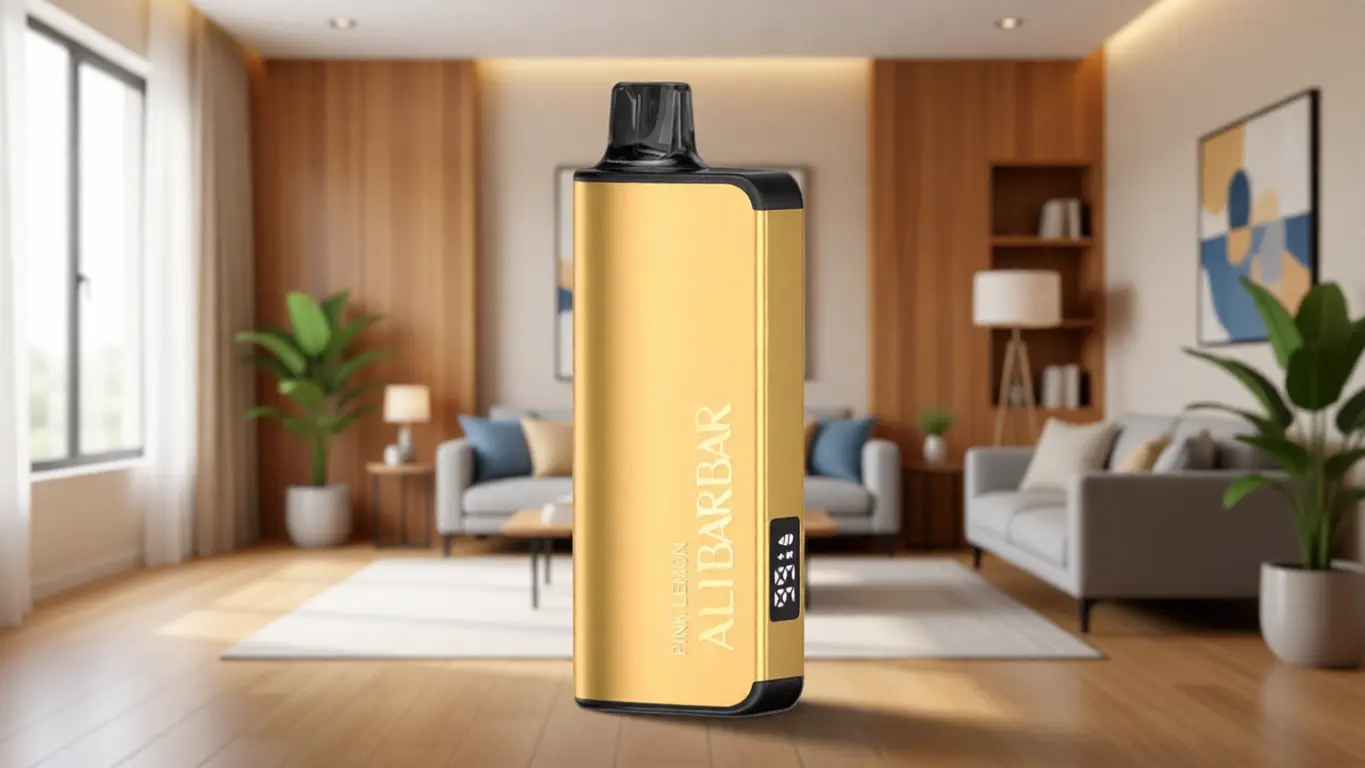
Manufacturers who treat thermal management as a primary design concern have already built the safeguards that make burnt hits rare. The ALIBARBAR range, for example, illustrates a few of these engineering choices clearly, without relying on gimmicks.
Optimised wick and coil pairing: In the ALIBARBAR INGOT 9000 and INGOT 15000, the heating element is a mesh coil — a flat, perforated metal sheet rather than a round wire — that distributes heat over a much wider surface area. This lowers the peak temperature at any single point on the wick and dramatically reduces the likelihood of localised scorching, even during a long draw. The cotton wick itself is positioned with a vertical orientation matched to the liquid reservoir’s shape, so capillary action remains efficient until the very last millilitre.
Visible liquid level: Both the INGOT series and the Ice Adjust 12000 incorporate a transparent window that lets you see exactly how much liquid remains. A surprisingly high number of burnt hits occur simply because the user had no way of knowing the reservoir was nearly dry. A visual gauge changes that.
Calibrated power delivery: These devices do not attempt to pump out maximum power at all stages. They are tuned to deliver a consistent output from the first draw to the last, with the coil receiving only the energy that the wick can reliably supply. This kind of regulation isn’t always advertised on the front of the box, but it’s the hidden architecture that separates a device that performs predictably from one that demands constant vigilance.
None of this means these devices can never deliver a dry hit if they are fully drained or pushed beyond their intended use, but the margin of safety is intentionally wider. And because OZVAPE Shop stocks factory‑certified ALIBARBAR units, what you get matches the documented specifications — no counterfeits with inferior wicking material that burns at a lower threshold.
A Framework for Evaluating Your Next Device
If you want to minimise the chance of ever tasting burnt vapour again, you don’t need to memorise every specification. Instead, apply a short diagnostic checklist to any device you consider:
Can I see the liquid level clearly? If not, you’re operating blind. You will eventually run it dry.
Does the device promise a fixed, high‑puff count without explaining how it manages wicking? Sheer capacity without efficient fluid transfer creates a dry‑hit trap in the last quarter of the device’s life.
Is the coil replaceable, or is the whole unit sealed? A sealed device that starts tasting burnt is a total loss. A modular system lets you swap out a degraded pod or coil and keep the battery, which is both economical and safer.
What do long‑term users say about the last few hundred draws? The most telling data is rarely in the spec sheet. Search for user reports on whether the flavour holds up right until the end, or whether the device turns harsh prematurely.
Is the power regulation specified? Terms like “constant output” or “regulated voltage” indicate the manufacturer has thought about the relationship between battery state and coil temperature.
When you can compare devices side by side across these criteria, the choice becomes less about branding and more about whether the engineering matches your actual routine. A platform like OZVAPE Shop that lays out specifications in a standardised format reduces the friction in that comparison — you aren’t left guessing whether a feature exists because it’s hidden in marketing language.
Common Missteps and Industry Realities
Over years of observing how people interact with personal electronic devices, a few patterns emerge that silently push users toward burnt‑hit territory. Recognising them is half the battle.
Chaining draws without pause: Wicking is not instantaneous. If you take three deep, rapid draws in succession, the second and third pulls can outrun the capillary flow, producing a burnt taste even though there is still liquid in the reservoir. This doesn’t mean the device is defective — it means the user’s rhythm exceeds the physical recovery time of the wick. High‑capacity devices with thicker wicks are more forgiving, but no device can wick at infinite speed.
Assuming puff count tells the whole story: Two devices can both claim, say, 3000 puffs, but if one uses a thin, loosely packed wick and the other a dense, structured wick, the first will deliver that burnt taste far earlier under real‑world conditions. The puff count rating is a laboratory figure taken under ideal, intermittent draws. In everyday use, a device with a poorly engineered wicking system can fail well before half its rated capacity.
Price as a proxy for safety: The market is now full of extremely affordable devices that look identical to higher‑priced models but cut costs on the quality of the cotton, the precision of the coil welding, or the consistency of the liquid formulation. A burnt hit is not always a sign of user error — it can be the inevitable result of a coil that was never properly bonded to the wick in the first place.
Ignoring the early warning signs: A device often gives notice before a full‑blown burnt hit: the flavour becomes slightly muted, or there’s a faint aftertaste that wasn’t there before. That’s the wick starting to dry out at the edges. Stopping immediately and letting the device rest for a few minutes — or replacing the pod if it’s a modular system — prevents the damage from becoming permanent.
From a manufacturing perspective, the industry is currently split between sealed disposable units built for convenience and modular systems built for longevity. The disposables, by their nature, must squeeze maximum performance from a fixed amount of material, and corners are sometimes cut in wick density and coil quality. Modular devices place the responsibility of maintenance on the user, but they also give the user the power to immediately resolve a burnt taste. This trade‑off is worth understanding before a purchase, because the device that is cheapest at the register may end up being the most expensive in terms of compromised experience.
Frequently Asked Questions
Q: Is one burnt hit dangerous?
A: For an otherwise healthy adult, a single incident of inhaling scorched cotton vapour is unlikely to cause lasting harm. The body’s natural protective mechanisms in the throat and lungs handle acute irritants efficiently. The real risk lies in repeated exposure after ignoring the warning signs.
Q: Can I keep using a device after it tastes burnt?
A: No. A burnt taste indicates the wicking material has carbonised. Once that carbon layer forms, the device will not return to normal function even if liquid is still present. Continuing to use it increases your exposure to thermal decomposition products and can damage the heating element further.
Q: What causes a burnt taste even when there’s still liquid in the tank?
A: The most common cause is poor wicking. The liquid is in the reservoir but not reaching the coil fast enough. This can happen because the liquid is too viscous, the wick is too tightly packed, or you are drawing too rapidly for the capillary action to keep up.
Q: Are certain coil materials less prone to burning?
A: Mesh coils generally distribute heat more evenly than round wire, reducing hotspot formation. The coil material itself (Kanthal, stainless steel) plays a secondary role; the physical geometry and how well it contacts the wick matter more.
Q: What should I do the moment I taste a burnt hit?
A: Stop drawing immediately. Remove the pod or coil if the device allows it, and inspect the wick. If it appears discoloured or black, dispose of it. If the device is sealed, it has reached the end of its usable life. Do not attempt to “flush out” the taste by continuing to use it.
Q: Does a burnt vape produce diacetyl?
A: Diacetyl is a buttery-flavoured compound found in some flavouring ingredients, not a typical by‑product of thermal degradation of cotton. However, the acrid components from burning wick material include a different set of irritants. The health concern from a burnt hit is not diacetyl exposure but aldehydes and fine particulates from pyrolysis.
Q: Are rechargeable devices more reliable in preventing burnt hits?
A: Not inherently. A rechargeable device with a regulated power output and a visible liquid level is more reliable than a disposable that lacks those features. However, a poorly designed rechargeable device can still burn a coil. The presence of a rechargeable battery alone is not a guarantee.
Q: How can I be sure the device I buy has quality wicking material?
A: Purchase from a retailer that sources factory‑certified inventory. Avoid deals that seem unusually low compared to the device’s standard price, as counterfeit units often substitute inferior cotton that chars at lower temperatures.
Q: Does the airflow setting affect the chance of a burnt taste?
A: Yes. A device with adjustable airflow set too tightly may not allow enough cooling air across the coil, raising its surface temperature. Opening the airflow, if adjustable, can help, but only if the wick remains saturated.
Q: What’s the most reliable indicator that a disposable is nearing its end?
A: A transparent reservoir that lets you see the liquid level is the most straightforward indicator. In sealed devices without a window, the earliest sign is usually a subtle change in flavour consistency — a slightly dry or muted taste — before the full burnt hit occurs.
Knowledge as Your Safeguard
The body’s instant rejection of a burnt taste is a remarkably honest safety mechanism. It tells you, without ambiguity, that something in the inhalation is not what the lungs were designed to process. The real question isn’t whether inhaling a burnt vape is bad for you — the answer is embedded in your own cough — but whether you will act on that signal and how you’ll choose differently next time.
Device engineering has advanced far enough that burnt hits are now a function of design choices, not an inevitable part of using portable electronic equipment. By selecting a device that gives you clear feedback about its status, maintains consistent thermal output, and uses quality materials that tolerate real‑world usage patterns, you turn a moment of concern into a one‑time learning experience rather than a recurring frustration.
At OZVAPE Shop, we have deliberately chosen to partner with manufacturers like ALIBARBAR whose products embed these safeguards into their architecture — not as marketing claims, but as factual, verifiable features. When you hold a device that shows you exactly how much liquid is left and that has been engineered to stay within its safe thermal window even as the afternoon wears on, you no longer need to second‑guess every draw. The right choice is the one that matches your actual routine, not the one with the most attention‑grabbing puff count. And when your routine includes the quiet confidence that your device was built to avoid the very problem your body already knows how to detect, you’re no longer just a user — you’re an informed participant in your own wellbeing.