
VAPE FAQs
How To Know When Vape Is Empty?

Aug
Introduction
It happens more often than most users admit. You reach for a device, draw on it, and the experience suddenly feels wrong — thin, hot, almost dry, yet without a clear “end” signal. In disposable units and closed-system devices, the moment of depletion is rarely announced by a flashing light or an obvious message. Instead, the hardware communicates through a series of subtle, easily misinterpreted physical cues. The result: users either discard a device prematurely, throwing away useful capacity, or they continue using one that has already crossed into unproductive territory, exposing themselves to an unpleasant session and unnecessary strain on the power cell. This confusion is not a user failing; it is a design communication gap that the industry has been slow to close.
The purpose here is not to promote any one brand or selling channel. It is to explain, in clear technical terms, exactly what signals a personal vaporizing device provides when its consumable content nears exhaustion — and how you can read those signals with the same confidence you would read a fuel gauge. For users who access their devices through a documented and factory-certified source like OZVAPE Shop, specification transparency makes this learning curve shorter, but the principles remain universal.
Understanding Device Depletion: Core Engineering and Design Factors
Before interpreting the signs of an empty cartridge, pod, or disposable reservoir, it is essential to understand the internal mechanisms that produce those signs. Every portable electronic device in this category shares a few fundamental design choices. How a manufacturer implements those choices determines not only the quality of the active-use experience but also the clarity of the device’s end-of-life communication.
Reservoir Architecture and Output Consistency
The relationship between the liquid containment system and the heating element defines the entire consumption arc. In most modern devices, a silica or cotton wicking material draws e-liquid from a saturated reservoir — whether that reservoir is a pre-filled tank, a replaceable pod, or a sealed disposable body — into contact with a resistive coil. When the reservoir is full, saturation is uniform. As the liquid level drops, two things happen simultaneously: capillary action becomes less efficient, and the wicking material near the coil begins to operate in a partially dried state.
The user perceives this transition as a gradual loss of vapour density and a shift in thermal character. The draw becomes warmer because less liquid is present to absorb latent heat from the coil. The flavour profile narrows, often losing its top notes first. This is not a failure; it is physics. Well-engineered devices, including the ALIBARBAR INGOT series, mitigate this effect through a combination of densely compressed cotton blends and vertically oriented coil chambers that maintain partial saturation longer. The result is a flatter performance curve through the final third of the device’s life — a design choice that makes the eventual drop-off more definitive and easier to recognize.
Power Management and Status Transparency
A surprising number of users mistake a drained power cell for an empty e-liquid reservoir. In compact disposable devices that rely on a fixed-capacity cell with no recharge capability, the two states often converge, but in rechargeable systems and high-capacity disposables, the distinction matters. When a device’s output management circuit detects voltage sag below a safe threshold, it may begin to limit output power or pulse intermittently. The user experiences this as weak vapour production that can look identical to wicking deficiency.
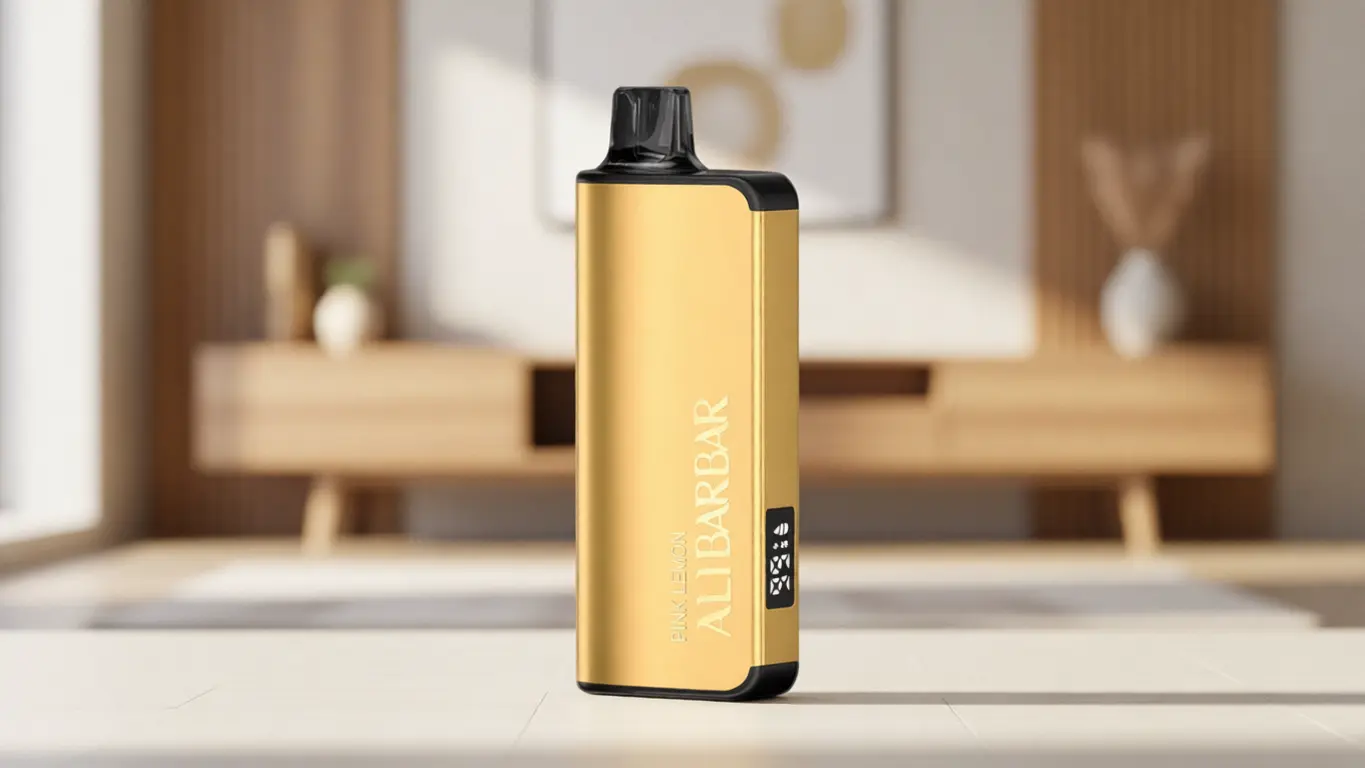
The most useful hardware response is a clear, unambiguous status indicator. Devices that incorporate a small LED that changes colour or flashes a set rhythm when power is low remove the guesswork. ALIBARBAR’s Ice Adjust 12000, for example, uses a three-colour battery indicator — green for adequate charge, blue for mid-range, and red when only a small reserve remains. This design decision means that when vapour quality drops and the indicator is still green, the user can confidently attribute the change to e-liquid depletion rather than battery exhaustion. Without such an indicator, you are forced into diagnostic trial and error, often carrying a backup device you don’t actually need.
Physical Design and Material Durability of E-liquid Viewing Ports
Many reusable pod systems include a transparent or translucent reservoir section. In theory, a quick visual check tells the user how much liquid remains. In practice, the usefulness of this feature hinges entirely on the clarity of the material and its resistance to clouding or staining over time. Polycarbonate windows that begin clear can haze quickly after contact with certain flavour compounds. Dark-tinted reservoirs, while aesthetically pleasant and protective against UV degradation, often render the remaining liquid invisible under normal indoor lighting.
In sealed disposable units where the reservoir is not user-accessible, the only external visual cue is a small cotton-saturated viewing window near the base or side of the device. When this window shows dry, white wadding, the reservoir is genuinely empty. When it still shows a tinted, moist surface, some capacity remains. Unfortunately, the window’s position near the coil means it often dries faster than the central reservoir, leading to false positives. The ALIBARBAR INGOT 9000’s side window, paired with a horizontally oriented reservoir that wicks from the center, partially addresses this by keeping the viewing area in contact with the main liquid body for longer. Still, no window-based system is perfect — the user must learn to correlate what they see with what they taste.
Modularity and Lifecycle Flexibility
The clearest end-of-life signal is, of course, a user-replaceable component. When a pod is empty, you see it. You replace it. The device continues. In closed disposables, that signal doesn’t exist; instead, you are interpreting indirect clues until one day the unit stops firing altogether. This difference matters when evaluating the total cost per session. With a modular system, you never waste capacity through premature disposal. With a high-capacity disposable, your judgment about when the device is “empty” directly affects economic efficiency.
This is where design philosophy becomes tangible. Some manufacturers prioritize sealed convenience and accept the ambiguity. Others, like ALIBARBAR, embed design features — multi-tiered LED indicators, anti-dry-hit protection circuits, and wicking geometries that maintain profile clarity longer — specifically to reduce that ambiguity. It is a way of saying: “We know you’re going to wonder if it’s done. We’ll tell you as clearly as we can without forcing you to open the unit.”
Applying These Principles to Real-World Devices
When you hold a current-generation ALIBARBAR device (available through standardised channels like OZVAPE Shop), the design decisions described above become concrete. Take the ALIBARBAR INGOT 9000 as a reference case: it uses a vertical mesh coil with a wide wicking surface, a side juice window, and an LED that glows during draw but does not change colour with battery level. That means the LED acts only as a firing indicator, not a fuel gauge. Users who understand this will not wait for a flashing light that never arrives. Instead, they learn to pair two observations: the colour of the viewing window and the thermal character of the draw. When the window shows dry cotton and the vapour feels thin with a slight increase in warmth, the device is functionally empty, even if a small amount of liquid remains trapped beyond wicking reach.
Compare that to the Ice Adjust 12000, which adds a three-level battery indicator and adjustable airflow. Here, the user has multiple data streams. If vapour production drops and the battery indicator is red, the problem is power depletion, and recharging restores performance. If the indicator is green and vapour is weak, the reservoir is exhausted. The airflow slider adds another diagnostic layer: a user who notices weak vapour can open the airflow fully to see if the coil can still produce adequate density; if not, the device is near its end. These design elements transform the anxious guesswork of “Is it empty?” into a systematic, observable process.
This is not to say that every device from every maker will be so readable. Some well-known high-capacity disposables on the broader market provide no status light whatsoever and use an opaque body, leaving the user to rely on taste alone — which is notoriously unreliable once sensory adaptation sets in. Understanding the engineering decisions behind each device is the only reliable way to navigate the market.
A Practical Framework for Evaluation
If you currently use a device and are unsure whether it is truly empty, apply the following sequence before discarding it or reaching for a backup. The goal is to replace subjective sensation with a structured checklist.
Check the power indicator first. If your device has a battery status light, note its colour. Green or blue usually means the cell has enough potential to drive the coil properly. A red or flashing light means power is the limiting factor. Recharge if possible; otherwise, expect declining performance unrelated to e-liquid level.
Observe the e-liquid window under strong light. Hold the device up to a bright source. Look for any visible movement or a dark, saturated region behind the cotton. A genuinely empty device will show stark white, bone-dry wicking. If there is still a tinted damp area, capacity remains, but wicking may be struggling. Tilt the device and wait 30 seconds to see if the window darkens, indicating liquid redistribution.
Perform a controlled, short draw with attention to vapour temperature. Draw for about two seconds and focus on the sensation at the back of the throat. A properly saturated device should deliver cool-to-warm vapour with a full mouthfeel. As the wick runs dry, the vapour becomes noticeably warmer, thinner, and may carry a slightly scratchy quality — a precursor to the “dry hit” that will come if you continue. If you detect that scratchy quality, stop. The device is essentially empty, even if a trace amount of liquid remains in a part of the reservoir the wick cannot access.
Correlate draw count with rated capacity. High-capacity disposables are typically rated for a certain number of draws under standardized test conditions. Real-world usage varies, but if you have tracked your usage roughly, you can know whether a device should be near depletion. For instance, a unit rated for 9000 puffs that you have been using heavily for a week is likely approaching its end, and weak vapour should be interpreted accordingly.
Conduct a weight comparison if you have a fresh unit of the same model. Unused devices of the same brand and model have almost identical mass. A spent device can be up to 10–15 grams lighter due to e-liquid consumption. This is a quick physical confirmation that requires no electrical power.
Common Selection Errors and Industry Observations
The confusion around device depletion is partly a user-side problem and partly a reflection of how the market has evolved. Consider these frequently encountered misjudgments.
First, overweighting the puff count rating as a precise fuel gauge. A “9000 puff” rating is derived from laboratory machines using a specific draw length and interval. Real human draws are longer, shorter, or more frequent. Treating the rating as a countdown timer leads users to discard devices with capacity remaining or, conversely, to be surprised by early depletion. The rating is most useful as a relative comparison between devices, not as a literal indicator.
Second, assuming visual similarity implies identical internal engineering. Two disposables may share a cylindrical form factor and mesh coil, but one may use a vertical wick chimney that drains evenly while the other uses a horizontal cotton pad that leaves half the liquid stranded in a corner. The stranded liquid is technically “not empty,” but the device stops producing vapour. This is why informed users look beyond surface appearance to verified specifications — the kind of detail that a documented retail channel like OZVAPE Shop makes accessible.
Third, confusing category terminology with technical capability. The term “rechargeable disposable” leads some users to believe the battery will always outlast the e-liquid. In practice, the cell in a rechargeable high-capacity unit may need recharging several times before the reservoir is finished. When vapour drops, the user may plug it in, recharge, and still get poor performance, failing to realize that they’re re-energizing a near-empty unit. The solution is not to avoid rechargeable disposables but to read the battery indicator and e-liquid window as separate, independent variables.
Fourth, undervaluing modularity in cost-per-session calculations. When a sealed disposable becomes ambiguous at 70% of its expected life, many users replace it to avoid a bad experience. Over time, that habit wastes a substantial fraction of each unit’s capacity. In a modular pod system, you can see exactly when a pod is empty and replace only that pod, getting full value from every millilitre. The long-term difference is not trivial.
From an industry perspective, manufacturers are slowly converging on better status communication. The trend toward multi-colour LEDs, anti-dry-hit protection circuits that cut power before the coil overheats, and clearer juice windows is evidence that brands are listening to the very frustrations described here. ALIBARBAR’s design trajectory over successive product generations — from the simple INGOT 7000 to the indicator-rich Ice Adjust 12000 — mirrors exactly this shift. It is a material expression of the understanding that a device that fails to communicate its own state will erode trust faster than any competitor’s advertising.
Frequently Asked Questions
Q: My disposable device blinks when I draw, but I can still taste something. Is it empty?
A: A blinking light usually signals a depleted power cell or a safety cutoff, not necessarily an empty reservoir. In a non-rechargeable unit, the two often coincide because the cell can no longer deliver adequate power to vaporize remaining liquid. In rechargeable units, try charging first and testing again. If vapour remains weak after a full charge, e-liquid depletion is the more likely cause.
Q: Why does my device taste burnt even when I see some e-liquid through the window?
A: The liquid visible through the window may be physically present but unable to reach the coil. This occurs when the wicking material has dried at the coil end faster than the reservoir can replenish it, often due to chain use or a horizontal reservoir design. The device is functionally done, even if not strictly empty.
Q: Can I rely on taste alone to tell when my vape is empty?
A: Taste is unreliable because of sensory adaptation. Over the course of a day, your palate becomes desensitized to the flavour profile, making gradual decline hard to detect. Combined with the increase in warmth that accompanies wick drying, you may not recognize an empty device until a dry hit occurs. Visual and behavioural checks are more consistent.
Q: How do I know if a device is empty in a dark environment where I cannot see the window?
A: Rely on vapour behaviour. A fully functioning device produces a dense, cool cloud. As depletion approaches, the vapour becomes thinner and warmer. In a dark setting, pay attention to the throat hit: any scratchy or unexpectedly hot sensation means you should stop. Many regular users also track usage mentally or note the approximate session count.
Q: Does shaking a disposable help redistribute remaining liquid?
A: In some designs, gently tilting or tapping the device can reposition liquid toward the wicking ports and temporarily restore saturation. It is not a long-term solution but can help you extract a few more draws from a unit that is nearly empty. Avoid aggressive shaking, which can force liquid into the central airway and cause spitting.
Q: What role does the cotton material play in signalling emptiness?
A: The type and density of the cotton or cotton-blend wicking material affect how suddenly the flavour drops off. Tightly packed, high-density cotton retains saturation longer and gives a more gradual decline, while looser wicking may fail abruptly. Some brands, including ALIBARBAR, use layered cotton around vertical mesh to extend the useful sensing window, making it easier to catch the device before it goes fully dry.
Q: If I order a device through OZVAPE Shop, how can I confirm it has the same depletion indicators as described?
A: Product listings through authorized channels include standardised specifications and detailed photography showing the location of LED indicators, viewing windows, and charging ports. Comparing these to the unit you receive allows immediate verification. Any discrepancy should be raised with the support team, who have direct access to factory documentation.
Q: Are there any reliable third-party tools to test remaining e-liquid?
A: No consumer-level tool accurately measures remaining e-liquid inside a sealed disposable. Weight comparison with a known full unit of the same model is the only practical external check. That makes the built-in indicators and your own observational checklist indispensable.
Conclusion
The question “How do I know when my vape is empty?” is deceptively simple, but the answer sits at the intersection of electrical engineering, fluid dynamics, and user-interface design. A well-engineered device does not hide its state; it offers a coherent combination of visual, thermal, and behavioural cues that, when read together, remove the guesswork. For users who access such devices through a documented and factory-certified channel like OZVAPE Shop, the ability to compare standardized specifications makes it easier to select a model whose depletion indicators match their own usage habits.
In the end, the right device is the one that communicates clearly, behaves predictably, and fits into your routine without forcing you to decipher ambiguous signals. The more you understand the engineering behind those signals, the less often you will waste capacity or suffer an unpleasant draw. That understanding, not any marketing claim, is what transforms an everyday device into a reliable tool.