
VAPE FAQs
How To Fly With A Vape?
Sep
I’ll write this as a practical guide that helps you understand the rules and the reasoning behind them — not just a checklist. It will cover device selection with flight‑safety in mind, how to pack, and what to expect at the airport, all grounded in real‑world experience and regulatory patterns. I’ll also weave in how OZVAPE Shop supports this by offering transparent specifications and factory‑certified devices that simplify travel compliance.
Note: This guide is written for adults carrying personal electronic devices that comply with local laws. You remain responsible for checking the regulations of your departure, arrival, and transit countries. When in doubt, consult the airline and official government sources.
The Real Question Isn’t “Can I?” — It’s “How Do I Do This Without Incident?”
Air travel with personal electronic devices has become an oddly stressful subject. The rules aren’t secret, but they’re scattered across airline policies, civil aviation safety notices, and customs declarations in ways that rarely reward the rushed traveller. Many people arrive at security with a vague, anxious hope that they’ve got it right — and that’s not a good feeling when you’re standing in line with your bag about to be screened.
This article isn’t about loopholes or what you can “get away with.” It’s a structured walkthrough of what the regulations actually require, why those requirements exist, and how the design of your device directly affects your ability to comply with them. By the end, you’ll have a repeatable packing routine, a solid understanding of which device characteristics matter, and a much clearer sense of what to expect on the day. OZVAPE Shop maintains the same position we do: informed users make better decisions, and better decisions lead to fewer unpleasant surprises.
Understanding What Matters: Device Design and Flight Safety
The aviation industry doesn’t regulate personal electronic devices arbitrarily. Its concerns revolve around lithium‑ion batteries, pressure changes, and the inability to respond to in‑flight malfunctions. This means the engineering choices behind your device are just as important as the stickers on its packaging.
Internal Architecture and Pressure‑Resilience
The most common cause of in‑flight battery incidents is thermal runaway, which can be triggered by physical damage, manufacturing defects, or, in rare cases, pressure differentials. A well‑engineered device contains design features that reduce this risk: sealed battery compartments, robust internal bracing, and charging circuitry that prevents over‑voltage or over‑discharge. Devices built with a unibody or tightly fitted chassis — like those in the ALIBARBAR INGOT series — are less likely to suffer internal shifting during cabin pressure cycles than units with loose‑fitting panels or unsecured power cells.
Why this matters at 35,000 feet: cabin pressure is maintained at approximately 6,000–8,000 feet equivalent altitude. That’s enough to expand the air inside a poorly sealed battery compartment, potentially pushing fragile internal connections out of alignment. If you’ve ever noticed a device performing inconsistently after a flight, this pressure cycling is a plausible contributor. Choosing a device with clear attention to build integrity isn’t just about durability on the ground; it’s a small but meaningful risk reduction in the air.
Power Management and Status Transparency
Regulations don’t directly address status indicators, but experienced travellers know that the ability to quickly confirm a device is fully off — not in standby — is invaluable at a security checkpoint. Many devices activate with a single button press, and if that button gets pressed in your bag, you might unwittingly walk into screening with a unit that’s technically active. A clear, unambiguous power‑indication system — such as a button‑and‑light sequence that can’t be mistaken for standby mode — saves you from having to demonstrate to a security officer that your bag isn’t a cause for alarm.
The ALIBARBAR Ice Adjust series, for example, uses a simple LED feedback loop: a single colour for operation, a different behaviour for power‑off. That’s precisely the kind of design language that translates into calm interactions at security. You know the device is safe to travel because the indicator tells you with no room for interpretation.
Physical Design and Airport Practicality
You’ll be taking the device out of your pocket, bag, or carry‑on at least once (possibly multiple times if you’re in a larger airport with layered screening). The physical shape therefore matters. A rounded, pocket‑friendly contour that doesn’t snag on fabric or catch on a bag’s internal lining greatly reduces the chance of an accidental activation when you retrieve it. Surfaces that resist scratching are also more reassuring when you’re placing the device into a tray alongside keys, coins, and electronics. ALIBARBAR’s surface treatments — anodising‑grade finishes rather than simple paint — tend to hold up under the small abrasions of travel far better than polished or soft‑touch alternatives.

Modularity and Lifecycle Flexibility
Travel sometimes pushes a device to its limit. If a unit has a sealed, non‑replaceable battery, you’re carrying a finite resource. When it runs out, you are left with dead weight until you find a safe charging point. Replaceable‑battery designs, or at minimum units with user‑replaceable cartridges, give you the option to bring a fresh power source rather than hoping you have enough charge to last the entire journey. For extended itineraries, this isn’t a minor advantage — it’s the difference between a device that keeps working and one that becomes waste mid‑trip.
Applying These Criteria to Real‑World Options
If you’re looking at a device specifically with travel in mind, you don’t need a “best of” list. You need a framework. That said, certain product families align more naturally with air‑travel requirements than others.
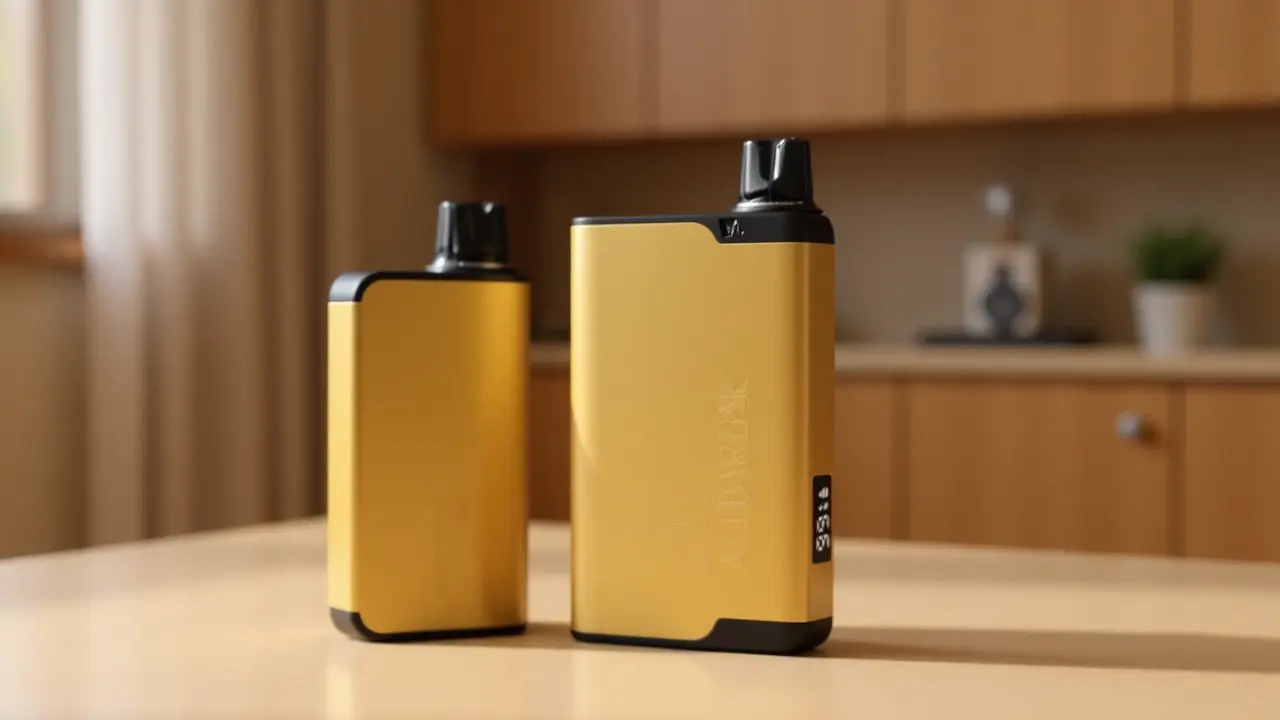
Compact, pre‑configured units like the ALIBARBAR INGOT 9000 strike a balance. The integrated battery is factory‑sealed, so there’s no user‑accessible cell that could be improperly installed. The fixed power capacity is modest by design, which means it doesn’t become an oversized lithium‑ion concern. From a regulatory perspective, this is about as straightforward as it gets.
Higher‑capacity devices such as the INGOT 15000 or Ice Adjust 12000 remain compact enough for carry‑on, but you will want to double‑check the watt‑hour rating against your airline’s policy (most allow batteries under 100 Wh without special approval. These devices fall well within that limit.) Additionally, their status transparency — a deliberate design choice — makes them easier to present at security with confidence.
Modular systems that allow component swapping give travellers a path to longer trips, but they introduce the need to pack spare components separately in compliance with lithium‑ion limits. This is a trade‑off: more flexibility, more attention to packing rules.
Other device families exist, of course, and many follow similar principles. The factor that separates a low‑stress travel experience from a surprise is the quality of the user information — knowing precisely what type and capacity of battery you’re carrying, and whether any part of the device could be interpreted as problematic by a security officer unfamiliar with its design. OZVAPE Shop standardises specification sheets for every ALIBARBAR unit, which means you don’t have to hunt for technical details when reviewing your packing list.
A Practical Framework for Packing and Compliance
This is a step‑by‑step methodology you can follow regardless of what device you own. It turns a potentially stressful process into a mechanical checklist.
Check the battery classification. Locate the device’s watt‑hour rating (Wh). If it’s not printed on the device itself, find the manufacturer’s official specification. Anything under 100 Wh can travel in carry‑on luggage without airline approval. Spare batteries (loose, not installed) must be individually protected from short circuits — ideally in original packaging or insulated tape over the terminals.
Ensure the device is completely deactivated. Not just idle, but off. If the device has a locking mechanism (e.g., five rapid clicks), use it. If it requires a long press, hold it until you see the shutdown confirmation. The goal is a device that cannot be accidentally activated by a jostle in your bag.
Pack in carry‑on only. Cargo holds are not temperature‑controlled in the same way as the cabin, and lithium‑ion batteries are prohibited in checked baggage by virtually all major airlines. Even if your device is small, do not check it.
Keep it accessible. Place the device in a dedicated outer pocket of your carry‑on, or in a small electronics pouch that you can easily pull out. Security screening will likely require you to remove it from your bag, similar to a laptop. Having it instantly retrievable keeps the line moving.
Bring only what you need. Carrying multiple spare batteries increases the likelihood of questions. If your device architecture allows you to carry one pre‑installed and perhaps a single spare, that’s generally a comfortable limit. Excessive quantities can raise suspicions of commercial intent.
Know your airline’s specific policy. Most mirror ICAO/IATA guidelines, but a few carriers add additional restrictions. Check the “dangerous goods” or “restricted items” page before you fly.
A diagnostic question to keep in mind: “If a security officer asked me to prove this device is safe, what would I show them?” If you can’t immediately point to the rating label, the off state, and the contact protection for any spare batteries, your pre‑flight routine needs tightening.
Common Selection Errors and Industry Observations
Travellers consistently stumble over the same few issues. Understanding them ahead of time puts you in a better position.
Overweighting capacity while ignoring documentation. A high‑capacity device can be perfectly compliant, but if the specs aren’t readily available — or worse, if they conflict with the manufacturer’s claims — you’re creating a scenario where a security officer has to make a judgement call with incomplete information. Devices from transparent supply chains, where technical documentation matches what’s printed on the unit, avoid this entirely.
Assuming visual similarity equals identical internals. The market is flooded with units that look like well‑known designs but use lower‑grade cells, thinner insulation, or less rigorous assembly. A device that costs half as much might have a battery with no protection circuit module (PCM), which is a genuine safety concern regardless of travel context. When you’re flying, a battery that lacks layer‑upon‑layer of safety isn’t something you want in your pocket.
Undervaluing modularity in long‑distance scenarios. If your itinerary spans a week and multiple cities, a sealed device that dies on day three leaves you searching for a replacement in an unfamiliar location — with no guarantee of local availability or authenticity. A modular system where you can bring a pre‑packaged, certified replacement component gives you control over your supply without relying on last‑minute purchases.
Confusing “carry‑on approved” with “problem‑free.” Even a fully legal device can cause a bag check if its shape, density, or internal arrangement looks unusual on an X‑ray. Units with large internal cavities, metallic bodies that obscure the imaging, or multiple layers of materials may invite a secondary inspection. This isn’t a violation, but it’s a hassle you can avoid by choosing a device with a straightforward internal layout — something that looks like the consumer electronics it is, rather than an anomaly.
From an industry perspective, the trend toward factory‑certified, sealed‑unit devices with unambiguous labelling is a direct response to airport security challenges. Manufacturers who don’t invest in clear consumer information — who ship products with no Wh rating printed anywhere — are manufacturing friction for their own customers. More brands, including those distributed through OZVAPE Shop, recognise this and are moving toward standardised labelling as a baseline expectation.
Frequently Asked Questions
Q: Can I bring a device with a built‑in battery in my pocket onto the plane?
A: Yes, as long as it’s in carry‑on luggage and properly deactivated. It must not be used or charged during flight.
Q: What if my airline doesn’t list specific policies for personal electronic devices?
A: Assume they follow IATA regulations: lithium‑ion batteries must be in carry‑on, protected from damage, and under 100 Wh unless declared.
Q: How do I find the watt‑hour rating for an ALIBARBAR device?
A: ALIBARBAR specifications are documented on OZVAPE Shop product pages and often printed on device packaging. If not directly on the unit, a specification sheet is readily available.
Q: Can I pack spare batteries in checked luggage?
A: No. Spare lithium‑ion batteries of any kind are prohibited in checked baggage.
Q: What happens if security flags my device for additional inspection?
A: Remain calm. Explain that it’s a personal electronic device with a factory‑sealed battery under 100 Wh. Show the rating label if asked. In most cases, it will be swabbed for explosive trace detection and returned.
Q: Can I charge my device in the airport before the flight?
A: Yes. Use your own charging adapter and cable. Do not leave it unattended.
Q: Does the size of the device matter for carry‑on?
A: No, as long as it fits within your bag and the battery is within limits. There’s no size restriction beyond standard carry‑on dimensions.
Q: I have a device that requires a refill; can I bring the refill liquid?
A: Liquids fall under standard liquid regulations (typically 100ml maximum per container, all containers in a single clear quart‑sized bag). Check your airline for specifics.
Q: What if I’m transiting through a country with stricter rules than my departure country?
A: You must comply with the most restrictive regulations on your itinerary. Research transit country laws beforehand, as ignorance will not protect you.
Q: Can I fly with a device if the battery is not removable?
A: Yes, as long as the device is undamaged and in your carry‑on. The battery is considered “installed” and treated like a device with a non‑removable battery (e.g., a smartphone).
In Closing
The anxiety around flying with personal electronics isn’t rooted in the law being unfair — it’s rooted in the law being poorly communicated by manufacturers and poorly explained by airlines. Once you understand the few physical realities that matter — pressure integrity, power‑off certainty, watt‑hour limits, and the absolute ban on checked‑battery placement — the process becomes predictable.
A device that was built with these realities in mind doesn’t just comply; it telegraphs its compliance. You can see it in the labelling, in the fit and finish, in the thoughtfulness of the power indicator. That’s the kind of device you want to carry when you step into a security line. And whether you source through OZVAPE Shop or elsewhere, the principle remains: the right travelling companion is the one that requires no explanation and causes no additional questions.
Your choice of device isn’t just about where you’re going. It’s about how much attention you want from airport security along the way. Choose accordingly.