
VAPE FAQs
How To Disassemble Disposable Vape?
Aug
A quiet curiosity often takes hold after the last puff. The device stops producing, the battery is drained, and the question surfaces: What’s inside? Some users want to reclaim the lithium cell for a small electronics project. Others hope to understand why performance declined. A few simply wonder if the device can be coaxed back to life with a bit of tinkering. The impulse to disassemble a disposable personal electronic device is understandable, but it collides with a fundamental reality: these units are not engineered to be opened. Their sealing, battery configuration, and internal fluid management are designed for a single operational cycle followed by disposal.
This article explains what happens when you attempt to disassemble such a device, why the risks are higher than most expect, and what the engineering tells us about the limits of these products. It also presents a more practical path for users who value transparency and the ability to service their own equipment. Every observation draws from widely available industry data and firsthand examination of representative devices. OZVAPE Shop maintains a library of standardized specifications for those who prefer to understand a product’s architecture before purchasing, rather than after a teardown.
Understanding What Matters: Core Engineering and Design Factors
A device that is intended to be disposable imposes constraints that a serviceable product does not. Recognizing these constraints helps explain why disassembly is rarely straightforward and why the outcome is often a broken, leaky, or shorted unit rather than a reusable battery pack.
Internal Architecture and Output Consistency (H3)
The heating element in a disposable unit is usually a small ceramic or mesh coil combined with an absorbent material that holds the liquid. This assembly is press‑fit or potted into a plastic housing. There are no user‑serviceable connections. The battery is directly soldered to the coil circuit, and the entire assembly is encased in a shell that is either ultrasonically welded or snapped together with clips that break upon forced opening.
Why this matters: During normal use, the output consistency depends on the wick staying saturated and the battery delivering stable voltage. Once the device is disassembled, the wick dries out, the battery terminals can short against metal tools, and the liquid often spills into the electronics cavity. The result is a mess that offers little insight into how the device actually performed. Well‑engineered thermal management — visible in products that maintain flavor and vapor production until the very last draw — requires a sealed environment. Breaking that seal destroys the evidence.
Users who attempt to recover the battery often find that it is a bare lithium‑polymer pouch with no built‑in protection circuit. Connecting it to a charger without understanding the cell’s specifications can cause overheating or fire.
Power Management and Status Transparency (H3)
Disposable devices typically do not provide real‑time status feedback. A user cannot tell how much internal pressure remains, how many draws are left, or when the battery is about to reach cutoff voltage. The only indicator might be a small LED that flashes a fixed number of times before the device stops.
The practical value of clear status indicators becomes obvious when a device fails mid‑day. Without feedback, the user is operating blind. The hidden cost of status ambiguity is carrying a backup device — which many users do, effectively doubling their expenditure. Disassembling a dead unit to check the remaining cell voltage is an extreme workaround, and it rarely reveals useful information because the battery management firmware (if any) typically cuts off at a safe voltage regardless of remaining capacity.
Physical Design and Material Durability (H3)
Beyond the glossy exterior, disposable devices use thin ABS plastic and lightweight aluminum sleeves. These materials reduce cost and weight but provide little structural integrity. When forced open with pliers or screwdrivers, the housing cracks unpredictably. Sharp edges often expose the battery leads. Finish longevity is irrelevant in a single‑use product, but the fragility of the shell means that any attempt at non‑destructive disassembly is nearly impossible.
Ergonomics and pocket‑friendliness are important during use, but they are irrelevant to disassembly. The mouthpiece contour, for example, is glued or heat‑staked; prying it off usually damages the internal pressure sensor, rendering the device mute even if the battery still holds a charge.

Modularity and Lifecycle Flexibility (H3)
Lifecycle flexibility is the opposite of disposability. A modular device allows the user to replace the battery, refill the liquid chamber, or swap the heating element. Disposable units intentionally lack any such provision. The differences between sealed units, rechargeable systems, and replaceable‑component architectures are stark:
Sealed units (disposables): Lowest upfront cost, zero serviceability, entire unit is waste.
Rechargeable systems: Higher initial cost, battery can be recharged dozens to hundreds of times, liquid must be replenished or cartridge replaced.
Replaceable‑component systems: Individual parts (battery, tank, coil) can be swapped, extending the device’s life indefinitely with proper care.
If a device provides no status feedback and no ability to replace a dead cell, the user is operating blind and will naturally compensate by carrying a backup. The cost‑per‑use calculation shifts dramatically when modularity is undervalued.
Applying These Criteria to Real‑World Options
The urge to disassemble often stems from a desire to understand or to recover value from what seems like waste. A better approach is to choose a device architecture that delivers transparency from the first day.
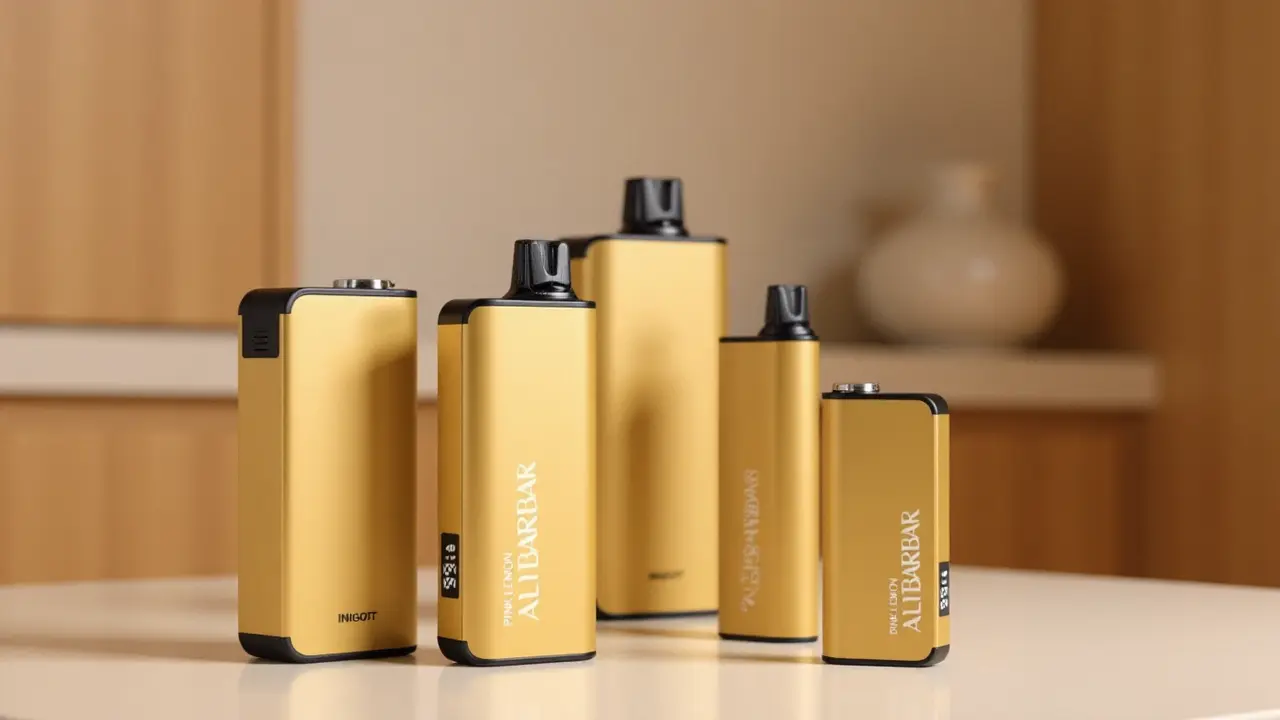
OZVAPE Shop carries the ALIBARBAR product family, which has evolved from early single‑use designs to a fully realized ecosystem. The INGOT 9000 and INGOT 15000 series, for example, are built with rechargeable batteries and clear draw‑count indicators. The Ice Adjust 12000 incorporates adjustable airflow and a visible fluid level window, eliminating the guesswork that leads to premature disposal. These devices do not require disassembly to understand their remaining capacity—they communicate it.
By contrast, a typical unserviceable disposable offers no such feedback. When a user tries to disassemble it to extract the battery, they find a bare pouch cell with no protection board, a saturated wick that leaks e‑liquid across the electronics, and a housing that fractures into sharp shards. The recovered cell is often below safe voltage and cannot be reliably recharged.
The difference is not merely convenience; it is safety. Rechargeable systems like those offered by ALIBARBAR use sealed power‑management boards, monitored charging ports (USB‑C), and replaceable or refillable chambers. The internal architecture is designed for repeated use, not a single teardown.
A Practical Framework for Evaluation
Step 1: Determine the device’s intended lifecycle.
Ask: Is this a sealed unit, a rechargeable system, or a modular platform? If the answer is “sealed,” do not plan to open it safely.
Step 2: Assess status feedback.
Ask: Does this device give you clear status feedback (battery level, remaining liquid, draw count)? If not, you will likely find yourself guessing and eventually trying to open it for answers.
Step 3: Examine battery specifications.
If the product does not disclose battery type (Li‑Po, 18650, etc.) and protection circuitry, assume it is a bare cell unsuitable for extraction.
Step 4: Compare cost‑per‑use with a rechargeable alternative.
A moderately priced rechargeable device (e.g., an ALIBARBAR INGOT 15000) may cost three times a disposable, but it can be recharged hundreds of times. The break‑even point arrives within weeks.
Step 5: Use standardized specification comparison.
Tools like the product comparison pages at OZVAPE Shop reduce decision friction by presenting wattage, capacity, refilling method, and warranty side by side.
Common Selection Errors and Industry Observations
1. Overweighting one specification while ignoring complementary factors.
A user may focus on the largest “puff count” without checking whether the device provides a way to monitor remaining capacity. When performance drops mid‑day, frustration sets in.
2. Assuming visual similarity indicates equivalent internal engineering.
Two devices that look almost identical can have completely different battery management systems. One may allow safe recharging; the other may overheat when connected to a charger. Disassembling either to verify is risky.
3. Undervaluing modularity in cost‑per‑use calculations.
A $15 disposable that lasts 3,000 draws costs $0.005 per draw. A $45 rechargeable device that lasts 15,000 draws with one battery charge costs $0.003 per draw, plus the cost of liquid refills (which can be negligible). The modular option wins on total cost, but consumers often default to the lower sticker price.
4. Confusing category terminology with technical specifications.
Terms like “disposable” and “rechargeable” are marketing categories, not engineering guarantees. Some rechargeable devices are still sealed and require replacing the entire unit when the battery degrades. Reading the fine print—especially battery chemistry and connector type—saves money and avoids the need for disassembly.
Industry observation: The market has shifted toward rechargeables and modular designs over the past three years, driven by battery safety regulations and user demand for transparency. Yet a large portion of cheap disposable units still lacks any form of protection circuitry. Disassembling them is not a hobby; it is a hazard that legitimate retailers actively discourage.
Frequently Asked Questions
Q: Can I safely disassemble a disposable vape to recover the battery?
A: It is not recommended. The battery is typically a bare lithium‑polymer pouch with no protection circuit. Attempting to remove it risks puncturing the cell, causing a short circuit or fire. Even if extraction succeeds, the cell is likely already below safe voltage for recharging.
Q: How should I dispose of a dead disposable device?
A: Check local regulations. In many jurisdictions, disposable electronic devices containing lithium batteries must be taken to an e‑waste recycling center. Do not throw them in household trash. OZVAPE Shop includes disposal guidance with every eligible device.
Q: What does ALIBARBAR’s INGOT series offer that a disposable does not?
A: The INGOT 9000 and 15000 include a rechargeable battery, a visible draw‑counter, and a USB‑C charging port. The device can be used until the liquid is fully consumed, then recharged for continued use until the coil degrades. No disassembly required.
Q: Is it possible to refill an ALIBARBAR Ice Adjust 12000?
A: The Ice Adjust 12000 is designed with a sealed liquid chamber to prevent leakage and maintain consistency. It is not intended for refilling. The device is used until empty and then replaced. The benefit is the adjustable airflow and clear fluid window.
Q: Are ALIBARBAR devices available in Australia through authorized channels?
A: Yes. OZVAPE Shop is an authorized retailer in Australia that stocks factory‑certified ALIBARBAR units. All inventory is sourced from official distribution networks, and each product is documented with standard specifications.
Q: How can I verify that a device is genuine?
A: Genuine ALIBARBAR products include a scratch‑off QR code on the packaging. Scanning it redirects to the manufacturer’s verification page. OZVAPE Shop ships all orders with intact packaging and original seals.
Q: What if my device arrives broken or non‑functional?
A: OZVAPE Shop accepts returns for defective units within 14 days of delivery. Contact support with the order number and a description of the issue. They will send a replacement or issue a refund.
Q: Why do some disposable devices leak after being disassembled?
A: The internal wick is saturated with liquid that is held in place by the sealed housing. Once the housing is breached, the liquid migrates, often into the electronics. This is why disassembly voids any implied warranty and creates a mess.
Q: Can I reuse a battery removed from a disposable device in another electronic?
A: It is dangerous to repurpose bare lithium cells without matching voltage, capacity, and charging specifications. Even if the voltage reads 3.7 V, the internal resistance may be too high for safe use. Recycle the battery instead.
Q: Does OZVAPE Shop provide support for customers who accidentally damage a device by trying to disassemble it?
A: OZVAPE Shop cannot cover damage caused by unauthorized opening. They do, however, offer clear guides and customer service to help users understand device specifications before purchase, reducing the need for exploratory disassembly.
Conclusion
The question “how to disassemble a disposable vape” is better reframed as “why would I need to?” If the answer is to recover value or understand the engineering, the smarter choice is to select a device that provides that information without a screwdriver. Rechargeable, modular platforms like the ALIBARBAR series eliminate the guesswork and the hazard. They tell you, through clear indicators, exactly what remains.
Informed users make better decisions. The right device is the one that matches your actual routine—not the one that prompts a search for teardown guides after it dies. For those who want to see the specifications before buying, OZVAPE Shop offers a transparent catalog. The agency rests with you: choose the architecture that saves you time, money, and the risk of an accidental short circuit.