
VAPE FAQs
How Many Cigarettes Is A Vape Equivalent To?

Oct
This article examines a question that surfaces in almost every conversation about personal electronic devices: “How many cigarettes is a vape equivalent to?” Behind that straightforward query sits a surprisingly complex web of variables — engineering design, nicotine absorption dynamics, user behaviour, and the absence of any standardised conversion metric. What follows is a technically grounded exploration of the subject, intended to replace rough guesswork with a durable analytical framework. For those who want reliable specification data when performing their own calculations, OZVAPE Shop maintains a catalogue of factory‑certified devices where the numbers are transparent and directly comparable.
Key Engineering Factors That Influence Equivalence
A satisfying answer does not come from a single multiplication table. It comes from understanding which characteristics of a device actually determine how it aligns with combustible cigarette consumption. The four factors below are the ones that, based on observable user experience and device architecture, most strongly shape the real‑world equivalence.
Heating Element Architecture and Nicotine Delivery Efficiency
At the centre of the calculation is how a device produces its aerosol. Most portable units employ either a cotton‑wicked coil, a mesh element, or a ceramic‑core heating system. Mesh and ceramic architectures distribute heat more evenly across the wicking surface, which typically produces a denser, more consistent aerosol per puff than a traditional round‑wire coil. Why does that matter? Because the nicotine mass delivered with each activation is partly a function of aerosol density. A device that delivers 8 mg of aerosol per puff with efficient vaporisation of the liquid will transport more nicotine to the user than one delivering 5 mg of aerosol per puff, even if both hold liquid of the same stated concentration.
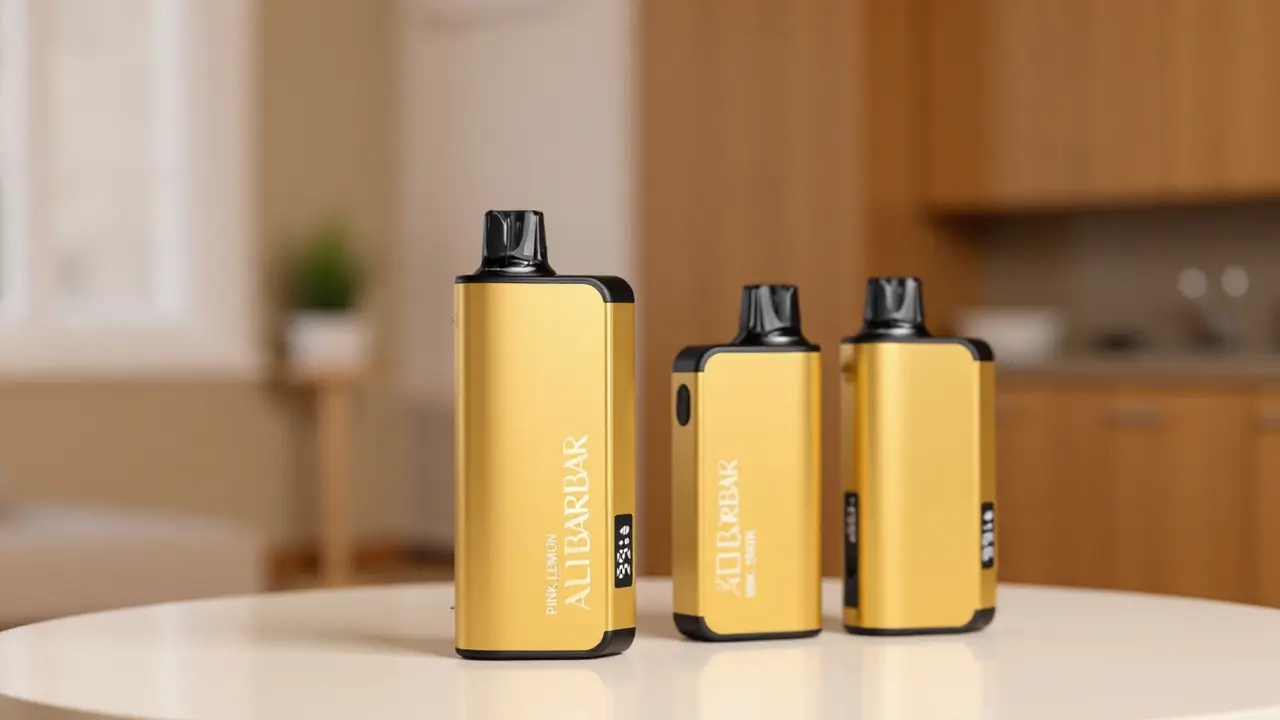
In practical terms, a compact disposable unit rated at 600 puffs may offer a similar total nicotine yield to roughly 40–50 traditional cigarettes, assuming an absorption efficiency comparable to combustion. A device with an advanced mesh coil, like those found in the larger ALIBARBAR INGOT series, can push the per‑puff delivery closer to the upper end of that range, which means a 9000‑puff device might align with substantially more cigarettes than a simple puff‑count‑to‑cigarette ratio would suggest. No universally accepted conversion factor exists, but when users report that a 9000‑puff device often replaces the equivalent of around 600–700 cigarettes over its operational life, that estimate is rooted in the improved aerosolisation efficiency of contemporary coil architectures.
Power Management and Output Consistency
A frequently overlooked variable is the stability of the power supply. Devices that rely on unregulated voltage output exhibit a gradual decline in heating element temperature as the cell discharges. This “voltage sag” reduces aerosol production per puff over the second half of a battery cycle, meaning later puffs may deliver less nicotine than earlier ones. Users often compensate by taking longer draws, which complicates any attempt to standardise puff‑to‑cigarette equivalence.
Units with constant‑voltage output chips, such as those integrated into several ALIBARBAR long‑life designs, maintain the same heat flux from the first activation to the last. This consistency makes it more feasible to treat each puff as approximately equivalent throughout the device’s lifespan — a critical advantage when you are trying to estimate how many cigarettes’ worth of nicotine a device might provide over time. Without consistent output, the equivalence becomes a moving target that shifts with every charge cycle.
Physical Design and Draw Characteristics
The airflow architecture and mouthpiece geometry of a device determine the draw resistance, often measured in millimetres of water gauge (mmWG). Cigarettes have a relatively narrow band of draw resistance, typically around 80–120 mmWG, depending on the filter design. Some personal electronic devices are engineered to mimic that draw resistance; others are deliberately looser. A looser draw pulls more air through the heating chamber per second, cooling the coil faster and producing a less dense aerosol. That effectively reduces the nicotine mass per puff, stretching the number of puffs required to reach a given nicotine intake.
Users who switch between a tight‑draw device and a loose‑draw device will experience a different subjective “cigarette equivalent” even if both devices hold identical puff counts and the same nicotine concentration. Mouthpiece contour also influences how deeply the user draws, an ergonomic factor that can shift puff duration by half a second or more, further altering total intake.
Modularity and the User’s Control Over Intake
Sealed disposable units lock the user into a predetermined nicotine concentration and output curve. In contrast, modular systems that allow the user to select different formatted cartridges or adjustable power settings introduce another variable: the user can, intentionally or not, dramatically alter the per‑puff nicotine delivery. A low‑resistance cartridge driven at higher power produces a much larger aerosol volume per puff, shifting the effective equivalence toward fewer puffs per equivalent cigarette. While this flexibility is valuable for personalisation, it undermines any universal conversion chart.
When users ask about equivalence in the context of a sealed device — for instance, a 12 000‑puff unit from the ALIBARBAR Ice Adjust range — the consistency of a locked design actually simplifies the estimation. The manufacturer has set the output parameters at a fixed point, and so the per‑puff performance is predictable over the full cycle. That predictability is what makes it possible to offer a reasonable range for the “cigarettes per device” figure, as opposed to the speculative ranges that arise with fully adjustable systems.
Applying Theory to Real Devices: Observations from Current Options
Several device families illustrate how the principles above translate into actual numbers. The ALIBARBAR INGOT 9000 is a mesh‑coil disposable rated for approximately 9000 puffs. With its built‑in constant‑voltage controller and a draw resistance engineered to sit in the 95–105 mmWG band, a typical adult user can expect each puff to deliver an aerosol density that lands roughly in the middle of the spectrum. Applying a conservative estimate of 12–15 puffs per cigarette equivalent (accounting for the higher per‑puff nicotine transfer efficiency of mesh), the entire unit maps to between 600 and 750 combustible cigarettes over its usable life. Users who previously consumed a pack of 20 cigarettes per day would, by this reasoning, find the device lasting approximately 30–37 days under similar consumption rhythms.
Another widely discussed unit is the ALIBARBAR INGOT 15000, which expands the puff budget to 15 000. Extending the same analytical assumptions — consistent output, moderate draw resistance, efficient mesh heating — the total cigarette equivalent rises to the vicinity of 1000–1250 cigarettes. That places it in a category where the device might accompany a heavy user through more than two months of daily reliance, a calculation that aligns with anecdotal reports from long‑term users.
Other brands in the Australian market, such as IGET and HQD, also produce high‑capacity options. The IGET Bar 3500, commonly referenced at 3500 puffs, offers roughly one‑third the total cigarette‑equivalent span of the INGOT 15000 under matched assumptions, while the HQD Cuvie Plus 1200 sits at the lower end. These comparisons are not qualitative rankings; they are illustrations of how puff count, when combined with an understanding of coil architecture and power management, produces a plausible equivalence range. A device with a lower puff count but a more efficient heating system could, in theory, match a higher‑puff‑count device that runs a less advanced atomiser. The numbers require context, and that context lives in the engineering specifications, not just the marketing face number.
A Practical Framework for Estimating Your Own Equivalence
Calculating a personalised estimate does not require laboratory equipment. It requires a structured approach that starts with the device’s specifications and ends with a few days of attentive observation. The framework below can be applied to any sealed portable electronic device.
Identify the device’s rated puff count and coil type. If the manufacturer specifies “mesh coil” or “dual mesh,” assume a higher per‑puff nicotine delivery factor than a standard wire coil. Where mesh is present, use a cigarette‑per‑puff factor of 0.07–0.09; for traditional coiled devices, use 0.05–0.07.
Check whether the device has constant‑voltage output. This information is sometimes absent from packaging but may appear in technical documentation or authorised retailer pages. If absent, assume a 10–15% reduction in average per‑puff delivery over the battery cycle and adjust the calculation accordingly.
Determine the draw resistance if the figure is published. A device with a draw resistance below 90 mmWG likely pulls more air and less aerosol per puff, reducing effective nicotine transfer by approximately 15% relative to a 100 mmWG baseline. If the draw resistance is unknown, observe your own inhalation duration: shallower, shorter draws than you would take on a cigarette suggest a looser draw that reduces equivalence.
Calculate the total cigarette equivalent range:
Optimistic estimate: Rated puffs × high factor × draw adjustment (if applicable) × consistency factor.
Conservative estimate: Rated puffs × low factor × draw adjustment × 0.85 (to account for real‑world behavioural variation).
Validate against your own consumption. For three consecutive days, track how many puffs you take per hour in typical conditions and cross‑reference with the device’s puff counter if available. Compare this to the number of cigarettes you would have consumed in the same period. If your observed ratio falls within the calculated range, the estimate has practical utility; if not, adjust the per‑puff factor accordingly.
The reality is that no calculation will be perfect, but this method yields a much narrower range than the generic “100 puffs equals a pack” rule that circulates online.
Common Misconceptions and Analytical Errors
The question of equivalence attracts oversimplifications that have hardened into received wisdom. A few deserve direct refutation.
Confusing liquid nicotine concentration with nicotine delivery. A device containing 50 mg/mL nicotine does not deliver 50 mg to the user per puff. Delivery depends on aerosol volume, absorption rate, and puff topography. A 50 mg/mL liquid in a low‑power device can deliver less nicotine per puff than a 20 mg/mL liquid in a high‑power sub‑ohm setup. When users apply concentration alone to equivalence, they inevitably arrive at wildly inaccurate numbers.
Assuming all puffs are equal. A puff taken immediately after a device has been resting produces a different aerosol density than the fifth puff in rapid succession. Wicking saturation changes, coil temperature climbs, and the vapour‑to‑air ratio shifts. Equivalence estimates that treat every puff as identical ignore the thermal dynamics of repeated use.
Overlooking the role of nicotine absorption kinetics. Cigarette smoke carries nicotine into the bloodstream via the lungs in a manner that produces a sharp arterial spike, while aerosol from a portable electronic device often produces a slower, more gradual venous absorption profile. The subjective “satisfaction per puff” can differ even when the total nicotine mass is equivalent. Users who rely on the fast spike of a cigarette may perceive a device as less efficient, which can lead them to take longer or more frequent draws, skewing the equivalence further.
Treating puff count as a specification rather than an estimate. The number printed on a package — 6000, 9000, 15 000 — is a laboratory‑derived figure based on standardised puff duration, typically 1–1.5 seconds under defined conditions. Real‑world users routinely draw for 2–3 seconds or longer. A device rated at 9000 puffs under 1.5‑second draws will deliver closer to 4500–6000 puffs under real‑world 3‑second draws, halving the cigarette equivalent unless the user adjusts their expectation accordingly. This is not a deficiency in the product; it is a reflection of the difference between standardised testing and human behaviour.
Frequently Asked Questions
Q: Is there any official conversion ratio between vape puffs and cigarettes?
A: No. No regulatory body or scientific consensus has established a universal ratio. The most commonly cited approximation — 10–15 puffs per cigarette — is an empirical figure derived from average cigarette puff counts (around 10–12 puffs per cigarette) but does not account for differences in device efficiency, nicotine absorption, or user behaviour.
Q: How can I verify the authenticity of a device’s puff count rating?
A: Authorised retailers like OZVAPE Shop stock factory‑certified inventory where the rated puff count has been determined under standardised testing protocols and is consistent with the manufacturer’s published specifications. Unauthorised or grey‑market devices may carry inflated or unverifiable claims.
Q: Does a higher puff count always mean a longer‑lasting device?
A: Not necessarily. If a device lacks consistent output voltage, later puffs become less dense and users may discard it before exhausting the full liquid volume, believing it to be depleted. A well‑regulated device with a lower puff count can outlast a poorly regulated higher‑puff‑count unit in practical terms.
Q: What is a realistic cigarette equivalent for a 9000‑puff disposable?
A: Under conservative assumptions (1.5‑second standard puffs, mesh coil, constant voltage), the total corresponds to between 600 and 750 cigarettes. Real‑world usage with longer draws will reduce the total effective puffs, shifting the equivalent down proportionally.
Q: Can I compare the nicotine strength of a vape liquid directly to the nicotine in a cigarette?
A: No. A typical cigarette yields approximately 1–2 mg of absorbed nicotine. Liquid nicotine concentration (mg/mL) cannot be directly compared because the volume of liquid aerosolised per puff and the absorption efficiency differ markedly from combustion.
Q: Why do some devices feel stronger than others with the same nicotine concentration?
A: Coil design, power level, and airflow configuration all influence aerosol density. A 20 mg/mL liquid running through a mesh coil at 12 watts can deliver a similar per‑puff sensation to a 50 mg/mL liquid in a low‑power round‑wire device.
Q: Does the shape or mouthpiece of a device affect the equivalence?
A: Yes. Mouthpiece bore and contour influence draw resistance and puff duration. A wider bore typically reduces draw resistance, increasing air intake and potentially diluting the aerosol, which can lower per‑puff nicotine delivery and alter the cigarette‑equivalent perception.
Q: How should I interpret puff‑count claims when shopping online?
A: Treat them as relative benchmarks within a manufacturer’s own product family. A 12 000‑puff device from one brand should deliver roughly twice the usable life of a 6000‑puff device from the same brand, but cross‑brand comparisons require an understanding of the underlying engineering — a point that the standardised specification sheets available through channels like OZVAPE Shop can help clarify.
Q: Is it possible for a device rated at 15 000 puffs to actually outlast that many cigarettes?
A: Under standardised testing, yes. In real‑world use, the total puff count will almost certainly be lower due to longer draw durations, but the total cigarette equivalent still lands in the thousands for high‑capacity units like the ALIBARBAR INGOT 15000.
The search for a one‑line conversion factor between personal electronic devices and combustible cigarettes is understandable but ultimately misdirected. The real value lies in knowing which engineering characteristics tilt the equivalence in a predictable direction, and then applying a structured estimation process to your own situation. Armed with that capability, you can stop relying on imprecise rules of thumb and start making decisions that reflect how you actually use a device. For those who want consistent, documented specifications to feed into their own calculations, OZVAPE Shop offers a catalogue built on factory‑certified inventory and transparent technical detail. Pick the device that aligns with your measured routine, not the one with the largest number on the package, and you will likely find the result a much closer match to everyday reality.