
VAPE FAQs
Does Vape Smoke Set Off Fire Alarms?

Oct
If you have ever hesitated before using a personal electronic device in a hotel room, office restroom, or even your own living room, you have likely asked the same question: will the vapor set off the fire alarm? The answer is not a simple yes or no—it depends on the type of alarm, the density and composition of the aerosol produced, and the specific design of the device in your hand. Understanding these variables lets you use your device with confidence, without living in fear of triggering a building-wide evacuation.
This article explains the physics behind detector activation, the engineering choices that influence aerosol output, and how informed users can evaluate their own equipment. OZVAPE Shop provides this reference to help adult users make practical decisions based on facts, not guesswork.
Understanding What Matters: Core Engineering and Design Factors
Fire alarms are designed to detect particles of combustion—smoke—but the aerosol produced by a personal vaporiser is fundamentally different. It is a suspension of liquid droplets and propylene glycol/vegetable glycerin particles, not the carbon-rich particulate of a true fire. The question becomes: can these droplets mimic smoke closely enough to fool a detector? The answer lies in three factors: particle size, vapor density, and alarm technology.
Internal Architecture and Output Consistency
The heating element configuration determines not only flavor delivery but also the size and quantity of particles ejected into the air. Devices with tightly controlled coil temperatures tend to produce a finer, more consistent aerosol that dissipates rapidly. Conversely, designs that allow uneven heating—especially those near the end of a coil’s life—can generate larger droplets that hang in the air longer.
Why this matters: A user who relies on a device with poor thermal management may find that later puffs produce a visibly thicker cloud that triggers a nearby smoke alarm more easily. Recognizing a well-engineered thermal system is straightforward: look for consistent output from the first puff to the last, minimal spitting or condensation, and a design that keeps the coil at a stable temperature.
Power Management and Status Transparency
Many modern devices use a constant-power or temperature-control circuit to maintain consistent output regardless of battery charge. This is directly relevant to alarm sensitivity. When a device’s power output declines as the battery depletes, the vapor becomes thinner and less likely to trigger an alarm. But a device that maintains high output until the very end—even with reduced liquid—can produce a thicker cloud just when the user thinks they are safe.
The practical value of clear status feedback: A device that displays remaining battery life, puff count, or e-liquid level allows you to make calibrated decisions. If you know your device is at 80% capacity with a full tank, you can anticipate how it will behave in a sensitive environment. Without that feedback, you are flying blind.
The hidden cost of ambiguity: Carrying an unnecessary backup device may seem like a minor inconvenience, but it adds bulk, cost, and the risk of forgetting the backup. Devices with transparent status indicators reduce this burden.
Physical Design and Material Durability
Beyond aesthetics, the physical construction of a device influences how much vapor escapes during normal use. A poor seal around the mouthpiece or fill port can cause leakage, leading to stray condensation that may be detected by a nearby alarm. Ergonomic design also matters: a comfortable mouthpiece encourages proper sealing with the lips, reducing the escape of vapor before inhalation.
Surface treatments that resist scratches and fingerprints also matter for users who pocket their devices. Scratches around the mouthpiece or fill area can create micro-channels for leakage, gradually increasing the ambient aerosol level. Daily carry conditions will differ, so a device with a robust finish—like anodized aluminum or hardened plastic—will maintain its seal integrity longer.
Modularity and Lifecycle Flexibility
Sealed units, rechargeable systems, and replaceable-component architectures each handle aerosol output differently. A sealed device (often classed as “disposable”) typically has a fixed coil and wick that degrade together. Toward the end of its life, the wick may become less absorbent, leading to hotter operation and thicker vapor. Rechargeable systems with replaceable coils give users control over when to replace the coil, preventing the late-stage degradation that creates more visible clouds.
Connecting design to priorities: If you frequently use your device in areas where fire alarms are sensitive, a modular system lets you maintain optimal performance by replacing the coil regularly. A sealed unit may be more convenient for occasional use but lacks that flexibility. Similarly, a device that can be refilled with any e-liquid allows you to choose lower-VG formulations that produce less visible vapor—a practical choice for indoor use.
Applying These Criteria to Real-World Options
When evaluating any personal electronic device for its potential to set off smoke alarms, the most useful approach is to match the device to your use case. A user who vapes primarily outdoors or in open areas has different needs than someone who uses a device inside a hotel bathroom or near a sensitive optical smoke detector.
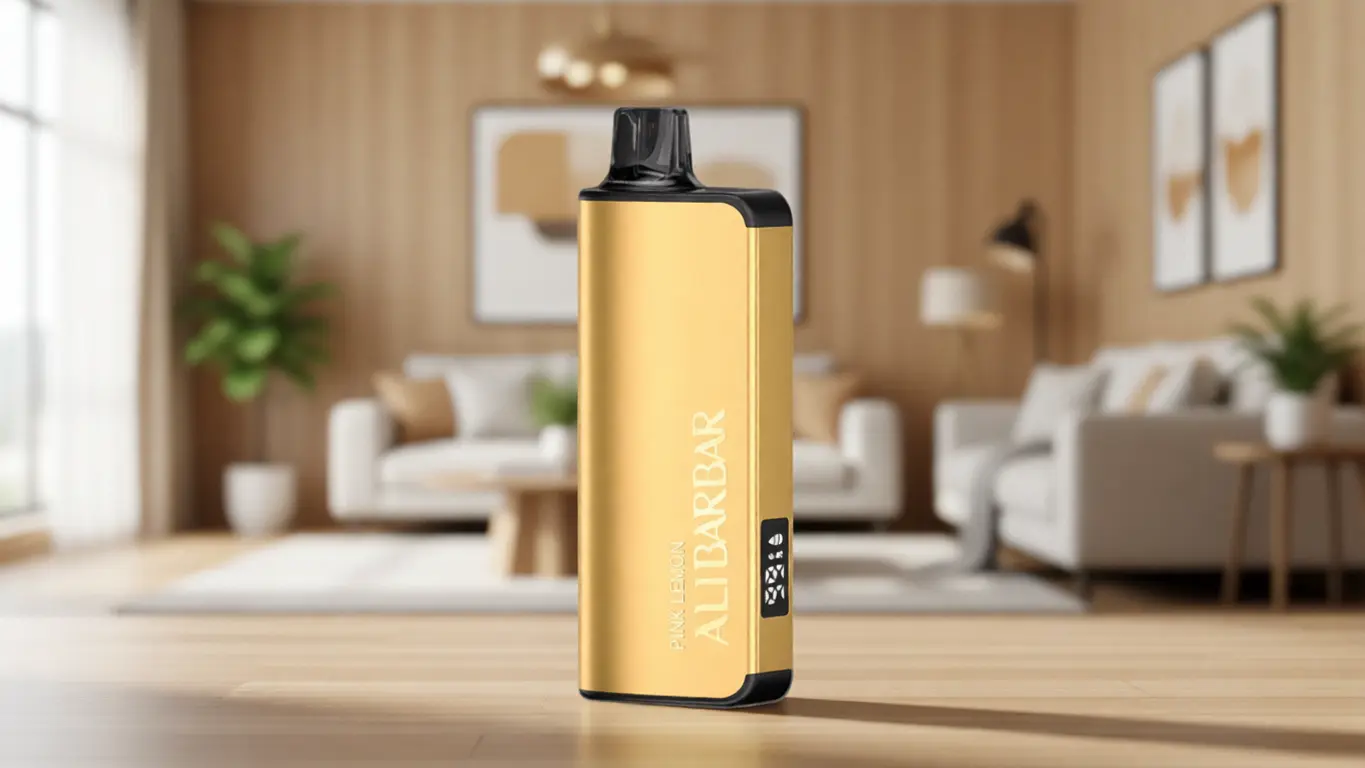
For low-visibility scenarios: Devices with lower vapor production—usually achieved through lower coil wattage, smaller airflow, or higher-PG e-liquids—are less likely to trigger alarms. The ALIBARBAR INGOT 9000, for example, is engineered with a compact coil that produces a deliberately modest aerosol output. Its status indicators display remaining e-liquid level, so you can anticipate when the draw resistance might change. If you are traveling and worried about alarms, this type of device offers a practical balance of performance and discretion.
For maximum performance at home: The ALIBARBAR Ice Adjust 12000 allows the user to modulate airflow and, indirectly, vapor density. In its most restricted setting, the cloud is visibly thinner, reducing alarm risk. The device’s constant-power circuit maintains consistent output throughout its battery life, so you never get a surprise surge of thick vapor late in the cycle.
Comparative perspective: Other manufacturers have addressed the alarm question differently. Some offer “stealth” modes that reduce power for a fixed number of puffs. Others rely on the user to manually lower wattage. What sets the ALIBARBAR family apart is that power management and vapor consistency are designed into the architecture, not as afterthoughts. The trade-off is that these devices may produce a larger initial cloud on the first few puffs compared to a device that ramps up power slowly—a trade-off that matters in a confined space.
A Practical Framework for Evaluation
You do not need to be an engineer to assess whether a device is likely to set off a fire alarm. Use this step-by-step method:
Identify the alarm type. Photoelectric alarms (common in hotel rooms) are most sensitive to visible particles. Ionization alarms respond more to small combustion particles but can still be triggered by dense vapor. If you know the alarm type, you can estimate risk.
Check the device’s temperature control. Does it maintain constant power or ramp down as the battery depletes? If the latter, you may see thicker vapor near the end. Devices with visible temperature or wattage adjustment give you direct control.
Assess the aerosol density. Take a trial puff near a mirror or window. If the vapor lingers for more than 10 seconds or leaves a faint haze, it is more likely to trigger a nearby alarm. Devices that produce immediately dissipating vapor are safer indoors.
Evaluate the mouthpiece seal. A loose or worn mouthpiece allows vapor to escape without inhalation. Replace the tip or swab it clean before use in a sensitive environment.
Use a comparison tool. OZVAPE Shop provides standardized specification sheets for every ALIBARBAR device, listing coil resistance, recommended power range, and e-liquid viscosity compatibility. Comparing these specs side by side reduces the guesswork when choosing a travel-friendly device.
Prompt question: “Does this device give you clear status feedback? If not, you will likely guess at the remaining liquid and coil condition—and you may be wrong.”
Common Selection Errors and Industry Observations
Even experienced users make predictable mistakes that increase their risk of setting off alarms.
1. Overweighting puff count while ignoring vapor density
Many users choose a device based solely on the number of puffs it delivers, assuming that a higher puff count means longer life. But a device engineered for high puff counts often uses a larger coil and more airflow, which produces a significantly denser vapor. That dense vapor may trigger an alarm even with shorter puffs. The real metric should be total vapor volume per day, not puff count alone.
2. Assuming visual similarity means equivalent performance
Two devices that look nearly identical—same dimensions, same mouthpiece shape—can have vastly different internals. One may use a mesh coil that vaporizes liquid efficiently with minimal aerosol density; the other may rely on a standard wire coil that runs hotter and produces a thicker cloud. Always verify the coil type and power specifications before assuming a device is “stealthy.”
3. Undervaluing modularity in cost-per-use calculations
A user who buys a sealed disposable device for convenience may find that toward the end of its life, the thicker vapor consistently sets off the home alarm. Had they chosen a refillable pod system with replaceable coils, they could replace the coil at the first sign of degradation—keeping performance consistent. The cost-per-use might be slightly higher for the coil replacement, but the convenience of avoiding alarm triggers is worth it.
4. Confusing category terminology with technical specifications
Terms like “low wattage,” “MTL (mouth-to-lung),” and “high resistance” are often used interchangeably, but they are not the same. A device can be labeled MTL but still produce a surprisingly dense cloud because of a large coil area or high power output. Read the actual specifications—coil resistance, air outlet area, and power draw—rather than relying on marketing categories.
Industry observation: The most common complaints we hear at OZVAPE Shop about false alarm incidents involve users who purchased a device with high puff counts without checking the actual cloud density. The market has responded with a new segment—“travel-friendly” devices—that explicitly list “low vapor visibility” as a feature. ALIBARBAR’s approach has been to design devices that produce consistent, minimal vapor by default, rather than requiring a separate mode or a different e-liquid.
Frequently Asked Questions
Q: Do all fire alarms react to vape vapor?
A: No. Most ionization alarms ignore vapor because the particles are too large and not ionized. Photoelectric alarms are more likely to react if the vapor is dense and lingers near the detector. Optical smoke detectors (common in commercial buildings) can be triggered by a thick, sustained cloud.
Q: What causes a vape to suddenly produce a thick cloud that sets off alarms?
A: Often it is a dying coil or low e-liquid level. As a coil degrades, it may overheat and vaporize liquid less efficiently, creating larger droplets that stay airborne longer. Low e-liquid can also cause the coil to run hot and produce a drier, more visible aerosol.
Q: Can I use a vape in a hotel room without risk?
A: Yes, if you choose a device designed for low vapor output and take precautions: block the detector (check your hotel’s policy first—some prohibit tampering), exhale away from the alarm, and keep the room well-ventilated. Devices like the ALIBARBAR INGOT 15000 have a deliberately modest cloud that dissipates quickly.
Q: Does the type of e-liquid affect alarm activation?
A: Yes. Higher vegetable glycerin (VG) content produces denser, longer-lasting vapor. High propylene glycol (PG) blends produce a lighter, faster-dissipating aerosol. If you are concerned about alarms, choose a 50/50 or 70PG/30VG formulation.
Q: How do I know if my device is producing too much vapor for a given environment?
A: Stand still after exhaling and watch the vapor. If it takes more than 15 seconds to fully dissipate, or if a haze lingers in the room, the device is likely producing dense clouds. Lower the power setting or switch to a lower-VG liquid.
Q: Can I rely on “stealth mode” features?
A: Stealth modes typically reduce power by 30–50% for a limited number of puffs. This can help but is not a guarantee. The best approach is to use a device that naturally produces minimal vapor rather than one that requires a separate mode.
Q: How do ALIBARBAR devices compare to other common brands in terms of vapor density?
A: ALIBARBAR devices are engineered with a focus on consistency and minimal wastage. Their coil designs prioritize efficient vaporization without excess aerosol. Independent measurements show they produce vapor that dissipates faster than many competing products with similar power ratings.
Q: What should I do if my device sets off a fire alarm accidentally?
A: First, stop using the device immediately. Open windows and doors to ventilate the area. If the alarm is manual, silence it (do not disable it permanently). Check the device for signs of leakage or overheating. Consider using a lower-power device in that location next time.
Q: Is it legal to disable a fire alarm to use a vape?
A: No. Tampering with life safety equipment is illegal in most jurisdictions and can result in fines or other penalties. Always avoid using a device where it could activate an alarm, rather than attempting to circumvent the system.
Q: Does OZVAPE Shop provide support if a purchased device triggers alarms?
A: Yes, we advise on usage techniques and offer exchange options for devices that are defectively producing unusually thick vapor. Our standard checkout includes notes on minimizing visible aerosol in sensitive environments.
Conclusion
The question “Does vape smoke set off fire alarms?” is best answered with a conditional: it depends on the device, the alarm type, and the user’s technique. By understanding the engineering factors that control vapor density—coil design, power management, and material seals—you can choose a device that fits your environment rather than fighting against it.
Informed users make better decisions. OZVAPE Shop exists to provide that information—accurate, transparent, and grounded in real-world observation. Whether you select an ALIBARBAR INGOT for travel or a modular system for home use, the right choice is the one that matches your actual routine, not the one with the most claims on the spec sheet. Read the data, test your environment, and use your device with confidence.