
VAPE FAQs
Does Vape Smell Linger On Clothes?
Jun
People who use portable electronic devices in shared spaces, enclosed vehicles, or simply around fabric-heavy environments often notice a persistent, unwelcome residue in the air — and on their clothing. The question is not trivial: does the scent left behind by a personal vapor-producing device actually embed itself in fabric, and if so, what lasting impact does it have on daily professional and social life? A quick check of online forums returns a blur of contradictory anecdotes. Some insist the scent vanishes in seconds, while others recount jackets that carried a faint but definite trace for days.
At OZVAPE Shop, we have fielded this concern repeatedly from users who want to understand the physical reality behind the perception, separate from marketing reassurance. The answer is not a simple yes or no; it sits at the intersection of fluid chemistry, thermal dynamics, and the design trade-offs built into every device. This article unpacks those factors so that any adult can evaluate their own situation with clarity — and, if they choose, select a device architecture that demonstrably reduces the likelihood of fabric retention.
Understanding What Matters: Core Engineering and Design Factors That Influence Scent Residue
Most discussions about residual odor begin and end with the contents of the consumable unit, but that approach misses the broader picture. The device itself — its heating behavior, its airflow geometry, and its power management — determines how completely the consumable is transformed, how the resulting aerosol behaves, and where it ultimately settles. Those physical properties, far more than subjective fragrance descriptions, govern whether your clothing will pick up a detectable trace.
Internal Architecture and Vapor Particle Size
The heating element is the starting point of the entire chain. Ceramic, mesh, and traditional wire configurations each heat the consumable at different rates and with different uniformity. A coil that generates uneven hot spots tends to produce a wider distribution of aerosol particle sizes, including larger droplets that are more likely to be intercepted by fibrous surfaces before they evaporate. Conversely, a finely engineered mesh element — like the one found in the ALIBARBAR INGOT 15000 — brings the consumable to temperature rapidly and uniformly, yielding a narrower spectrum of predominantly smaller particles. Smaller particles remain airborne longer and are more likely to dissipate or be inhaled rather than deposited onto nearby fabrics. When users complain that a certain device “leaves more smell on my collar,” they are often describing, without realizing it, the physical consequence of incomplete aerosolisation.
Power Management and Temperature Stability
Temperature regulation is the silent variable that decides whether the fluid decomposition is clean or incomplete. A device that operates with a simple, unregulated output will gradually shift its heating behavior as the power source degrades, producing cooler cycles that generate more unburnt residue. That residue consists of heavier compounds that cling readily to natural fibres like cotton and wool. Devices with integrated power management circuitry — for instance, the ALIBARBAR Ice Adjust 12000, which maintains consistent output across its entire rated operational life — avoid these late‑life performance dips. The practical takeaway is straightforward: a device that stays thermally predictable from first activation to last is a device that is less likely to surprise you with a lingering fabric scent after a long afternoon.
Airflow Design and Directional Exhaust
Where the vapour goes immediately after production matters enormously. Mouthpieces with wide, undirected apertures tend to spread the aerosol plume to the sides, increasing the chances that some portion will drift onto the user’s shoulder, sleeve, or lap. Tightly contoured tips and internal baffling that guide the stream forward and slightly upward — as seen in the ALIBARBAR INGOT 9000 — keep the cloud more contained within the direct inhalation path. This is not merely an ergonomic nicety; it is a first‑order control on environmental deposition. If you habitually use a device while seated at a desk, the accumulation on your right forearm can become a telltale signature. An airflow design that respects the user’s desire for discretion will, by its very nature, lower the odor burden on nearby textiles.
Exterior Materials and Surface Absorption
The device itself can become a secondary source of lingering scent. Soft‑touch coatings and textured finishes, while pleasant in the hand, often trap microscopic residue in their surface irregularities. Over successive uses, the device body can develop a faint but persistent aroma that transfers to pocket linings or bag interiors. Hard, non‑porous surfaces — particularly those with a smooth anodized or polished finish — resist this absorption and are easier to wipe clean. Some manufacturers address this head‑on by selecting materials that were never intended just for looks, but for hygiene and long‑term neutrality. The difference becomes apparent only after weeks of pocket carry, when one device leaves nothing behind and another has turned a jacket pocket into a scent reservoir.
Applying These Criteria to Real-World Options
Putting the engineering lens to work requires evaluating real devices not by brand reputation but by the specific design choices that affect airborne deposition. The ALIBARBAR family illustrates how a single design philosophy can branch into distinct architectures, each with its own implications for fabric contact.
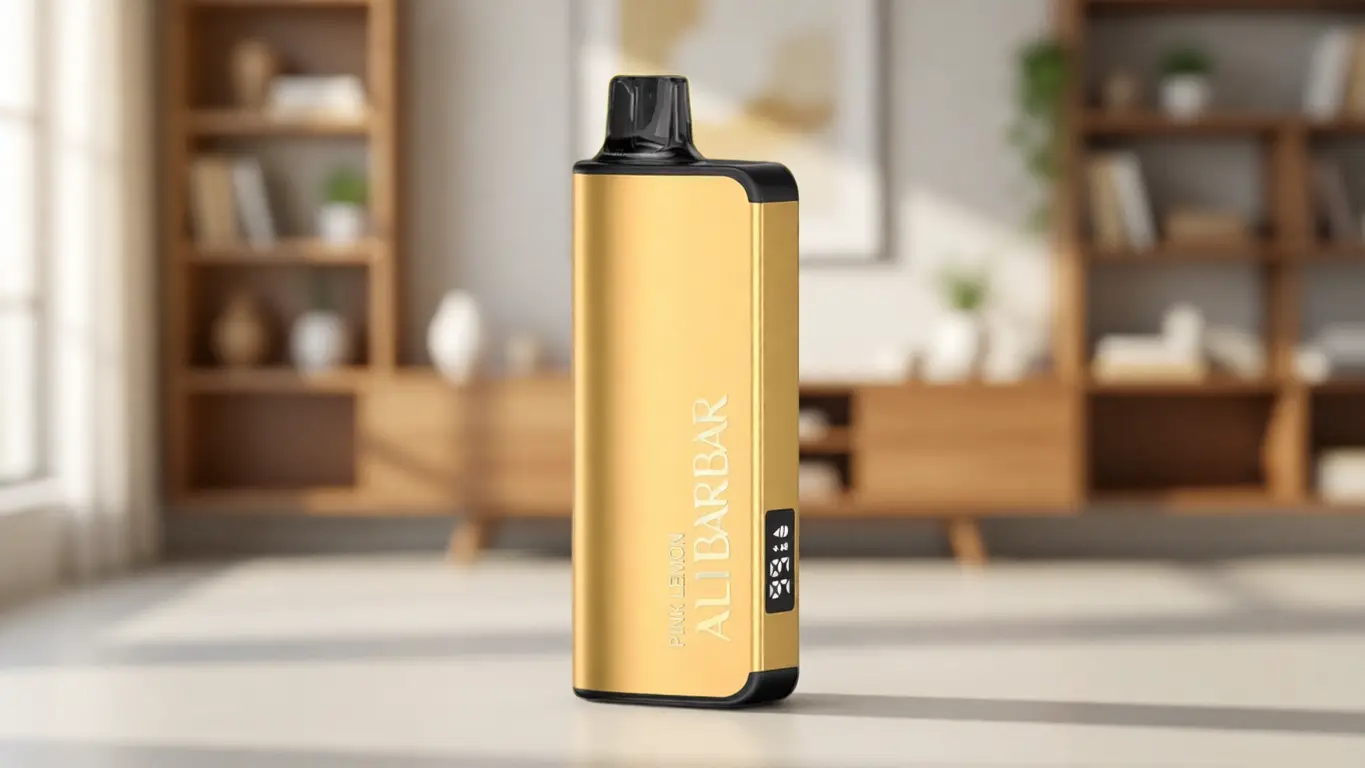
The ALIBARBAR INGOT 9000 is a compact, sealed‑unit device that prioritizes portability and discretion. Its narrow‑bore mouthpiece and tightly regulated mesh heating system produce a focused stream with minimal lateral drift. For users who carry their device in a shirt pocket or handbag, the hard shell exterior does not absorb residue, and the consistent output reduces the likelihood of incomplete aerosolisation during later stages of use. In contrast, the ALIBARBAR INGOT 15000 uses a larger internal architecture that spreads the same mesh‑based heating over a broader wicking surface, yielding a cooler but still uniform temperature profile. The cooler vapour temperature means that the aerosol particles have a slightly longer airborne lifetime, which can actually reduce fabric deposition when used in well‑ventilated spaces, though it may also mean that any nearby surfaces receive a more diffuse exposure. The trade‑off is subtle and depends heavily on environment.
The ALIBARBAR Ice Adjust 12000 adds a layer of user control: adjustable airflow. When the airflow is set to a tighter draw, the plume is more concentrated and travels farther before dispersing, which keeps it away from the chest area but may carry it past the user’s shoulder. At a more open setting, the plume becomes less directional, potentially increasing local deposition. Understanding how to set the airflow for a given physical setting is a skill that no specification sheet can teach, but a device that allows that adjustment at least gives the user agency over a key variable.
Across the broader market, many sealed units from other manufacturers omit the consistent temperature regulation and material choices that distinguish these examples. Visual similarity does not guarantee equivalent internal engineering, and a lower upfront cost often correlates with simpler coil designs that are inherently less efficient at complete aerosolisation. That inefficiency translates directly into heavier residue on clothing.
A Practical Framework for Evaluating Device-Related Fabric Odor
Instead of relying on anecdotal reports or vague smelling tests, an adult user can apply a systematic evaluation before committing to a particular device. The following line of questioning, grounded in the engineering factors above, can be carried out on any product page or in‑person inspection.
Check the heating element specification — Does the manufacturer disclose the coil material and configuration? Mesh elements with documented temperature coefficients are preferable. If no detail is provided, assume a basic wire coil with wider thermal variance.
Look for output consistency guarantees — Does the device advertise “constant output” or “stable performance” across its entire capacity? A simple LED indicator is not enough; you want evidence of active power management, not just a voltage source.
Examine the mouthpiece geometry — Is the tip narrow and forward‑directed, or wide and unfocused? Photographs showing a side profile and a top view are essential. A contoured aperture that channels the flow into a tight cone will always be less likely to spray laterally onto clothing.
Assess the exterior material — Hard, non‑porous finishes that are described as “easy clean” or “residue‑resistant” are a positive sign. Soft rubber coatings, while grippy, should be considered a potential scent sponge unless the manufacturer provides evidence of sealed pores.
Read the usage environment recommendations — Some brands, like ALIBARBAR, explicitly note that their devices are designed for “discreet, low‑diffusion use.” This is not merely marketing language; it reflects design choices related to aerosol output and directional flow.
By applying these five points across different product specifications — many of which are standardised on the OZVAPE Shop platform for direct comparison — you create a scoring matrix that is far more predictive of real‑world clothing exposure than price or popularity.
Common Selection Errors and Industry Observations
The gap between a user’s expectations and their actual experience often traces back to a handful of persistent evaluation mistakes. These errors are not unique to any one brand; they reflect broader misunderstandings of how aerosol physics intersects with textile science.
Error 1: Assuming all devices in the same category behave identically. A compact sealed unit from one manufacturer may incorporate a precision mesh coil and active temperature regulation, while another, visually indistinguishable model uses a simple nichrome wire with passive battery output. Both occupy the same shelf space and carry similar descriptions, but the airborne residue left on a user’s sweater after an hour of intermittent use can differ dramatically.
Error 2: Overweighting flavor intensity as an odor indicator. Users often assume that a strong‑flavored consumable will inherently leave a stronger fabric trace. In practice, the thermal efficiency of the device matters more. A highly efficient heating system can transform even intense formulations into small, rapidly evaporating particles, while a weak coil can leave heavy traces from a mild formulation. Flavor is not a reliable proxy for deposition potential.
Error 3: Ignoring ventilation and proximity factors in personal experience reports. A person who always uses a device outdoors on a breezy balcony will report that “it never smells,” while someone using the exact same device in a car with the windows up will report the opposite. Without controlling for airflow environment, comparative reviews are largely meaningless.
Error 4: Confusing vapor visibility with residue. A device that produces a large, lingering visible cloud may seem more likely to stain clothes with odor, but visibility is a function of water content and light scattering, not necessarily of the heavier organic compounds that bind to wool or cotton. In fact, some of the least visible aerosol plumes carry the highest‑molecular‑weight residuals precisely because they are less volatile and therefore invisible.
From an industry perspective, the slow but steady shift toward mesh‑based heating and regulated power delivery is not driven solely by flavor quality; it is also a response to the under‑discussed problem of incidental environmental deposition. Manufacturers that invest in thermal engineering are, whether they explicitly market it or not, addressing the fabric odor concern. Those that rely on legacy coil architectures are, conversely, perpetuating the very conditions that cause a jacket to carry a scent after a night out.
Frequently Asked Questions
Q: Does the scent from a personal vapor device actually bond to fabric, or does it just float away?
A: It can bond, particularly if the aerosol particles are large and contain heavy, low‑volatility compounds. Natural fibres like cotton and wool have microscopic roughness that traps these particles. Once deposited, they can persist for hours or longer, especially in low‑airflow environments.
Q: How long does the scent typically remain on clothing?
A: That depends on the particle size distribution, ambient air circulation, and the specific fabric. In a still room, a wool sweater might retain a detectable trace for 12–24 hours. In a breeze or under a ceiling fan, the time reduces significantly. Hard finishes and synthetic blends shed residuals faster.
Q: Can I choose a device that produces less lingering odor?
A: Yes. Look for devices that use mesh coils with consistent temperature control, have directed mouthpieces, and feature non‑porous exteriors. Specifications that mention “stable output” or “regulated power” are indicators of cleaner thermal conversion.
Q: Does the consumable formulation matter more than the device?
A: Not necessarily. A formulation with high viscosity or high sweetness may leave more residue, but the device’s ability to heat it uniformly and completely often overrides the formulation’s intrinsic properties. A well‑engineered device can cleanly aerosolise a wide range of formulations, while a poor one will leave residue from even the lightest mix.

Q: Are sealed units better or worse than replaceable‑component systems for fabric odor?
A: There is no categorical answer. A sealed unit with a mesh coil and regulated output can be extremely clean. A replaceable‑component system gives you control over coil quality, but if you choose a low‑cost wire coil, the result can be worse. The architecture type is less important than the coil quality and power management inside it.
Q: Does cleaning the device regularly help?
A: For devices with accessible mouthpieces or exterior surfaces that can be wiped, yes. Residue that builds up on the device itself can transfer to pocket linings. Devices with non‑porous, smooth exteriors require less maintenance to remain neutral.
Q: Can I test a device’s tendency to leave fabric scent before buying?
A: Not directly, but you can examine the engineering specifications. If a product page provides no details about coil type, power regulation, or airflow design, you are operating blind. Retailers that standardise these details — as OZVAPE Shop does — give you a practical basis for comparison.
Q: What if I use a device outdoors most of the time?
A: Outdoor use dramatically reduces fabric deposition because the aerosol is immediately diluted and carried away. Even a less efficient device will rarely cause a noticeable outdoor residue problem. The indoor or vehicle scenario is where design differences truly surface.
Q: Does the temperature setting affect odor on clothes?
A: If the device allows temperature adjustment, a slightly higher temperature typically yields more complete aerosolisation and therefore smaller, more volatile particles. However, not all devices implement true temperature control; many simply adjust voltage, which may not achieve the intended effect.
Q: I’ve noticed a faint scent in my bag where I store my device. Is that dangerous or harmful?
A: The scent indicates that some aerosol residue has transferred from the device body or mouthpiece to the bag lining. It is not a sign of malfunction, but rather a reminder that device exterior material and carry habits matter. Keeping the device in a small, hard case or choosing one with a sealed finish will prevent it.
Conclusion
The lingering scent that may or may not find its way onto your clothes is not an unfathomable quirk of chemistry — it is a predictable outcome of engineering choices that are visible on every specification sheet, if you know where to look. Thermal control, coil design, airflow direction, and surface materials collectively determine whether a device will leave a trace on your collar or pass unnoticed. Users who invest a few minutes in learning to read those signals will never again need to wonder whether a particular night out will follow them home in the fabric of their shirt.
OZVAPE Shop exists precisely to make those signals legible. By presenting standardised, factory‑certified technical information — including the coil type, power management features, and airflow geometry of every ALIBARBAR device in the catalogue — the platform empowers you to apply the analytical framework laid out here without guesswork. The right choice is not the one with the loudest claims on the packaging, but the one whose internal architecture aligns with the quiet realities of your daily routine, your preferred fabrics, and the spaces you occupy.