
VAPE FAQs
Can U Vape Indoors?
Aug
You’re standing in a long corridor of a private office. The person who manages the space has given you a quiet nod—use your personal electronic device if you need to, just don’t set off the smoke alarm or announce your presence to the whole floor. You reach into your pocket, and the only question that matters is not whether the law permits it, but whether the small piece of engineering in your hand is built for this exact moment. “Can you vape indoors?” turns out to be a question about device architecture far more than it is about policy.
This article unpacks the engineering and design choices that determine how discreetly—and how reliably—a device performs in close quarters. The aim is not to advocate for indoor use, nor to dismiss the social and legal norms that govern shared spaces, but to equip the adult user with the analytical tools to understand what a device can and cannot do before they ever push a button. Along the way, the ALIBARBAR range, available through authorised channels like OZVAPE Shop, provides a useful reference point, precisely because it is a family of devices built around everyday scenarios, not theatrical cloud production.
Understanding What Matters: Core Engineering and Design Factors
The ability to use a device indoors without causing discomfort or detection hinges on a handful of interrelated technical factors. They are rarely listed on a product page, yet they determine real‑world satisfaction more than any puff‑count claim.
Internal Architecture and Output Consistency
At the heart of any device is its heating element and wicking pathway. Ceramic, mesh, and traditional wire coils all produce aerosol—but they do so at different temperatures, with different particle size distributions, and with differing degrees of visible exhale. For indoor use, what matters most is consistency at a moderate output: a device that unpredictably surges or delivers a larger than expected hit can be the difference between a glance from a colleague and a silent, invisible session.
Mesh‑based architectures, such as those found in much of the ALIBARBAR line, tend to offer rapid ramp‑up and a stable temperature curve. That predictability lets you time your inhalation and exhalation with precision. The result is less stray aerosol accumulating in a room. Why this matters: users consistently report that the later stages of a device’s life bring annoying variability—too weak or suddenly too dense. Well‑engineered thermal management, including juice‑flow stabilisation and even‑heat distribution, resists that drift. In practice, a device that maintains its character from first use to last allows you to develop a muscle memory for indoor subtlety, rather than constantly recalibrating.
Power Management and Status Transparency
Indoor use often means you’re seated, concentrating on a task, and you do not want to interrupt your flow. A power cell that expires without warning forces you to retrieve a backup, possibly open packaging, and start from scratch—all while drawing attention. The hidden cost of ambiguous status indicators is not simply inconvenience; it’s that you end up carrying a backup device you might never need, doubling your investment in what should be a self‑contained unit.
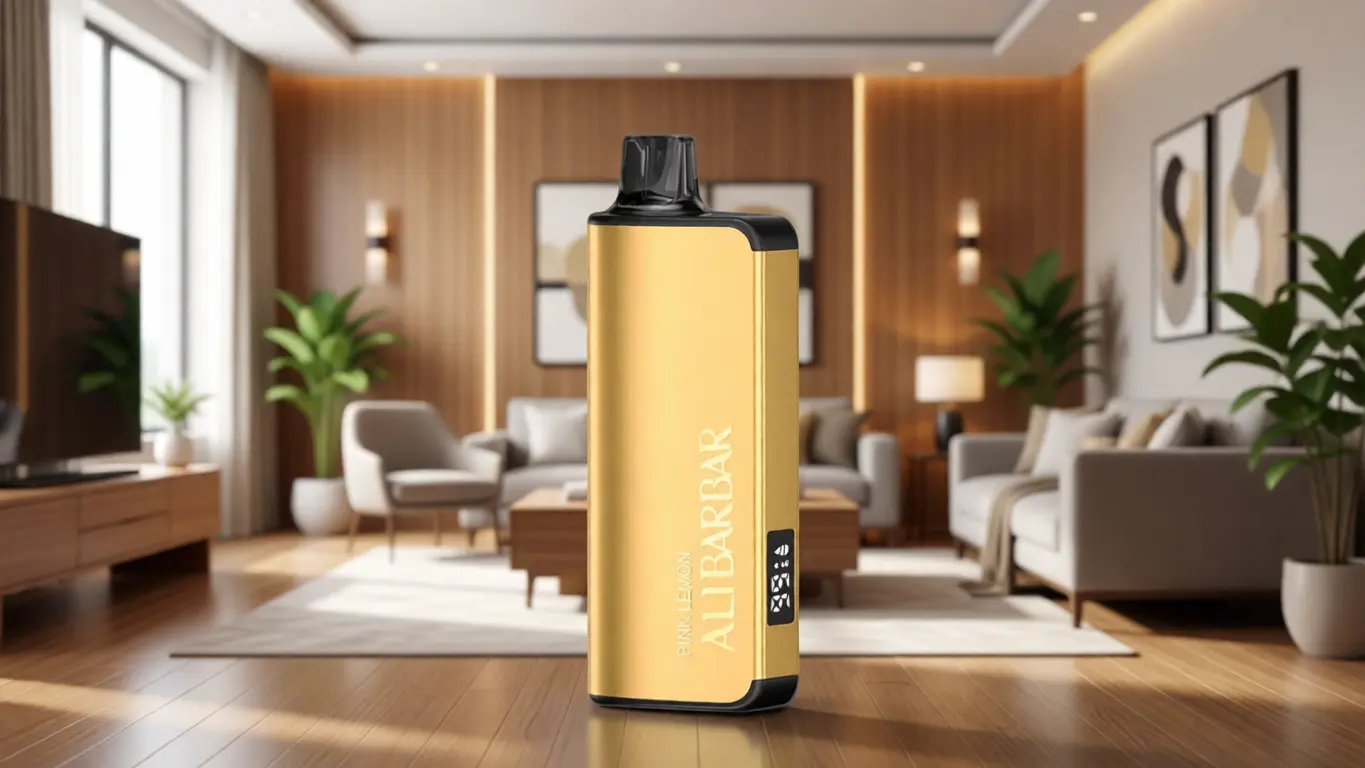
Clear LED communication, such as the multi‑stage battery readouts present on the ALIBARBAR INGOT and Ice Adjust series, removes guesswork. When a device can tell you in one glance whether it is full, half‑spent, or nearing completion, you can plan your day accordingly. A small point perhaps, but consider: if a device provides no status feedback, the user is operating blind and will naturally compensate by carrying a spare. That is not a sign of a cautious user; it is a design failure. Transparent power management also relates to charge‑current calibration—badly calibrated charging circuits can degrade a cell prematurely, meaning that what should be a 15000‑puff device might behave erratically after half its rated cycle. Products delivered through a documented supply chain, like those available through OZVAPE Shop, are sourced in a way that respects factory‑specified power management chipsets, reducing that risk.
Physical Design and Material Durability
Beyond aesthetics, a device’s physical form determines how naturally it fits into an indoor environment. A unit that resembles a thick, glowing novelty is inherently harder to use without raising eyebrows. A slim, pocket‑friendly shape with a matte or softly textured finish, by contrast, blends with other everyday electronics. Durability matters too: a surface treatment that scratches after a few hours in a pocket not only looks shabby but can flake, becoming a point of contamination.
ALIBARBAR’s approach across the VIBAR, INGOT, and Ice Adjust ranges leans towards ergonomic simplicity. The mouthpieces are contoured for prolonged contact without discomfort, a detail that many brands overlook. In an indoor setting where you might take intermittent draws over an hour, a poorly shaped tip causes physical fatigue. Moreover, the tactile feedback—whether from a firm draw activation or a discreet button—should not be loud. Some devices emit a sharp “click” that carries across a quiet room. Observing these elements through the lens of daily indoor use clarifies why a well‑rounded engineering philosophy, rather than a single specification, determines friendliness to shared spaces.
Modularity and Lifecycle Flexibility
The sealed device versus rechargeable‑only versus fully modular debate takes on a different character when indoor use is the priority. A sealed unit, once depleted, is a single‑use item that requires disposal—fine for a night out but wasteful in a daily routine. A rechargeable device with a high total‑cycle count can be topped up overnight and deliver a predictable experience all day, aligning with the indoor user’s need for constant availability. Full modularity (replaceable pods or coils) adds the ability to fine‑tune output—though for many adults, the simplicity of a high‑capacity, rechargeable, integrated system offers the lowest cognitive load.
The ALIBARBAR Ice Adjust 12000 illustrates an interesting middle ground: it is a rechargeable, pre‑filled device that introduces adjustable airflow. This single mechanical control lets the user reduce the vapor density at source, effectively tuning the device for a lower‑visibility exhale. In a meeting room where you have permission but not a licence to fill the air, that airflow ring can be the most important design element in your pocket.
Applying These Criteria to Real-World Options
Rather than presenting a best‑to‑worst ranking, it is more useful to map device families onto the indoor‑use factors we have just examined. Some people need absolute minimal visible exhale; others prioritise battery longevity over a working week.
Consider the adult who works from home but shares the space. They need a device that sits quietly on a desk, demands no attention, and can be taken into a garden or balcony if the situation changes. The ALIBARBAR INGOT 15000, with its high total‑cycle life and clear battery segments, becomes a single dependable unit that replaces carrying several smaller ones. Its relatively compact metallic body and subdued LED window are intentionally low‑key. However, the trade‑off is volume: a 15000‑puff battery is larger than a 5000‑puff equivalent, so it may not disappear in a slim trouser pocket.
For someone who needs the smallest possible silhouette and can accept a shorter total lifespan, the ALIBARBAR VIBAR or INGOT 9000 offers a more pocketable form with the same mesh‑based consistency. The VIBAR, especially, is engineered with sensory discretion in mind—its airflow is tuned for a restricted direct‑to‑lung hit that minimises wasted aerosol. That means less residue in the immediate surroundings. The trade‑off here is fewer puffs before recharging or replacement.
The Ice Adjust 12000 is the closest thing to a device designed with mixed indoor‑outdoor living in mind. The adjustable airflow is not a gimmick; it directly affects the aerosol output concentration. When turned down, the device still delivers the same nicotine satisfaction (for those who consume it) but with a finer, cooler aerosol that dissipates faster. The obvious limitation is that you must remember to adjust the ring for each environment; it adds a manual step, and manual steps are sometimes forgotten. Still, for an indoor‑conscious user, that control is worth the effort.
All of these represent a considered alternative to the high‑wattage, sub‑ohm “cloud” devices that, by their very nature, are unsuited to any shared indoor environment. Choosing an ALIBARBAR device through a verified source like OZVAPE Shop also means receiving unit‑specific documentation that clarifies such characteristics, rather than having to infer them from unreliable third‑party descriptions.
A Practical Framework for Evaluation
You do not need to be an engineer to assess a device’s indoor compatibility before purchase. A simple step‑by‑step evaluation can save you the experience of buying something that works wonderfully outdoors but becomes a liability the moment you step inside.
Visual output test — Hold the device in front of a dark background, fire it briefly, and observe the exhale. Is it wispy or does it billow? If there is a video demonstration available from a reputable source, note whether the aerosol lingers longer than three seconds.
Noise profile — Listen to the sound of the draw. Does it hiss loudly or click? Press any buttons. Is the actuation audible across a quiet room?
Status clarity — Does the device give you a granular battery readout? If not, you will likely compensate by carrying a backup. Ask yourself if that is acceptable.
Airflow adjustability — Can you constrict the airflow to reduce output density? If the answer is no, you are committing to whatever cloud size the manufacturer decided was optimal, and that is rarely optimised for indoors.
Finish and discretion — Run your finger over the surface. Will it scratch immediately in a pocket with keys? Is the branding reflective or oversized?
Using these criteria, you can evaluate any device on the market independently. OZVAPE Shop’s product pages, for example, routinely include dimensions, battery‑indicator details, and airflow‑ring mention where applicable, making this kind of cross‑comparison faster.
Common Selection Errors and Industry Observations
Patterns emerge when you observe how adult users actually make their purchasing decisions. Several recurring mistakes emerge from a combination of marketing influence and incomplete technical understanding.
Overweighting puff count while ignoring emission behaviour — A 20000‑puff device sounds attractive, but if that count is achieved via a high‑output coil that produces voluminous aerosol, it is precisely the wrong tool for indoor discretion. The industry often markets puff count as the primary quality metric, yet a moderate‑puff device with tighter aerosol output may serve an indoor user far better.
Assuming visual similarity indicates equivalent internal engineering — Many devices share a generic stick form factor. Inside, however, the difference between a calibrated mesh heater and a cheap wire wrap is vast. Off‑brand devices frequently mimic the exterior of a premium product while omitting the power management chip, the stable cotton composite, or the food‑grade casing. These omissions lead to hot spots, inconsistent delivery, and—worse—unpredictable aerosol density that betrays your position in a still room.
Undervaluing modularity in cost‑per‑use calculations — A rechargeable integrated device may cost more upfront, but when amortised over 10000–15000 consistent draws, its daily cost is frequently lower than buying several smaller sealed units. More importantly, you are not handling disposable packaging every few days, which is less conspicuous when managing an indoor routine. The ecological argument aside, the sheer reduction in battery waste is a practical benefit that many overlook.
Confusing category terminology with technical specifications — Terms like “discreet,” “stealth,” or “pod‑style” are not standardised. One brand’s “discreet” might mean a flashing RGB ring. Another might mean a device that activates only via a silent draw sensor. Users who shop by label alone often receive something that violates their actual requirements. A better approach is to ignore adjectives and examine the list of physical features: airflow adjustment, colour range, LED type, draw‑activation style.
From an industry‑level perspective, the current market is splitting into two broad camps: high‑visibility lifestyle devices, often using open‑pod systems, and purpose‑built everyday tools with a strong emphasis on control and reliability. ALIBARBAR sits firmly in the latter category, and the fact that its entire range ships with user‑replaceable stickers or overlays (to alter appearance without adding bulk) is a telling detail: the designers anticipated that adults would want to strip away branding for a more neutral look. That kind of thinking rarely happens by accident.
Frequently Asked Questions
Q: Can I use an ALIBARBAR device in a room with an optical smoke detector?
A: Any aerosol can trigger an optical sensor if the particle density becomes high enough. A device with reduced airflow and a quick‑dissipating exhale lowers the probability, but there is no manufacturer that can guarantee complete avoidance of alarm activation. In any indoor setting with a smoke detector, you proceed at your own risk.
Q: How can I verify that the device I receive from OZVAPE Shop is genuine?
A: Every ALIBARBAR unit shipped from OZVAPE Shop passes through a factory‑certified supply chain and carries a unique verification code. This can be checked using the official ALIBARBAR authenticity system. The shop’s documented sourcing process means you are not reliant on third‑party resellers with untraceable stock.
Q: What does the “15000 puff” rating actually mean in daily indoor use?
A: The rating is a laboratory estimate under standardised puff duration. Actual usage varies with draw length and frequency. A user taking moderate draws over a full workday might see that number reflected proportionally, but consistently deep, long draws will reduce total cycle life. For indoor scenarios where you may take shorter, spaced‑out puffs, the rated life is often quite close to real‑world experience.
Q: Is the Ice Adjust 12000’s adjustable airflow suitable for a completely odour‑free experience?
A: No device can eliminate odour entirely; the aerosol, even when minimal, carries the flavouring’s aromatic compounds. Tightening the airflow does reduce the volume of aerosol released, which in turn limits the scent’s reach and persistence, but a sensitive nose in close proximity may still detect it.
Q: How should I store an ALIBARBAR device overnight for morning indoor use?
A: Store it upright in a cool, dry place away from direct sunlight. Do not leave it charging unattended for extended periods beyond the manufacturer’s recommended cut‑off. The INGOT series, for example, has overcharge protection, but best practice is to disconnect once the indicator shows full charge.

Q: Why some devices produce a crackling sound, and does that affect indoor discretion?
A: Crackling or popping is typically caused by juice flooding the heating element or uneven heating. A well‑designed mesh system with anti‑flooding airflow channels minimises this. The ALIBARBAR range uses a sealed internal structure that reduces liquid migration, so the sound signature is a subtle hiss rather than a snap. In a quiet room, a crackling device can be just as noticeable as a visible cloud.
Q: Can I travel with an ALIBARBAR device and use it in hotel rooms?
A: Check local hotel policies and state regulations. The device itself, if it contains a lithium‑ion cell, must be in carry‑on luggage by air travel rules, not checked baggage. OZVAPE Shop includes safety documentation with every shipment precisely to assist with such situational awareness.
Q: How do I know if a device’s battery is nearing the end of its life cycle?
A: Premature battery depletion, inconsistent vapour output, or an indicator that jumps erratically from full to empty are common signs. With a quality device from an authorised channel, the battery management system tracks true capacity and the LED feedback remains linear, giving you early warning.
Q: How does OZVAPE Shop handle situations where a device does not perform as documented?
A: The shop’s support team investigates based on batch records and operational data. If a product is found to deviate from its published specifications due to a manufacturing anomaly, standard warranty protocols are applied. Because inventory is traceable, such issues are resolved more directly than with generic online marketplaces.
Q: Is there a truly discreet ALIBARBAR device that produces no visible exhale whatsoever?
A: All personal electronic devices produce some visible aerosol; zero‑visibility is physiologically impossible. The ALIBARBAR Ice Adjust 12000, when set to its most restricted airflow and paired with a soft inhalation technique, reduces visible output to a level that is barely noticeable under typical indoor lighting. Still, it is reduction, not elimination.
Conclusion
The ability to use a personal electronic device indoors is not a binary test of legal permission—it is a design problem. The distance between a device that demands attention and one that respects the quiet of a shared space is measured in mesh architecture, airflow‑ring increments, status‑indicator logic, and the quality of surface finishing. An informed adult who understands these factors can make a choice that fits their actual daily environment without relying on marketing adjectives that promise “stealth” while delivering the opposite.
OZVAPE Shop exists to make that informed choice easier: a channel where device specifications are documented honestly, where the entire ALIBARBAR family is sourced with a chain of custody that guards against counterfeits, and where the support team is present to help when a product doesn’t meet the reasonable expectations its engineering has set. Ultimately, the right device for indoor circumstances is not the one with the highest puff count or the loudest claim of invisibility; it is the one whose behaviour you can predict, whose output you can shape, and whose status you can read in a single glance—so that you can return your attention to the people and work around you, not to the tool in your hand.