
VAPE FAQs
Can I Take A Disposable Vape On The Plane?
Oct
Your passport is ready. The itinerary has been confirmed. Then, a quiet uncertainty surfaces: what exactly are the rules for carrying the small sealed device that has become part of your daily routine? This question is not rare, but the answers available online often swing between alarmist and dismissive. The reality is more straightforward — if you understand the engineering of your device and the logic behind airline safety rules, the decision becomes clear.
At OZVAPE Shop, we maintain a library of device specifications for precisely this reason: when travel regulations meet transparent product data, anxiety gives way to informed action. This article unpacks every relevant factor so you can step onto a plane with a clear answer, whether you are carrying a compact sealed unit or evaluating a high‑capacity option from the ALIBARBAR range.
Understanding What Matters: Core Factors That Determine Air‑Travel Readiness
Airline rules do not exist in a vacuum. They respond to specific engineering properties — battery chemistry, liquid containment under pressure, and the user’s ability to know what state a device is in. When a traveler’s device is confiscated or causes hesitation at security, the root cause almost always traces back to one of these factors. Addressing each one systematically removes the guesswork.
Battery Safety and Chemistry
Lithium‑ion cells are the only component that triggers hard restrictions. The International Air Transport Association (IATA) standard is clear: portable electronic devices with batteries rated under 100 watt‑hours (Wh) may be carried in the cabin. Most sealed personal devices use a single cell with a capacity between 400 mAh and 1 500 mAh. At a nominal 3.7 V, even a 1 500 mAh battery translates to roughly 5.6 Wh — an order of magnitude below the threshold.
The frustration arises when a device does not clearly label its capacity or chemistry. If security personnel cannot verify the battery rating, they may default to refusal. Look for products that print this data directly on the housing or in documentation that can be accessed offline. If the information is absent, you are effectively travelling with an unknown quantity — a needless gamble.
Liquid Containment and Leak Resistance
The second engineering risk is cabin pressure fluctuation. At 8 000 feet of cabin altitude, air expands. A poorly sealed reservoir can weep liquid into your bag or, worse, onto your skin. Beyond the mess, a leaking device may be flagged by security as a hazardous material spill.
Well‑engineered disposables incorporate multi‑layer silicone seals and one‑way airflow paths that equalise pressure without exposing the reservoir chamber. The difference is rarely visible from the outside. The practical test: if a device has a history of users reporting leaks during normal use, it will almost certainly fail under the repeated pressure cycles of a long‑haul flight. Check user reports for leakage patterns, not just initial‑use impressions.
Power Status Transparency
A device that gives no indication of remaining charge forces an uncomfortable routine: you either carry a backup or accept the possibility of a dead unit mid‑travel. For air travel specifically, status transparency matters at two points — before departure (knowing whether your device has enough charge to last the journey) and at the gate (if asked by crew whether the device has any residual power, a clear indicator gives a confident answer).
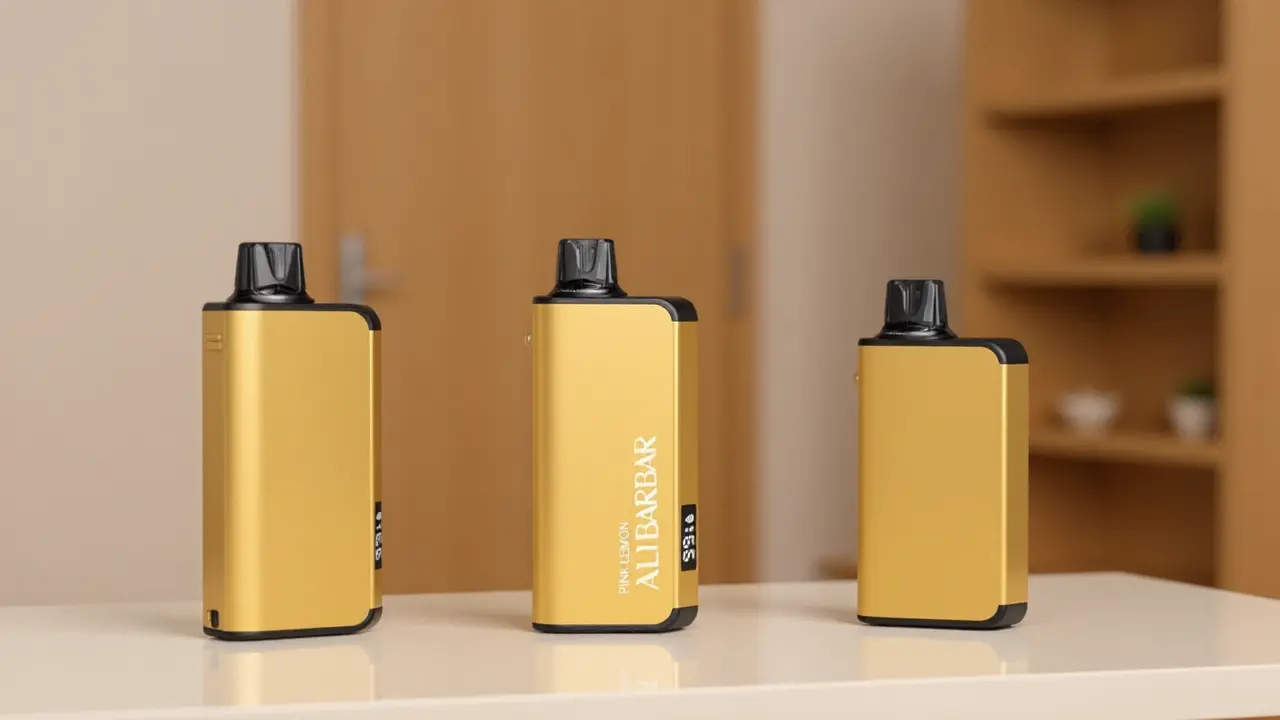
Many sealed devices use a simple LED beacon that blinks when the charge drops below a fixed threshold. Some, like certain units in the ALIBARBAR INGOT series, incorporate a multi‑stage indicator that communicates remaining capacity with far less ambiguity. This is not a luxury; it is a functional safety feature that reduces the likelihood of unintended disposal or the temptation to carry an extra device “just in case.”
Structural Durability and Carry‑Readiness
A device that lives in a pocket or carry‑on must survive body heat, constant friction, and occasional drops onto tray tables. People often overlook the simple design elements that prevent mid‑flight headaches: a recessed mouthpiece that will not collect lint, a flat underside that prevents rolling off a folded tray, and a finish that does not transfer dye onto light‑coloured clothing.
These details might seem trivial until you are in seat 22A with a greasy, lint‑covered mouthpiece and no way to clean it. Choose a device whose physical design anticipates the reality of travel, not just the moment it is held in the hand.
Applying These Criteria to Real‑World Travel Devices
The most instructive way to use this framework is to evaluate a concrete example. Take a device frequently carried by Australian travellers: the ALIBARBAR INGOT 15000. Its battery is rated at 650 mAh — roughly 2.4 Wh. The liquid reservoir is fully sealed and has not generated a pattern of leakage complaints in long‑term community feedback. The exterior carries a clear, etched battery label, and the LED sequence provides a graduated charge remaining readout.
That does not mean it is the only viable option. Other well‑known device families also satisfy the core criteria. The essential difference is documentation. When you cannot locate a battery rating because the manufacturer never published one, you are flying blind. In those cases, even a perfectly safe device can trigger security delays.
For any unit you consider, retrieving a full specification sheet before travel is prudent. Authorised retailers that maintain consistent product data — rather than just promotional imagery — become valuable before a trip. At OZVAPE Shop, the specification table on each product page includes the battery rating, so you can confirm compliance in under a minute.
A Practical Framework for Evaluation
Apply this sequence before you pack any sealed personal device:
Verify the battery rating. Find the labelled mAh and convert to watt‑hours: Wh = (mAh × V) / 1 000, using 3.7 V unless otherwise stated. Confirm it is well under 100 Wh.
Check liquid volume. While not a hard aviation limit in most jurisdictions, a reservoir exceeding 2 mL attracts scrutiny in some countries; confirm your destination’s restrictions.
Inspect for leak history. Search for long‑term use reports, not unboxing videos. A pattern of leakage means it will almost certainly fail at altitude.
Look for a status indicator. Ask: “If I take this out at the gate, can I prove it’s off or low on power without plugging it in?” If the answer is no, carry a small protective case and be prepared to dispose of it if challenged.
Pack in carry‑on only. Never place any lithium‑battery device in checked luggage. The cabin is pressurised; the cargo hold may not be, and a runaway thermal event in an inaccessible compartment is exactly what aviation regulators want to prevent.
Print or screenshot the specification. Security officers respond to evidence. A printed spec sheet showing battery capacity immediately resolves most challenges.
Diagnostic question: “Does my device, as designed, give me enough information to satisfy a security agent within ten seconds?” If not, your device may be fine, but your travel experience rests on an avoidable uncertainty.
Common Selection Errors and Industry Observations
Error 1: Overweighting “High Capacity” Without Checking Battery Specs
Some travellers gravitate toward devices advertised with large liquid capacities, assuming that a bigger reservoir equals a longer-lasting battery. In reality, the relationship is not linear — some high‑liquid units use the same small 400 mAh cell as their compact counterparts and rely on frequent recharging. That smaller cell is still perfectly safe for air travel, but the assumption can create confusion when a passenger realises they need a charging cable for the flight. Always separate “liquid capacity” from “battery capacity” in your evaluation.
Error 2: Assuming Visual Similarity Indicates Equivalent Internal Engineering
Two devices that look nearly identical can differ radically in seal quality and battery sourcing. The outer casing is often a cosmetic shell. The company that contracts the injection moulding is not necessarily the one that builds the battery assembly. Unless you know the supply chain, you cannot infer leak resistance from appearance alone. This is why a documented specification — ideally from an authorised retailer that verifies factory certifications — carries more weight than a photograph.
Error 3: Packing Devices in Checked Luggage for Convenience
The logic seems harmless: place it in the suitcase, avoid the security line. But lithium‑battery fires in the cargo hold are a known risk. Regulations universally prohibit spare lithium‑ion batteries in checked bags, and a sealed device is still a battery. An airline can deny boarding or impose penalties if a device is discovered in a checked bag during screening. The inconvenience of carrying it through the cabin is trivial compared to the potential consequences.
Error 4: Confusing Device Category Terminology
“Disposable,” “rechargeable,” and “single‑use” are marketing labels, not technical classifications. Some rechargeable devices have integrated USB‑C ports and a coil that can last through multiple refills, while others are genuinely sealed and cannot be opened. Security personnel rarely know the difference. What matters is whether the device contains a lithium cell and whether that cell can be removed. If it cannot, it is treated as a portable electronic device, and the 100 Wh rule applies. Assume all sealed personal devices fall under the same battery safety umbrella, regardless of brand terminology.
From an industry perspective, the push toward higher‑capacity rechargeable disposables is creating new friction at checkpoints. A few years ago, the typical battery was 280 mAh; now some devices ship with 1 000 mAh or more. That shift puts more total energy in passengers’ pockets, and while it remains safely below the regulatory ceiling, it increases the scrutiny from agents who are trained to be suspicious of any large‑format lithium cell. Transparent labelling is becoming a competitive advantage, not just a regulatory courtesy.
Frequently Asked Questions
Q: Can I take a disposable electronic device on a domestic flight within Australia?
A: Yes, as long as the battery rating is under 100 Wh. Domestic airlines align with IATA guidelines; carry‑on is required, checked baggage is prohibited.
Q: What if my device does not have a visible battery capacity label?
A: The agent may refuse it. Carry a printed specification or a photograph of the original packaging showing the rating. If that is unavailable, you are travelling with an unverifiable lithium cell — a risky situation.

Q: Is there a limit on the number of devices I can bring?
A: IATA rules permit up to 15 portable electronic devices under 100 Wh for personal use, but individual airlines may impose lower caps. Check with your carrier before packing multiple units.
Q: Can I charge my device on the plane?
A: Only if the airline permits the use of USB ports or power outlets under cabin crew discretion. Devices must not be charged during takeoff and landing. If your device has a built‑in battery that recharges via USB‑C, it is subject to the same rules as a smartphone.
Q: Do pressure changes cause a device to leak?
A: Poorly sealed reservoirs can leak due to pressure differential. Devices with robust internal seals typically withstand cabin pressure without issue. If your device has leaked on the ground, expect airborne leakage.
Q: What happens if a security agent confiscates my device?
A: Confiscation is at the agent’s discretion if they deem the item unsafe. You will not be compensated. The best protection is documented compliance.
Q: Are there different rules for international flights?
A: Yes. The United Kingdom and many EU nations restrict liquid capacity to 2 mL per device. Some Middle Eastern carriers have additional blanket bans. Research destination‑specific regulations well before departure.
Q: Can I place the device in my carry‑on bag within a protective case?
A: A hard case that prevents accidental activation is recommended. If the device has an activation button, ensure it is not pressed by other items. This reduces the remote risk of overheating.
Q: I purchased my device from a local shop but lost the box. How can I confirm battery specs?
A: The retailer’s online product listing is often the quickest reference. Stores like OZVAPE Shop maintain technical specification tabs on each product page that can be retrieved from a smartphone at the terminal.
Q: Will my device set off the metal detector or X‑ray machine?
A: Electronics are expected by screeners. A sealed personal device will be visible on the scan. As long as it is not prohibited (e.g., a power bank over 100 Wh), you will pass through without incident.
Conclusion
The question of whether you can bring a disposable device on a plane does not have a single yes‑or‑no answer. It resolves into a series of verifiable checks: battery capacity, leak integrity, labelling, and the destination country’s rules. Once you understand what information you need, and why it matters, the process stops being intimidating and becomes routine.
Informed users who source their devices through channels that provide complete, consistent data — such as OZVAPE Shop — can verify compliance in a matter of minutes, turning what is often an anxiety‑producing uncertainty into a confident step through security. The right device for travel is not the one with the loudest marketing or the highest liquid count; it is the one that can be understood at a glance by both the passenger and the gate agent.