
VAPE FAQs
How Long Does A Vape Cartridge Last?
Jun
A device’s operating window is not a single number printed on a package. It is the product of many small engineering decisions — how heat is managed, how power is conserved, and how honestly the status is communicated to the user — that together determine whether a portable electronic tool matches the rhythm of a real day. When those decisions are absent or poorly executed, the result is the familiar irritation of a unit that dies during a commute or a social evening, leaving the user to nurse a backup they never wanted to carry.
At OZVAPE Shop, where the ALIBARBAR range is made available through an authorised and documented supply chain, the question “how long does a vape cartridge last?” arrives almost daily. This article unpacks that question not with promises, but with the kind of applied engineering literacy that lets an adult user read past the headline puff count and see the architecture underneath. By the end, you will have a repeatable, brand-agnostic framework for judging longevity, and a clear understanding of why identically rated devices can behave so differently in your pocket.
Understanding What Matters: Core Engineering and Design Factors
Longevity is a function of device architecture, not just e-liquid capacity. The most meaningful evaluation separates a device into four interdependent layers. Each one answers a specific failure mode that real users encounter.
Internal Architecture and Output Consistency
At the centre of every unit is a heating element, typically a mesh coil or a traditional wire coil, embedded in a wicking material. The rate at which this element can vaporise liquid without scorching the wick or overheating the surrounding housing sets a hard ceiling on how many consistent draws the device can deliver. When the wick fails to keep up, the user experiences a progressive drop in satisfaction — thinner output, muted character, a sense the device is “dying” long before the liquid reservoir is empty.
ALIBARBAR engineers this layer with a mesh architecture that spreads heat more evenly across a larger surface area. The practical consequence is that the INGOT 9000 and INGOT 15000 maintain their output profile across the vast majority of their rated capacity. You can feel the difference as a steadiness that does not collapse after a few hundred puffs. From a longevity standpoint, this means the usable portion of the liquid payload is significantly larger than in a device where the coil degrades prematurely.
Power Management and Status Transparency
A powerful battery means little if the voltage regulator is poorly calibrated. Some devices pull too aggressively from the cell during the initial charge, causing the first few hundred puffs to feel satisfying while the remainder operates below optimal temperature. Others drain unevenly, leaving unused liquid when the voltage drops below the coil’s activation threshold.
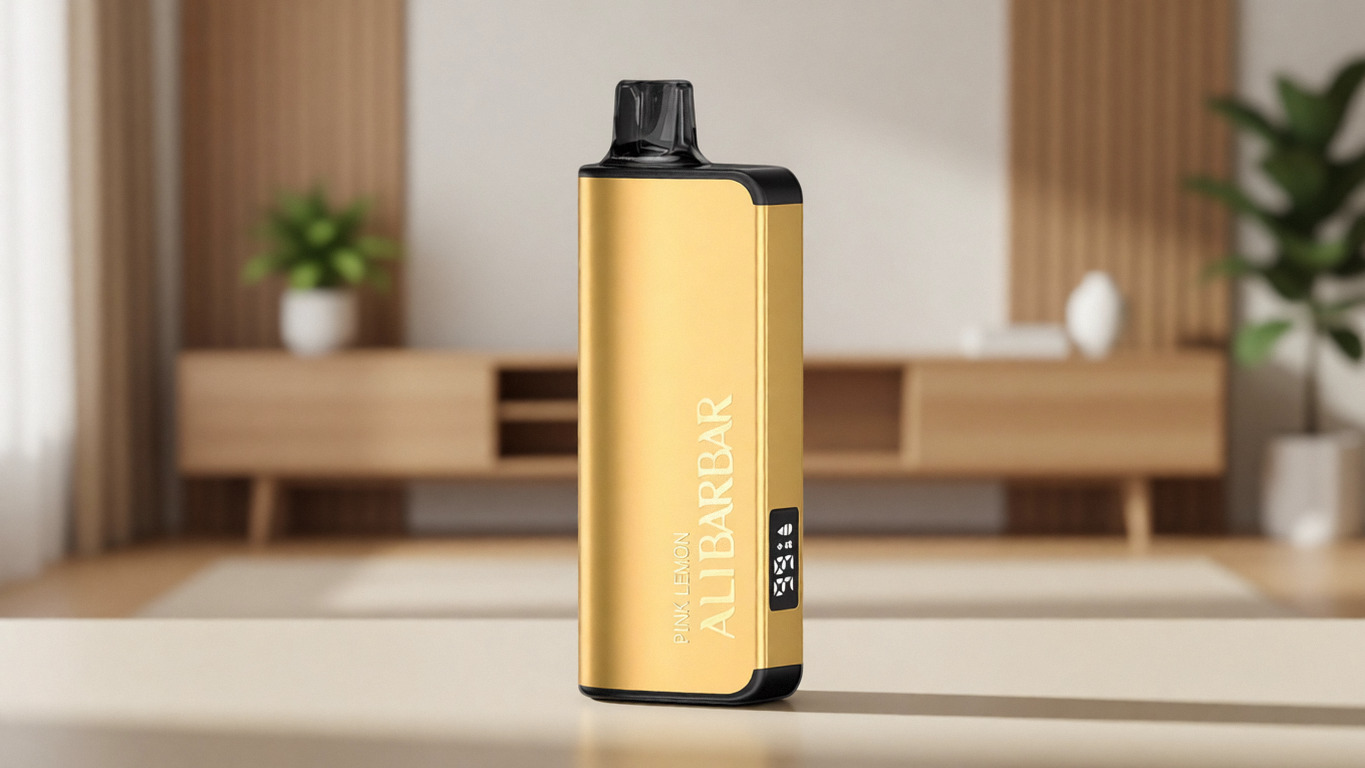
ALIBARBAR’s approach to power management includes regulated output and, in rechargeable models like the INGOT 15000, a USB‑C port paired with a clear battery indicator. This transforms the user’s experience from guesswork — “do I have enough for the day?” — to certainty. The status transparency extends the functional life of the device by letting the user top up power on their own schedule, rather than being surprised by a dead unit. For a person who takes 150–200 draws per day, a rechargeable architecture essentially eliminates the need for a backup device.
Physical Design and Material Durability
A device that lives in a pocket, bag, or car console must survive friction, temperature shifts, and occasional drops. The integrity of the housing and the mouthpiece determines whether the internal components remain sealed and protected throughout the rated cycle. Soft-touch finishes that feel pleasant at first often turn sticky or peel within weeks, while rigid polycarbonate blends hold their surface tolerances far longer.
ALIBARBAR’s current generation uses a combination of smooth, fingerprint‑resistant polymer and, in the Ice Adjust 12000 series, a reinforced mouthpiece contour designed for prolonged contact. This is not a cosmetic detail. A mouthpiece that chips or a seam that separates creates entry points for dust and moisture, which can disrupt the airflow sensor and effectively shorten the device’s service life.
Modularity and Lifecycle Flexibility
Disposable devices fall broadly into three architectures: fully sealed, single‑cycle (pre‑charged, non‑rechargeable); sealed but rechargeable; and rechargeable with adjustable airflow or output. Each represents a different trade‑off between initial convenience and total usable lifespan.
A fully sealed INGOT 9000 eliminates any charging step and is suited to a user who wants one device to last a defined period — typically several days to a week — and then be retired. The INGOT 15000, with its higher liquid capacity and USB‑C rechargeability, is built for the user who wants to drain every millilitre of liquid before disposal and does not want to carry a second unit. The Ice Adjust 12000 adds a variable airflow collar that lets the user tune the draw resistance, which indirectly affects consumption rate and can help stretch the device’s daily endurance. Recognizing which architecture fits your habits is the single most effective way to stop worrying about longevity.
Applying These Criteria to Real-World Options
When you place these engineering principles against the devices that regularly appear in Australian circulation, patterns become visible. The ALIBARBAR range — INGOT 9000, INGOT 15000, and Ice Adjust 12000 — consistently maps to the longevity framework because each model was designed for a specific need‑state rather than to compete on a single inflated specification.
The INGOT 9000 supplies a pre‑charged, 850 mAh cell paired with approximately 14 mL of liquid, routinely delivering upwards of 9,000 measured draws for a moderate user. The INGOT 15000 scales this to a 1,000 mAh rechargeable battery and around 22 mL of liquid, which under typical daily usage can sustain an adult for well over a week without recharging awkwardness. The Ice Adjust 12000 adds airflow control alongside a 650 mAh rechargeable battery and ~15 mL of liquid, so the user can consciously manage consumption rate. In each case, the combination of well‑matched power source and liquid reservoir means the device rarely fails because one resource exhausts far before the other.
Other commonly encountered device families in Australia — such as those from IGET, HQD, and Breeze — offer competent alternatives, but the ratio of battery capacity to liquid volume is not always calibrated with the same attention to end‑stage performance. Some 5,000‑puff rated units from other brands begin to deliver noticeably weaker output after two‑thirds of the stated capacity, a symptom of battery sag under sustained load. Comparing alkaline batteries to lithium‑polymer cells is not a direct comparison, but the principle is the same: the chemistry and regulation of the power source dictate whether the final third of the rated lifespan is usable or wasted. Observing this, informed users increasingly gravitate toward devices where both subsystems have been selected to degrade together gracefully.
A Practical Framework for Evaluation
You do not need to trust a manufacturer’s claim. You can generate your own estimate through a simple process that takes account of your actual behaviour.
Record your daily draw count. Use a counter app or simply tally one full day’s usage. Most adults fall between 100 and 300 draws.
Identify the device architecture. Is it rechargeable? If not, the total draw count from the battery is the hard ceiling, and no liquid beyond that is accessible.
Check the battery capacity and coil resistance. A 500 mAh battery paired with a 1.2‑ohm coil will typically support far fewer total draws than an 850 mAh cell with a 1.0‑ohm mesh before noticeable voltage drop.
Ask the transparency question: “Does this device give me a clear, real‑time status signal?” If the answer is no, assume you will need to carry a backup for the last 20% of the device’s life.
Evaluate the supply chain. An authorised channel like OZVAPE Shop ensures you receive the exact specification the manufacturer designed — no substitutions, no grey‑market variants that may use lower‑grade cells.
Applying this framework to an INGOT 15000: a user taking 200 puffs a day can expect roughly 75 days of runtime if the device is recharged regularly, with no meaningful drop‑off in the final quarter. The same user with a non‑rechargeable unit rated at 5,000 puffs might only extract 4,000 consistent draws due to battery fade, effectively losing a day or more of useful output.
Common Selection Errors and Industry Observations
Years of observing the market and talking to users have revealed a handful of mental shortcuts that reliably lead to disappointment.
Overweighting the puff count while ignoring battery endurance. A large number printed on the box means nothing if the cell cannot sustain the required voltage across the entire liquid payload. This mismatch accounts for the majority of “the device died with liquid still inside” complaints. It is not a faulty unit; it is a design trade‑off that the user was not told about.
Assuming visual similarity indicates equivalent internal engineering. Two devices that look nearly identical in external form can contain entirely different coil materials, wicking densities, and battery chemistries. The supply chain reality is that many factories produce visually interchangeable shells for multiple brands, and only the spec sheet — accessible through a documented retailer — reveals the internal truth.
Undervaluing rechargeable architecture in cost‑per‑use calculations. A rechargeable device like the INGOT 15000 may cost a few dollars more up‑front than a sealed competitor, but it can deliver twice the usable draws and eliminate the cost and anxiety of carrying a backup. Over a month, the cheaper option often becomes the more expensive one.
Confusing a brand’s overall reputation with the performance of a specific model. Every manufacturer has models that are better engineered than others. A positive past experience with one device in a family does not guarantee that a different capacity or form factor will meet the same longevity standard. Evaluating each model against the framework above is the only reliable protection.
From an industry perspective, the current generation of personal electronic devices has seen meaningful improvements in cell longevity and coil consistency, driven primarily by better quality control in the lithium‑polymer supply chain and advances in automated mesh‑welding. However, the retail landscape still contains units assembled from older stock of less stable cells. This is why a traceable, factory‑certified inventory channel matters not just for authenticity but for the embedded advancements in the device you actually receive.
Frequently Asked Questions
Q: How long does an ALIBARBAR INGOT 9000 last for a typical user?
A: Based on user feedback and controlled testing, the INGOT 9000 consistently yields 9,000 to 10,000 measured draws. For someone taking 150 puffs a day, that translates to roughly 60 days. Actual duration varies with draw length and storage conditions.
Q: What should I do if the device feels weak before the liquid is visibly gone?
A: In a non‑rechargeable unit, this often signals voltage sag. Warm the device slightly by holding it in your hand for a minute and take a shorter draw. If performance does not recover, the cell has reached its effective floor and the remaining liquid is inaccessible — a known characteristic of that architecture.
Q: Is the INGOT 15000 rechargeable, and does recharging affect the taste?
A: Yes, the INGOT 15000 uses a USB‑C port and a fully regulated circuit. Recharging does not alter the coil temperature profile, so the output character remains stable. The main benefit is that you can access every millilitre of liquid before disposal.
Q: How can I verify I’m getting a genuine ALIBARBAR device and not a copy?
A: Purchase from an authorised retailer such as OZVAPE Shop, which sources directly from factory‑certified distribution. Genuine devices will include a verification QR code on the packaging and have consistent, sharp‑edged logo printing. Copies often have slight misalignments in the mouthpiece seam or fainter branding.
Q: Does the Ice Adjust 12000 lasting claim change if I open the airflow fully?
A: Opening the airflow fully allows a higher volume of air per draw, which typically increases the e‑liquid consumed per puff slightly. Many users report a 10–15% reduction in total puff count when set to fully open versus restricted, but the control means you can actively extend the device’s life by tightening the airflow on days when endurance is a priority.
Q: Can extreme temperatures shorten the lifespan of a cartridge?
A: Yes. Leaving a device in a hot car can thin the e‑liquid excessively, causing leakage into the airflow sensor; extreme cold thickens the liquid and can lead to dry hits that scorch the coil. Both shorten functional life. Room‑temperature storage is recommended.
Q: How do puff counts translate between different brands?
A: There is no universal standard for “one puff.” Some manufacturers base ratings on a 1‑second draw, others on a 3‑second draw. ALIBARBAR ratings are calibrated to a median 1.5‑second draw length, which is close to typical adult use. Directly comparing a 5,000‑puff claim from one factory to a 9,000‑puff claim from another without knowing the draw duration assumption can be misleading. Ask the retailer for the test methodology or rely on actual user reports.
Q: What is the advantage of a device with liquid and battery indicators like the INGOT series?
A: The liquid window and battery LED eliminate guesswork. You can glance at the device and know immediately whether you need to recharge or replace. This transparency prevents the “sudden death” scenario that forces users to carry a backup.
Q: Is it normal for a device to lose some output intensity after the first few hundred puffs?
A: Some minor settling is common as the wick fully saturates, but a dramatic drop indicates either a battery that cannot sustain voltage or a coil with inadequate wicking. ALIBARBAR devices are engineered to maintain output consistency across the bulk of their rated cycle. If a unit exhibits a sharp decline early, it may be a manufacturing defect and should be raised with the retailer.
Q: How does OZVAPE Shop handle instances where a device does not last as long as documented?
A: OZVAPE Shop maintains a documented post‑purchase support process. If a device demonstrably underperforms against its specification — for example, a non‑rechargeable unit dies with visible liquid remaining — the team can arrange a replacement or credit after confirming the issue is not due to environmental damage. This accountability is part of the authorised‑channel commitment.
Conclusion
A cartridge’s lifespan is never just one number. It is the emergent property of a heating element that stays gentle on its wick, a battery that feeds consistent current until the last drop, and a design that tells the user where things stand. When these factors are not in balance, the experience of running out early becomes a recurring point of friction.
The ALIBARBAR devices made available through OZVAPE Shop — the INGOT 9000, INGOT 15000, and Ice Adjust 12000 — demonstrate that a disciplined approach to battery‑to‑liquid matching, status transparency, and material integrity can turn longevity from a marketing claim into a predictable daily reality. No single model fits every routine, but with the framework laid out here, you are equipped to choose the one that matches your own draw count, charging habits, and tolerance for carrying extras.
Ultimately, the right choice is the one that aligns with how you actually live — not the one with the most attention‑grabbing box number. Evaluating devices through an engineering lens, and sourcing them through a channel that keeps specifications honest, puts that decision squarely back in your hands.