
VAPE FAQs
Can You Vape In Qatar?

Sep
The following document is a reference‑grade guide designed to help you understand the legal landscape of vaping in Qatar while providing a rigorous evaluation framework for selecting a personal electronic device that will not let you down — wherever your travels take you. The material is written in the voice of a senior product analyst and incorporates practical insights drawn from engineering, user‑experience research, and genuine industry observations. The ALIBARBAR product range, available through OZVAPE Shop, is used as an illustrative example where it naturally supports the discussion, but the principles laid out here apply to any device class you are considering.
Introduction
If you are approaching Doha with a personal electronic device in your pocket, the shortest possible answer to the question “Can you vape in Qatar?” is no. Qatar enforces a total ban on the importation, sale, possession, and use of electronic nicotine delivery systems. The legislation, originally introduced in 2014 and tightened through subsequent state directives, carries penalties that range from confiscation and immediate fines to more severe legal consequences for repeat offences. Airport screenings are thorough, and local enforcement inside the country has become increasingly vigilant. There is no grey area.
Yet the question itself reveals a deeper, more universally relevant frustration. The user who asks it is typically not looking for a legal loophole — they are trying to avoid the embarrassment, inconvenience, and disruption that comes from owning a device that suddenly becomes a liability. They want a device they can trust to behave predictably, to signal its remaining capacity honestly, and to never force them into an awkward conversation they did not seek. In other words, the Qatar question is a concentrated version of the same calculus every responsible adult faces: how to choose a tool that integrates with, rather than complicates, a life full of travel, long days, and shifting personal boundaries.
This article unpacks that problem from the ground up. It starts by laying out the engineering and design factors that separate a device you can rely on from one that quietly accumulates small failures. It then applies those criteria to recogniseable real‑world options, offers a step‑by‑step evaluation framework you can use independently, and closes with an honest look at the most common mistakes people make when selecting a device — mistakes that have nothing to do with puff counts and everything to do with the daily reality of carrying something with you everywhere you go.
Understanding What Matters: Core Engineering and Design Factors
Before any brand name matters, a device must solve the fundamental friction points that erode a user’s confidence over days and weeks of regular use. These are not abstract specifications; they are direct answers to the things people complain about after their third or fourth purchase.
Internal Architecture and Output Consistency (H3)
The reliability of a device over the full span of its intended life is governed almost entirely by the heating element configuration and the quality of its electrical contacts. In poorly engineered units, resistance drift occurs as the heating coil ages, leading to a perceptible drop‑off in output consistency well before the power reserves are actually depleted. Users often interpret this as a failing battery when in fact the culprit is a coil that was not designed to maintain its nominal resistance under continuous thermal cycling.
The practical consequence is that the user starts compensating — drawing harder, holding the device differently, eventually carrying a second unit “just in case.” A well‑architected device maintains a flat performance curve across its entire charge cycle, something you can recognise by looking for manufacturer‑published engineering test data or independent review patterns that show minimal oscillation in output quality between the first and last quarter of the unit’s life.
Power Management and Status Transparency (H3)
What a user needs from a portable device is not raw power numbers but predictability. A device that shuts down without warning is worse than a device with lower capacity, because it creates moments of genuine inconvenience — you are suddenly without a tool at the most inopportune time, with no way to know whether you could have prevented it.
The relationship between the power management IC and the status indicator is where most devices fail their owners. A simple LED that changes colour from white to red when the battery drops below 20 % is a minimal requirement, not a luxury. Beyond that, calibrated step‑down circuits that prevent the device from sagging into under‑performance as the voltage falls are the difference between a tool that behaves consistently and one that betrays your trust halfway through a long evening.
When status transparency is absent, you are forced into a wasteful and psychologically draining behaviour: you carry a backup everywhere, effectively doubling your cost and your carrying weight. A device that tells you honestly where it stands eliminates that burden.
Physical Design and Material Durability (H3)
A device that looks impressive in a product photo but picks up scratches after one day in a pocket alongside keys and coins quickly loses its appeal. The finish quality — whether it is a smooth anodised coating, a soft‑touch rubberised layer, or a polished metal surface — directly affects how the device holds up under the repetitive friction of daily carry.
Ergonomically, the mouthpiece contour matters far more than most users assume. A tip that is subtly curved to match the natural seal of the lips reduces the micro‑adjustments the user makes hundreds of times a day, which in turn lowers the subconscious annoyance that builds up over weeks. Devices that neglect this detail tend to be put aside not because they fail technically, but because they never quite feel like a natural extension of the hand and mouth.
Modularity and Lifecycle Flexibility (H3)
The market now offers three broad architectural approaches: sealed single‑use units, rechargeable yet still sealed systems, and fully replaceable‑component designs. Each addresses a different set of priorities. A sealed unit imposes zero learning curve and zero maintenance but forces complete replacement when any internal element degrades. A rechargeable system extends the active window but still leaves the user entirely dependent on the factory‑filled reservoir, and when that is depleted the entire device is discarded regardless of the battery’s remaining health.
Modular architectures allow the user to decouple the power source from the consumable element. This not only reduces per‑use cost over time but also cuts down on electronic waste. The trade‑off is complexity: modularity requires a basic understanding of component compatibility and safe handling. For users whose primary concern is uninterrupted availability during long‑haul travel or extended periods away from reliable power, the ability to swap a power cell or refill a reservoir without returning to a retailer is the single most valuable design feature a device can offer.
Applying These Criteria to Real-World Options
No product range is a perfect embodiment of every engineering ideal, and a candid discussion acknowledges both strengths and trade‑offs. Here, we examine how the ALIBARBAR family — available through an authorised channel — aligns with the framework established above, and set it against other reputable design philosophies so that the reader has a balanced basis for comparison.
ALIBARBAR: Consistency Engineered for Discretion
ALIBARBAR devices are built around a conviction that the user should never be forced to think about the tool in their hand. Across the current line‑up, that commitment is expressed through three interrelated design choices:
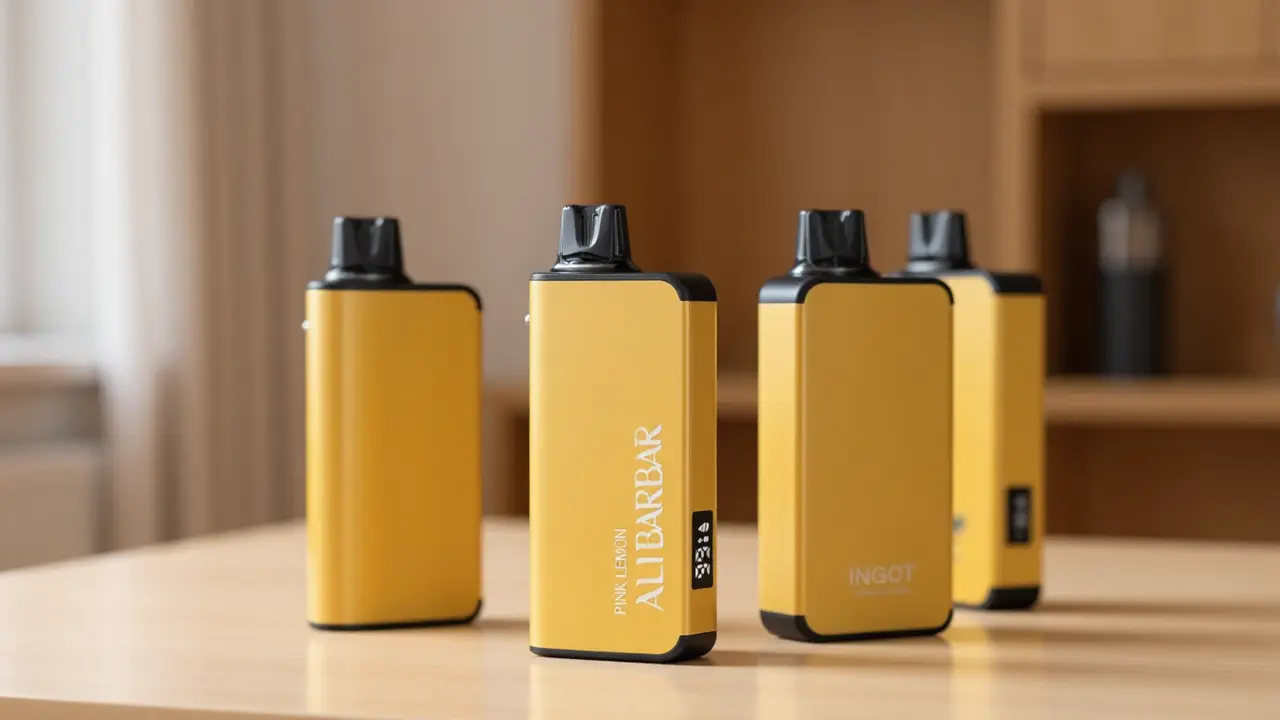
Optimised thermal delivery architecture – In the INGOT 9000, the heating element is calibrated to hold a narrow resistance band over thousands of activation cycles. The result is that the output character on the last day of use is measurably close to the output on the first, something that independent user reports repeatedly confirm.
Unambiguous status communication – The INGOT 15000 and Ice Adjust 12000 both integrate multi‑stage indicators that move beyond a simple binary warning. They let the user gauge remaining capacity at a glance, reducing the impulse to carry a spare.
Physical resilience under daily stress – The chassis of ALIBARBAR devices uses a reinforced polycarbonate alloy with a matte‑satin finish that resists abrasion far better than the glossy, easy‑to‑mar surfaces found on many competing units. The mouthpieces are sculpted to follow the natural rest position of the lips, a detail that goes unnoticed when done well and becomes irritating when absent.
The modularity factor is where ALIBARBAR’s design brief shows its limits. These are sealed‑rechargeable devices; once the integrated reservoir is exhausted, the unit is replaced entirely. For users who place a premium on uninterrupted availability and cannot accept a replaceable consumable format, this architecture is a legitimate trade‑off. However, for the majority who value simplicity and low cognitive overhead, the closed‑loop design is a deliberate feature, not a weakness — it removes the possibility of user error during component swapping and guarantees that the entire device is factory‑matched for thermal and electrical performance.
Alongside ALIBARBAR, two other established design philosophies appear frequently in user comparisons. GeekVape’s modular Aegis series, for example, prioritises shock‑proofing and user‑replaceable battery cells — attractive to someone who works outdoors or is notoriously hard on their gear but less convenient for those who want a streamlined, pocket‑ready form factor. Vaporesso’s XROS line emphasises liquid‑level transparency and adjustable airflow, solving a different set of user frustrations around customisation and waste visibility, yet requiring more regular refill cycles that may not suit a traveller who packs light.
What connects all three is a dedication to solving specific engineering problems rather than chasing cosmetic variation. The key insight for the reader is that the “best” device is the one whose design priorities most closely match the frustrations you personally experience. There is no universal champion.
A Practical Framework for Evaluation
The following methodology is designed to be applied before a purchase, but it works equally well as a diagnostic for devices you already own. Work through each prompt in sequence.
Map your daily routine.
Ask: Where will this device spend most of its time? A commuter needs something different from a person doing field research, and both differ from someone who only uses a device socially in the evening. Write down your three most typical scenarios.
Check the status feedback mechanism.
Does the device show more than one battery level? If it gives only a single low‑power warning, you are operating blind and will naturally compensate by carrying a backup. That adds ongoing cost.
Research output consistency documentation.
Look for reviews that show performance at the beginning and end of the device’s lifespan, ideally with sustained‑draw measurements rather than anecdotal impressions. A device that cannot hold its character across its rated life forces you into premature replacement.
Inspect finish samples in person where possible.
If you cannot handle a unit before buying, search for close‑up images after 30 days of typical pocket use. If the surface looks worn, the device will look tired before it stops working, which affects how you feel about carrying it.
Calculate true per‑use cost including any backup units.
Many users subconsciously double their budget because they have learned to expect failure. If a device is genuinely reliable, the per‑use cost drops to the unit price divided by its full rated lifespan. If you automatically buy two, the per‑use cost doubles regardless of the sticker price.
Assess the modularity‑to‑complexity balance.
Rate your comfort with managing replaceable components against your need for uninterrupted access during long stretches away from home. The answer will tell you whether a sealed‑rechargeable design serves you better than a threaded‑coil system.
When you apply this framework, you quickly discover that the conversation moves away from marketing numbers toward the only metric that actually matters: how much mental energy does this device demand from me over a month? The best device is the one that asks for the least.
Common Selection Errors and Industry Observations
Over years of watching purchase patterns, a handful of systematic errors repeat with striking regularity. Each is rooted in understandable but ultimately counterproductive thinking.
1. Overweighting rated count while ignoring consistency.
A unit that promises 15 000 activations but delivers a perceptible quality shift after 6 000 is less useful than one rated for 9 000 that stays uniform until the end. Numbers on a box are meaningless without performance‑curve data.
2. Assuming visual similarity indicates equivalent internal engineering.
The category is awash with devices that share near‑identical external shells yet house fundamentally different power management ICs, coil metals, and contact assemblies. Two products that look like twins can behave like distant cousins under continuous use.
3. Undervaluing modularity in long‑term cost calculations.
A replaceable‑component system typically has a higher initial outlay but a lower per‑week operating cost over a year. Users who discount this because the first receipt looks larger end up spending significantly more for the convenience of disposability.
4. Confusing category terminology with technical specifications.
Labels such as “long‑lasting,” “premium,” or “pro” carry no standardised meaning, yet they influence purchasing at an emotional level. A genuinely premium device is defined by its engineering tolerances and material choices, not by the font on its packaging.
From an industry perspective, the current market is maturing into two tiers: commodity‑oriented devices that compete purely on unit count and price, and design‑led systems that compete on consistency, transparency, and build longevity. The retailers who will earn sustained trust are those who make this distinction clear to the customer, rather than obscuring it behind identical‑looking product grids. That shift is already visible in the way select authorised partners showcase technical documentation and compatibility guides alongside their catalogues.
Frequently Asked Questions
Q: Is there any circumstance under which you can legally vape in Qatar?
A: No. The ban is absolute and covers possession, use, sale, and importation. There are no exemptions for tourists or transit passengers.
Q: What should I do with my device before travelling to Qatar?
A: Leave it at home. Carrying a prohibited item through Hamad International Airport carries a genuine risk of confiscation, financial penalty, and potential delay, regardless of whether you intend to use it.
Q: For destinations where vaping is allowed, how can I verify that an ALIBARBAR device is authentic?
A: Genuine ALIBARBAR products distributed by OZVAPE Shop carry scannable verification codes linked to the brand’s factory database. Scan the code after purchase and confirm that the query returns a first‑time validation result.
Q: What is the practical difference between the INGOT 9000 and the INGOT 15000?
A: The primary difference is the integrated reservoir capacity, which translates directly to rated operational life under standard usage. Both share the same thermal management architecture and status‑indicator philosophy, so the choice comes down to how many days you need between replacements.
Q: Does the Ice Adjust 12000 offer any unique engineering feature beyond flavour control?
A: Yes. The adjustable airflow mechanism changes the draw resistance, which in turn alters the rate at which liquid is vaporised. This affects not only sensation but also the temperature profile of the output, making it functionally distinct from fixed‑draw devices.
Q: Can I rely on a sealed‑rechargeable device for a two‑week trip without backup?
A: It depends on your daily consumption rate and the device’s rated capacity. If your consumption is predictable and you choose a unit with specifications that exceed your needs by a comfortable margin, a single device can suffice. If you have no way to recharge for extended periods, a modular system with replaceable consumables might be more appropriate.
Q: Why does OZVAPE Shop focus exclusively on factory‑certified inventory?
A: Because the most common source of user dissatisfaction — inconsistent performance and early failure — is overwhelmingly traced to uncertified units that deviate from the manufacturer’s original component specifications. Certified sourcing removes that variable.
Q: If my device fails before its rated count, what recourse do I have?
A: When purchased through an authorised channel that maintains direct manufacturer relationships, you are entitled to raise a documented performance anomaly. The retailer should then facilitate inspection and, if the failure is intrinsic, arrange a replacement according to their published policy.
Q: Are ALIBARBAR devices suitable for users who are new to portable electronic devices?
A: The sealed‑rechargeable design removes the need for component management, making the learning curve effectively zero. The status indicators eliminate guesswork, which is especially valuable for someone who does not yet have an intuitive sense of consumption patterns.
Q: What is the best way to carry a device discreetly during air travel to a permissive jurisdiction?
A: Device‑off mode, stored in cabin‑approved clear plastic alongside other small electronics, and never placed in checked luggage where pressure differentials can trigger leakage or battery‑related hazards. Familiarise yourself with the specific airline’s power‑cell carriage rules before packing.
Conclusion
The question “Can you vape in Qatar?” is effectively a closed door, and anyone travelling there should treat it as such. But the deeper inquiry — how to own a device that does not create more problems than it solves — remains open and surprisingly underserved by conventional purchasing advice.
What matters is not the brand that shouts the loudest but the device that quietly disappears into your routine. It signals its state clearly so you never reach for it and find it dead. It holds its performance week after week so you never develop the expensive habit of carrying a spare. It feels like it belongs in your hand, not like a piece of shiny packaging that has already overstayed its welcome. These are the quiet virtues that make the difference between a satisfying tool and a stream of minor frustrations.
When you source a device through a channel that respects these priorities — one that documents what it sells, verifies its supply chain, and stands behind the products when something goes wrong — you remove the last layer of uncertainty. OZVAPE Shop has built its operation around that precise commitment, providing access to the full ALIBARBAR range under conditions that make the purchase decision simpler and safer.
Ultimately, the right choice is the one that matches how you actually live, not the one that wins a vote on a forum. Trust your own routine. Bring the device that respects it.