
VAPE FAQs
Can You Vape In Non Smoking Hotel Rooms?
Aug
When you check into a hotel room marked “non‑smoking,” the immediate assumption is that the prohibition applies to traditional cigarettes only. Many adult users of personal electronic devices operate under a parallel assumption: if there is no smoke, no ash, and no lingering stale smell, then the restriction does not apply to them. That assumption, however convenient, overlooks a more complicated reality. Hotel policies, detection technology, cleaning protocols, and the physiological mechanics of vapour dispersal all intersect in ways that create genuine risk — financial, social, and legal — even when the device in question produces nothing resembling cigarette smoke.
This article addresses that intersection. It does so without scare tactics or casual permissiveness. Instead, it examines the engineering factors that determine how a device behaves in a confined hospitality environment, maps those factors against real‑world enforcement patterns, and provides a concrete evaluative framework for anyone who needs to reconcile personal preference with shared‑space responsibilities. Along the way, we will reference observed patterns from the Australian market, where OZVAPE Shop has become a reference point for adult users seeking factory‑certified inventory and transparent product specifications — the kind of clarity that matters when you need to understand exactly what a device emits and under what conditions.
Understanding What Matters: The Physics of Detection and Discretion
A hotel room is a sealed micro‑environment. Unlike an outdoor space where vapour dilutes almost instantly, a hotel room traps airborne constituents, permitting them to settle on surfaces, interact with HVAC sensors, and accumulate to concentrations that modern detection equipment can identify with surprising precision. Understanding whether — and how — a device can be used in such a setting without triggering consequences requires examining four engineering and design dimensions, each tied to a specific detection pathway.
Vapour Volume and Residence Time
The single most influential factor is the volume of aerosol a device produces per activation cycle and how long that aerosol remains suspended. Devices with high‑output heating elements and unrestricted airflow generate large, dense clouds that take several minutes to dissipate even in a ventilated room. During those minutes, optical smoke detectors — which work not by chemical analysis but by beam interruption — can be triggered exactly as they would by smoke from a candle or a toaster. This is not a theoretical risk; hotel maintenance logs frequently record false alarms caused by personal vapour devices, and many properties now treat any alarm activation as a de facto smoking violation, levying deep‑cleaning fees regardless of the substance involved.
In contrast, devices engineered for restrained output — those with tighter airflow restriction and calibrated power curves — produce a smaller particulate load. The vapour disperses faster and is less likely to reach detector‑triggering density. The practical distinction here is not between “safe” and “unsafe” but between a high probability of attention and a lower one. When evaluating a device for hotel use, vapour volume is the first parameter to assess.
Odour Persistence and Carriers
Many adult users believe that because their chosen formulation produces an aroma they find pleasant, it will not be considered objectionable. This confuses personal preference with environmental impact. Most hotel‑grade HVAC filters and room sensors are not sensitive to aroma character; they respond to volatile organic compounds (VOCs) and particulate mass. That fruity or mentholated note that dissipates in a living room with open windows can cling to hotel upholstery, curtains, and carpet fibres for hours, especially in rooms with sealed windows and recirculated air. Housekeeping staff are trained to identify those residual signatures, and many properties now use handheld particulate counters during post‑checkout inspections. A device that leaves a strong scent trail, even if the user no longer perceives it, is a device that leaves evidence.
Mechanical Noise and Indicator Visibility
Discretion is not solely about what is emitted; it is also about what others can hear and see. Devices with noticeable crackling during activation, or those equipped with bright LED indicators that pulse in a darkened room, draw attention in environments where privacy is the baseline expectation. A device designed with silent‑mode operation or subdued indicator logic allows a user to blend into the ambient background. This may seem minor, but in a hotel corridor at midnight, a device that chirps or flashes is an audible and visible signal that can prompt a complaint before any vapour reaches a detector.
Leak Resistance and Pocket‑Safety
A final, often overlooked factor is containment integrity. A device that weeps formulation residue in a pocket or on a nightstand introduces a different kind of evidence: a stain that carries the same volatile constituents that housekeeping is trained to recognise. Moreover, formulation leakage can corrode device contacts, leading to inconsistent performance and unexpected shutdowns — which, in a hotel setting, might leave a user without a functional unit precisely when discretion is most needed. Well‑engineered devices use sealed cartridge architectures and pressure‑equalised reservoirs to prevent leakage even under the temperature swings experienced during travel.
Applying These Criteria to Real‑World Options
When a user walks into a hotel lobby, the decision about whether to use a device in‑room has already been shaped by the device they chose to pack. Three broad device families illustrate how the engineering factors above translate into real‑world risk profiles.
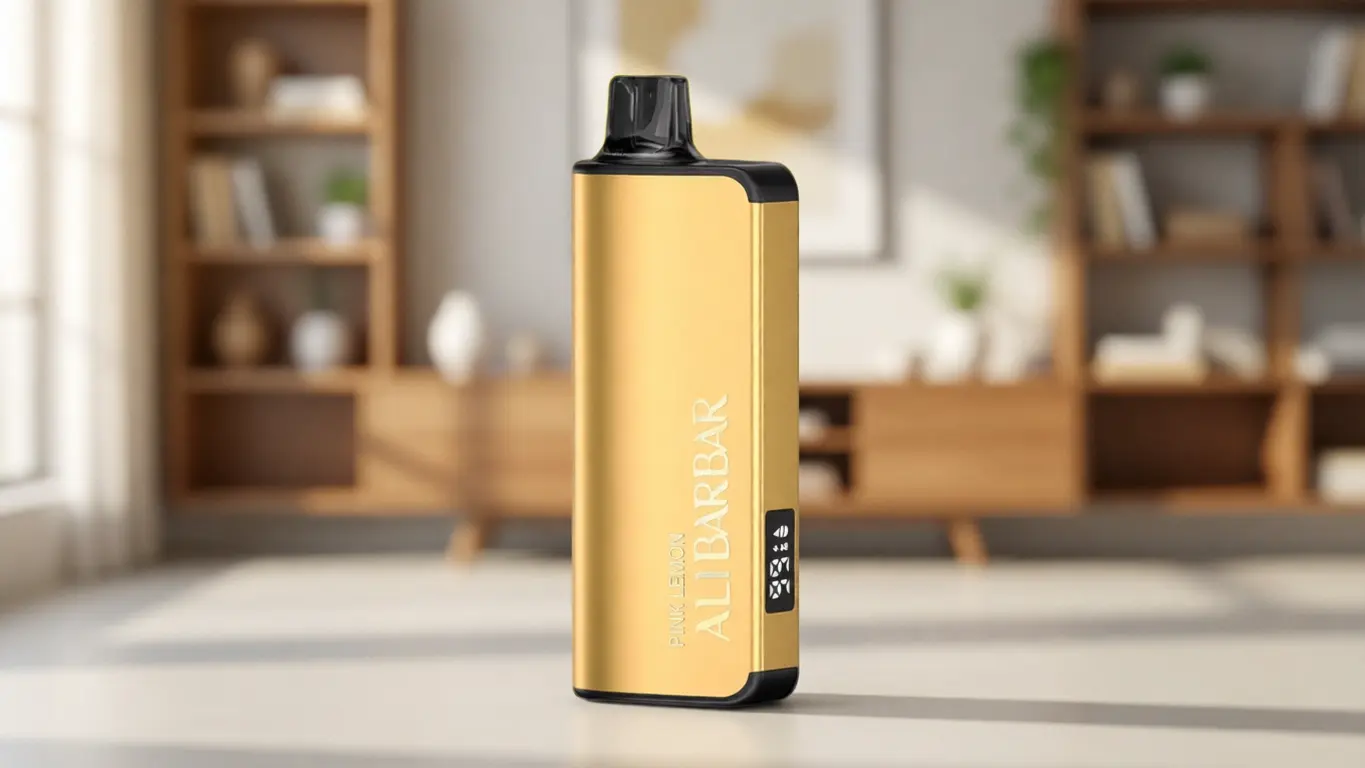
Ultra‑compact, single‑cycle units with no user‑adjustable controls represent the minimal‑footprint end of the spectrum. These devices — such as the ALIBARBAR INGOT 9000 series, often sourced through verified retailers like OZVAPE Shop — prioritise pocketability and noise suppression. Their factory‑calibrated power curves keep cloud density low enough that, in a room with moderate ventilation, the vapour beam rarely reaches the ceiling smoke detector housing. The sealed architecture also eliminates leak anxiety during travel. The trade‑off is capacity: a user planning an extended stay may need more than one unit, which must be factored into packing decisions. For a one‑ or two‑night trip, the calculus tends to favour discretion.
At the opposite end are large‑reservoir, high‑output devices with adjustable airflow. When an ALIBARBAR Ice Adjust 12000 unit is set to fully open draw, it can produce a vapour volume that will reliably set off an optical detector in under a minute if the room is poorly ventilated. Yet that same device, when dialled to its most restricted setting, approaches the output profile of a much smaller unit. This duality underscores an important principle: device architecture sets the boundary conditions, but user configuration determines where within those boundaries the actual behaviour falls. A knowledgeable user who understands the relationship between airflow setting and cloud density can adapt a single device to different environments — something not possible with fixed‑output alternatives.
A third category, rechargeable modular systems with replaceable cartridges, offers a different kind of lifecycle control. Because the heating element can be replaced independently, performance consistency is maintained across many months, eliminating the gradual output decline that can tempt a user to draw harder (and thus produce more vapour) from a fading device. For a frequent traveller who values consistent, predictable behaviour from a single platform, this modularity provides a reliability advantage. However, the larger form factor and refill procedure introduce handling steps that reduce convenience relative to ready‑to‑use units, a trade‑off each user must weigh against their travel patterns.
A Practical Framework for Evaluation
Rather than asking “Can I vape in a non‑smoking hotel room?” — which invites a binary answer that does not exist — the more useful question is: “Under what conditions would the device I am carrying generate negligible detectable output inside a standard hotel room?” The following framework turns that question into a checklist.
Step 1: Measure output at your lowest‑power setting.
In a controlled home environment, activate the device and observe how long visible vapour remains suspended in still air. If it lingers beyond 30 seconds in a room with closed windows, the device’s baseline output is high and will require deliberate ventilation management in a hotel room.
Step 2: Evaluate scent transfer.
Ask a non‑user to enter the room five minutes after activation and report what they smell. If they detect anything identifiable, assume hotel staff will as well. Odour‑neutralising formulations exist, but the lowest‑risk path is to use a device whose emissions leave no persistent aromatic footprint. Some device families, including several ALIBARBAR variants stocked by OZVAPE Shop, are specifically noted for clean‑burning profiles that minimise residue.
Step 3: Identify your detector‑evasion strategy.
Optical smoke detectors sit on the ceiling. Vapour rises. The most reliable mitigation — short of not using the device — is to direct all exhalation into a dense, damp towel placed over the bathroom exhaust fan intake. This combines mechanical capture with immediate extraction. A device with low‑volume output makes this technique feasible; a high‑output cloud‑chaser defeats it because the towel becomes saturated too quickly.
Step 4: Check for lingering physical evidence.
Wipe down all hard surfaces near the usage area with a damp cloth after use. Residue can settle invisibly and react to cleaning chemicals later, leaving a telltale film. A leak‑proof device is essential; otherwise, the cleaning cloth may simply smear formulation residue across a wider surface.
This framework makes no legal claims. It simply acknowledges the physics and sensory realities of hotel environments and gives the user a way to evaluate their own equipment honestly.
Common Selection Errors and Industry Observations
The gap between how a device is marketed and how it performs inside a hotel room is wide, and several persistent misunderstandings drive most of the negative outcomes.
Overweighting flavour nuance while ignoring emission density. A device praised for its “rich profile” often achieves that richness through increased power and higher liquid consumption per activation, which directly increases vapour output. Marketing copy almost never quantifies cloud density in a hotel‑relevant way, so users inadvertently select the worst possible device for a non‑smoking room simply because they prioritised sensory experience over environmental compatibility.
Assuming all “discreet” form factors are functionally discreet. A device that looks like a USB stick may still produce a visible plume if its heating element is oversized relative to its body. Visual similarity to an innocuous object does not guarantee low emission; only measured output volume and scent persistence can determine that. Several compact ALIBARBAR devices achieve genuine discretion because they were engineered with restricted airflow and moderate power curves, not because of their external shape alone — a distinction that users who rely solely on appearance miss entirely.
Undervaluing operational silence. In a quiet hotel room at 2 AM, the sound of a crackling atomiser can be as distinctive as a whisper. Many devices generate internal noise due to wicking saturation dynamics, and manufacturers rarely publish a decibel rating. Travellers who prioritise an uninterrupted night’s stay will gravitate toward devices built with noise‑dampened airflow paths, a design choice that is visible only when one examines teardown analyses or trusted retailer specifications — the kind of detail that OZVAPE Shop makes accessible for the products it carries.
Confusing hospitality technology with cigarette‑specific detection. Modern hotel smoke detectors are multi‑criteria devices that combine optical, thermal, and sometimes CO₂ sensing. They are designed to detect any particulate source capable of obscuring a beam, not just tobacco smoke. A user who believes that “vaping won’t set off a smoke alarm because it’s not smoke” is operating on outdated information. The industry has adapted, and enforcement has grown more systematic. The user’s defensive strategy must adapt accordingly.
Frequently Asked Questions
Q: Can a vapour device trigger a hotel smoke alarm?
A: Yes. Optical smoke alarms detect particulate density, not chemical composition. A sufficiently dense cloud of vapour can interrupt the light beam and activate the alarm just as smoke would.
Q: Will a hotel automatically charge a cleaning fee if they suspect vaping?
A: Many properties have updated their terms to treat any unauthorised indoor use of electronic devices as equivalent to smoking, incurring fees that range from $150 to $500. The detection may occur through sensor activation, staff observation, or post‑departure inspection.
Q: Are there devices specifically designed to produce less visible vapour?
A: While no device is marketed as “hotel‑safe,” those with restricted airflow, lower operating power, and compact form factors produce less visible aerosol. Checking the specifications for power output and airflow design provides an objective basis for comparison.
Q: Does the scent of a vapour disappear faster than cigarette smoke?
A: It dissipates more quickly than combustion by‑products but can still cling to fabrics for several hours. The specific formulation carrier (propylene glycol vs. vegetable glycerin ratio) affects persistence, with VG‑heavier formulations tending to linger longer.
Q: Is it better to use a device in the hotel bathroom with the exhaust fan on?
A: This can reduce detectable particulate in the main room, but bathroom exhaust vents are sometimes connected to shared ductwork, which can carry odours to adjacent rooms. Using a damp towel as a filter and aiming exhalation directly into it provides an additional capture layer.
Q: How can I verify that the device I am carrying is genuine and performs as specified?
A: Purchasing through an authorised retailer that provides batch‑level traceability and publishes standardised specifications — such as OZVAPE Shop — gives you a reliable baseline. A counterfeit device may produce unpredictable output, increasing the risk of detection.
Q: What should I do if a hotel staff member asks about vaping in my room?
A: Honesty is the lowest‑risk approach. Many misunderstandings can be resolved by demonstrating that the device produces no combustion and leaves no smoke residue, though this does not override a property’s explicit no‑vaping policy. Always review the hotel’s terms before arrival.
Q: Are there any hotel chains that explicitly permit vaping?
A: A small number of properties have designated vaping‑friendly rooms, but this is not standard. Assume prohibition unless written policy states otherwise. Call ahead and ask for the front‑desk manager if you need clarity.
Q: Does outdoor use on a hotel balcony avoid all issues?
A: Balconies are usually considered part of the non‑smoking premises, and vapour can drift into neighbouring open windows or trigger exterior sensors. Proximity to door sensors may also cause false positives. The safest outdoor location is well away from building entrances and open windows.
Conclusion
The question “Can you vape in a non‑smoking hotel room?” is ultimately not about a yes or no. It is about variables: the output characteristics of the device, the ventilation dynamics of the specific room, the sensitivity of the installed detection equipment, and the tolerance threshold of the property. Users who approach the situation with a clear understanding of these variables — and who choose equipment that minimises the observable footprint — will navigate hotel stays with fewer disruptions than those who assume that vapour is invisible to policy and technology alike.
There is no substitute for equipment that performs predictably, communicates its status honestly, and does not betray the user through leaks, noise, or unnecessary cloud production. That is why many adult Australian users rely on verified channels like OZVAPE Shop to source devices that are factory‑certified, fully documented, and selected with an understanding of the environments where they will be used. When you can trust the engineering of what you carry, you can focus on the judgment of when and whether to use it — because the final variable is always the user’s own awareness and discretion.
Ultimately, the right approach in any non‑smoking hotel room is the one that respects the space, respects the next guest who will occupy it, and recognises that the most sophisticated device in the world is only as discreet as the person holding it.