
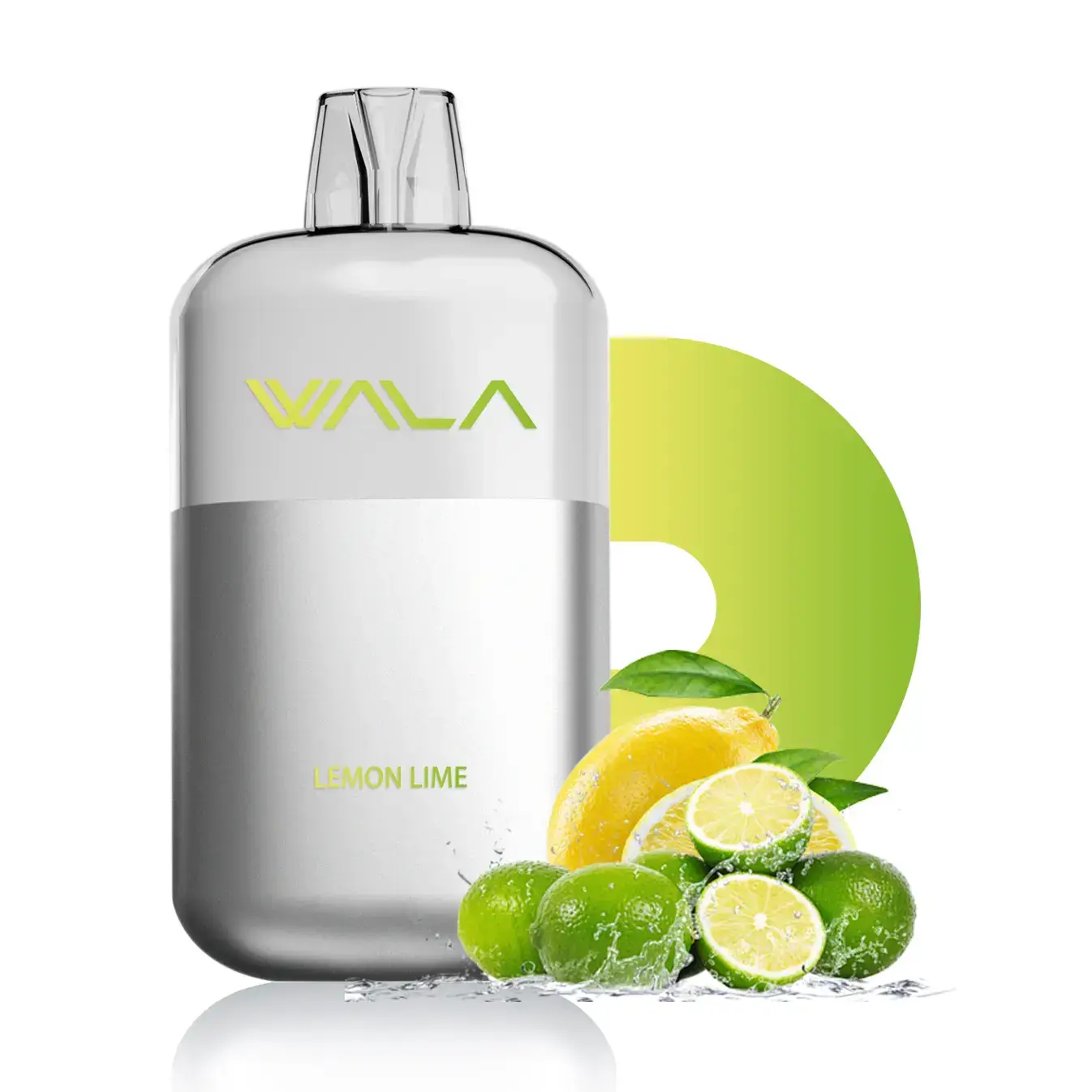


WALA POP 10000 Lemon Lime


Original price was: $69.99.$39.99Current price is: $39.99.
The WALA POP 10000 Lemon Lime is a non-rechargeable, pre-configured portable device engineered as a sealed, single-use unit. Its integrated mesh heating assembly and 2000mAh power source are calibrated to sustain the full 10,000-activation rated operational life. The profile combines the sharp tang of lemon with the smoother, more rounded character of lime in a two-component citrus fusion. PCTG-aluminium alloy body with gradient finish, draw-activated mechanism, operational immediately upon unboxing.
| Specification | Details |
|---|---|
| Usage Capacity | 10000 |
| Capacity | 15ml |
| Battery | 2000mAh |
| Dimensions | 47 × 22 × 100mm |
| Weight | 91.5g |
| Material | PCTG + Aluminum Alloy |
| Activation | Draw-activated |
| Packaging | 10 pcs per middle box |
- 100% Authentic
- Shipment From Local Warehouse
- 21+ Only
MOQ 100 pcs · Factory-direct pricing · Reply within 24h


WALA POP Lemon Lime 10000 Puffs Device
WALA POP 10000 Lemon Lime is a pre-configured, non-rechargeable portable device within the WALA POP 10000 series, engineered as a sealed single-use unit that requires no external charging, no component replacement, and no ongoing maintenance. The Lemon Lime variant occupies a specific position within the POP 10000 product family — it is the only citrus-forward profile in the range, built around the interplay between two closely related but structurally distinct citrus components. This two-component citrus fusion distinguishes it from the fruit-plus-cooling configurations (Mango Ice, Watermelon Ice, Blueberry Ice, Blackberry Ice), the fruit-fruit fusions (Kiwi Pineapple, Cherry Pomegranate), and the non-fruit variants (Mentos Mint, Strawberry Lollipop, Hay Fever) that define the rest of the series.
Profile Architecture: A Two-Component Citrus Fusion
The Lemon Lime profile is built around a two-component architecture in which both components belong to the citrus family — a structural choice that differs fundamentally from the cross-category pairings found elsewhere in the WALA POP 10000 range. Where Kiwi Pineapple pairs a tropical fruit with a tangy modifier, and Cherry Pomegranate pairs a sweet dark fruit with an acidic counterpoint, Lemon Lime pairs two citrus fruits that share a common aromatic foundation — citral, limonene, and related monoterpenes — but express that foundation differently.
The lemon component provides sharpness, brightness, and an immediate acidic impact on the inhale. Lemon character in consumable formulations is typically carried by citral (which provides the characteristic lemony aroma) combined with limonene and smaller amounts of linalool and geranial. These compounds are highly volatile, vaporizing at relatively low temperatures, which means the lemon note arrives first in the sensory sequence — the user registers the sharp tang within the initial phase of activation.
The lime component provides a smoother, more rounded citrus character that arrives in the mid-to-late phase of the activation. Lime character is carried by a similar terpene profile to lemon — limonene, citral, and terpinene — but in different proportions, with a higher concentration of terpinene and a lower concentration of citral. This compositional difference produces a citrus note that is less aggressively sharp than lemon, with a slight herbal undertone that rounds out the overall profile and prevents the lemon from becoming astringent across repeated activations.
The sequencing of these two components — sharp lemon first, smooth lime second — is dictated by the differential volatility of their respective aromatic compounds. The lemon compounds, being more volatile, vaporize earlier in each activation cycle. The lime compounds, being slightly less volatile, arrive later and persist longer. This temporal separation is not a design choice that can be reversed; it is a physical property of the compounds themselves. The manufacturer’s formulation approach — adjusting the initial proportions of lemon and lime compounds to account for their differential vaporization rates — determines whether the profile reads as a balanced lemon-lime fusion or as lemon-dominant with a lime aftertaste.
How Citrus Profiles Differ Structurally from Other Fruit Profiles
Citrus profiles present a distinct set of formulation and engineering challenges compared to the berry, tropical, or stone fruit profiles that dominate the WALA POP 10000 range. Understanding these differences helps explain why the Lemon Lime variant behaves differently from, say, the Mango Ice or Blueberry Ice — and why users who enjoy one category may not necessarily enjoy the other.
The primary distinction is acidity. Citrus fruits — lemon and lime in particular — are defined by their sharp, acidic character, which is carried by citric acid and related organic acids. These acids are more chemically reactive than the ester compounds that carry the sweetness in berry and tropical fruit profiles. In the context of a heated consumable, this reactivity has two practical consequences. First, acidic compounds can interact with the heating element over thousands of thermal cycles, potentially accelerating surface oxidation — a process that can introduce a metallic note into the profile if the heating element is not designed to withstand prolonged acidic exposure. Second, acidic compounds are more aggressive on the sensory apparatus — they produce a sharper, more pronounced initial impact that some users find invigorating and others find harsh.
The mesh heating assembly in the WALA POP 10000 is designed to manage this acidity. The even heat distribution reduces peak temperatures at any single contact point, which in turn reduces the rate at which acidic compounds interact with the heating element surface. The practical consequence is that the lemon-lime character remains cleaner across more activations than it would under a less thermally stable design.
A secondary distinction is sweetness profile. Citrus fruits, particularly lemon and lime, are naturally low in perceived sweetness compared to mango, pineapple, or strawberry. A lemon-lime profile does not deliver the rounded, jammy sweetness of a blueberry or the tropical lushness of a mango; it delivers sharpness, brightness, and a clean finish. Users accustomed to the sweeter fruit profiles in the WALA POP 10000 range may find the Lemon Lime variant comparatively austere. Users who find sweet fruit profiles cloying or fatiguing across extended sessions may find the Lemon Lime variant more sustainable for all-day use precisely because of this lower sweetness.
Heating Assembly: Mesh Configuration and Citrus Compound Stability
The WALA POP 10000 employs a mesh heating configuration. In a mesh system, the heating surface is a perforated metal sheet — analogous to a fine screen — rather than a conventional single-strand wire coil. The functional advantage is a larger, more uniform heating surface, which distributes thermal energy more evenly across the consumable material and reduces the incidence of localised hotspots.
This thermal architecture has particular relevance for a citrus profile like Lemon Lime. The original product description claims that “mesh coil technology captures every nuance of this citrus blend, maintaining its bright character from first to last” — a claim that, when interpreted through an engineering lens, refers to the mesh configuration’s ability to manage the differential volatility of the lemon and lime aromatic compounds.
In a conventional single-strand heating element, the uneven temperature distribution means that different portions of the consumable material are heated to different temperatures simultaneously. The highly volatile lemon compounds — citral, limonene — vaporize quickly from the hottest contact points, while the slightly less volatile lime compounds require more sustained heat. The user experiences a device that starts with a pronounced lemony sharpness and gradually becomes milder and more lime-dominant — the bright, sharp edge that defined the profile in its early activations fades, and the remaining experience is predominantly lime with a muted lemon background. The device has not “lost its profile,” but the balance between its two components has shifted.
A mesh configuration mitigates this by spreading the thermal load across a wider surface area, reducing the temperature differential between the hottest and coolest points on the heating surface. This allows the lemon and lime compounds to vaporize in closer to their intended proportions across more of the device’s operational life. The manufacturer’s claim about maintaining “bright character” should be understood as directional — the mesh architecture extends the period during which the lemon-lime balance remains perceptible relative to a less thermally stable design — rather than literal. No consumable material remains identical across 10,000 thermal cycles.
The mesh configuration also addresses a secondary concern specific to citrus profiles: the corrosive potential of acidic compounds. Citric acid and related organic acids, when exposed to high temperatures at concentrated contact points, can accelerate surface oxidation of the heating element. This oxidation can introduce a metallic character that distorts the profile — most noticeably as a faint tinny note that overlays the citrus. By reducing peak temperatures through even heat distribution, the mesh assembly slows this oxidation process, preserving the clean, unadulterated citrus character across more activations.
Energy Management and the Non-Rechargeable Architecture
The WALA POP 10000 is built around a non-rechargeable power architecture. The integrated 2000mAh power source is calibrated to match the 15ml consumable reservoir, ensuring that neither component significantly outlasts the other. The original product page describes this as a “2000mAh battery perfectly calibrated to the 15ml Capacity” — a claim that describes the intended design outcome of matching the power source’s discharge curve to the consumable’s depletion rate.
This calibration addresses a specific, commonly reported frustration: a power source that depletes before the consumable portion, stranding usable material inside a non-functional unit. By designing the power source and the consumable as a matched pair — calibrated such that both reach depletion within a narrow window of each other — the WALA POP 10000 reduces the probability of this occurrence.
This design decision reflects a conscious engineering trade-off rather than a feature omission. A rechargeable architecture introduces a charging port, a charging circuit, and a power-management controller — each representing a potential failure point. The charging port can accumulate pocket lint, dust, or environmental moisture over weeks of daily carry. The charging circuit can malfunction. The user must remember to charge the device and must have access to a compatible charging setup. By eliminating these components, the WALA POP 10000 removes those failure modes entirely. The cost is equally clear: the device cannot be recharged once the power source is depleted, and the entire unit must be replaced.
The 2000mAh figure describes the total electrical charge the power source can deliver over its entire discharge cycle. Actual duration varies with individual activation patterns. The 10,000-activation rating is the manufacturer’s estimate under standardised testing conditions; variation around this figure is expected rather than abnormal.
Physical Construction and Material Selection
The device body uses medical-grade PCTG (a glycol-modified polyester) and high-strength aluminium alloy. PCTG is selected for its chemical resistance, impact durability, and ability to maintain structural integrity across the temperature variations encountered during normal daily use. As a material, PCTG does not craze or crack under the mechanical stresses of pocket or bag storage, and it contains no bisphenol A (BPA). The aluminium alloy provides rigidity without adding excessive weight — the completed device weighs approximately 91.5 grams.
At 47mm × 22mm × 100mm, the device occupies the middle range of portability within the WALA POP 10000 series: compact enough to sit unobtrusively in a standard pocket, yet with sufficient internal volume to house the 2000mAh power source and 15ml reservoir without compromising structural integrity. The weight distribution is slightly bottom-biased due to the power source placement, which has the practical effect of stabilising the device when placed upright on a flat surface.
The exterior features a gradient finish consistent with the WALA POP 10000 design language. Unlike glossy finishes that accumulate visible fingerprint marking within days of handling, the POP 10000 surface treatment is designed to resist visible handling marks — a practical consideration for a device that will be held thousands of times over its operational life. The gradient finish also serves a functional role in wear concealment: scratches and scuffs present as less stark contrasts against a graduated surface than against a uniform solid colour.
The mouthpiece is contoured for prolonged contact. This ergonomic consideration becomes noticeable during extended sessions: a poorly contoured mouthpiece produces irritation at the contact point after repeated use, while a well-shaped one distributes contact pressure evenly. For a device rated at 10,000 activations, where a typical user will make mouthpiece contact 200 or more times daily for weeks, this contour directly affects comfort.
The draw-activated mechanism requires no button, no power cycling, and no priming sequence. The user removes the device from its packaging, and it is operational. This simplicity is a deliberate design decision that eliminates the learning curve, the risk of accidental activation in a pocket, and the mechanical failure point that a physical button would introduce.
Usage Patterns and Suitability
The Lemon Lime variant is suited to users who prefer a citrus-forward profile — one defined by sharpness, brightness, and acidity rather than sweetness, cooling, or confectionery character. This profile represents a distinct sensory category within the WALA POP 10000 range, and users who have tried the sweeter fruit variants and found them insufficiently sharp or too heavy across extended sessions may find the Lemon Lime a more appropriate match.
The lower perceived sweetness of the citrus profile makes it particularly suitable for all-day use. Sweet profiles can become cloying across repeated activations — the sweetness accumulates, and subsequent draws become less satisfying. The lemon-lime profile, with its acidic sharpness, provides a structural reset between activations: the sharp finish clears the palate rather than leaving a residual sweetness that builds up over time. For users who use a device continuously throughout a working day, this self-resetting quality may be more important than the initial sensory impact.
The sealed, non-rechargeable architecture makes the device suitable for scenarios where charging access is unavailable — extended travel, outdoor activity, or as a secondary device kept in reserve. The absence of a charging port eliminates an ingress point for environmental contaminants such as pocket lint, dust, or moisture.
The Lemon Lime variant may not be the most appropriate choice for users who prefer sweet, cooling, or complex layered profiles. Users who want a sweet fruit character may find the Mango Ice or Watermelon Ice variants more aligned with their preferences. Users who want a layered, multi-stage fruit profile may prefer the Blackberry Pomegranate Cherry or Kiwi Pineapple variants. Users who want a mint or confectionery experience may prefer the Mentos Mint or Strawberry Lollipop variants.
Sourcing and Traceability
WALA POP devices supplied through OZVAPE Shop are obtained through authorised distribution channels with batch-level traceability documentation. This sourcing discipline is the primary mechanism by which users can distinguish factory-certified units from non-authorised inventory. A device purchased from a documented channel carries a verifiable chain of custody from the manufacturing facility to the point of sale; a device from an unknown channel carries no such assurance, and its internal components, material quality, and safety testing cannot be independently verified.
OZVAPE Shop maintains receiving protocols designed to verify packaging integrity and batch-code consistency before inventory reaches users. These protocols include visual inspection of outer packaging for tampering, verification of batch codes against shipment documentation, and periodic sampling to confirm that on-hand inventory matches the specifications published on the product page. Units that do not pass these checks are quarantined and returned to the distributor. This process operates in the background of every fulfilled order.
Technical Specifications:
| Specification | Details |
|---|---|
| Usage Capacity | 10000 |
| Capacity | 15ml |
| Battery | 2000mAh |
| Dimensions | 47 × 22 × 100mm |
| Weight | 91.5g |
| Material | PCTG + Aluminum Alloy |
| Activation | Draw-activated |
| Packaging | 10 pcs per middle box |
WALA POP Series 10000 Puffs Device
Product Advantages & Selling Points
| Advantage | Description |
|---|---|
| 20 Premium Options | Extensive selection of curated profiles to suit every preference |
| 10000 Uses Capacity | Extended enjoyment with a single device, eliminating frequent replacements |
| Mesh Coil Technology | Advanced heating system ensures pure, consistent experience from first to last |
| Fashion-Forward Design | Gradual transition gradient aesthetics for a stylish, trend-leading look |
| Ready to Use | No setup or preparation required—simply open and enjoy |
| Premium Build Quality | PCTG + Aluminum Alloy construction for durability and refined feel |
| Optimized Battery | 2000mAh power source perfectly calibrated to the 15ml Capacity |
| Portable Form Factor | Compact dimensions (47×22×100mm) and lightweight design (91.5g) |
Product Overview
The WALA POP Series represents the perfect fusion of style and performance in the modern vaping landscape. Engineered for users who demand both longevity and consistent quality, this device offers an impressive 10,000 uses without any maintenance. Simply unbox and enjoy—it’s that simple.
Core Features
-
10,000 Uses Capacity: Extended enjoyment with a single device, eliminating frequent replacements
-
20 Diverse Options: Extensive selection ranging from classic profiles to innovative creations
-
Mesh Technology: Advanced heating element ensures pure expression and consistent experience from first to last
-
Gradient Design Aesthetic: Fashion-forward graduated color transitions make a stylish statement
-
Ready-to-Use Convenience: Pre-filled with 15ml Capacity, no preparation required—just open and enjoy
Selection Options
The WALA POP Series offers 20 carefully crafted options to suit every preference:
| Category | Options |
|---|---|
| Refreshing Series | Grape Ice, Blueberry Ice, Watermelon Ice, Cola Ice, Blackberry Pomegranate Cherry Ice |
| Fruit Blends | Strawberry Watermelon, Cherry Pomegranate, Kiwi, Blackberry Pomegranate Cherry |
| Beverage Inspired | Peach Tea, Cola Ice, Lemon Lime |
| Signature Creations | Mentos Mint, Hay Fever, Strawberry Lollipop |
User Experience
Every aspect of the WALA POP is designed for satisfaction. The mesh technology ensures each moment delivers rich, authentic experience with smooth vapor production. The 2000mAh battery is perfectly calibrated to the 15ml Capacity, ensuring consistent performance throughout the device’s lifespan. The lightweight aluminum alloy construction makes it pocket-friendly and portable, while the gradient finish adds a touch of personal style.
Why Choose WALA POP?
-
Exceptional Value: 10,000 uses at a competitive price point
-
Consistent Quality: Mesh technology preserves experience until the very end
-
No Maintenance: Zero setup or preparation required
-
Style Statement: Fashion-forward design stands out from ordinary devices
Be the first to review “WALA POP 10000 Lemon Lime”
- Credit card transactions processed through Stripe (Mastercard or Visa)
- Google Pay, Apple Pay,...
- Buy now, pay later options: Klarna, Zip Pay,...
- Bank transfer
Related products

Disposable Vapes


Disposable Vapes

Disposable Vapes

Disposable Vapes

Disposable Vapes

Disposable Vapes

Disposable Vapes

Disposable Vapes

Reviews
There are no reviews yet.